

Commentary
They face an uphill climb, but they could draw on a strategy that other diplomats have used in the past.
Shana Tabak, Alejandro Martin Rodriguez
{
  "authors": [
    "Natalia Bubnova",
    "Lora Saalman"
  ],
  "type": "legacyinthemedia",
  "centerAffiliationAll": "",
  "centers": [
    "Carnegie Endowment for International Peace",
    "Carnegie China",
    "Carnegie Russia Eurasia Center"
  ],
  "collections": [
    "China’s Foreign Relations"
  ],
  "englishNewsletterAll": "",
  "nonEnglishNewsletterAll": "",
  "primaryCenter": "Carnegie Russia Eurasia Center",
  "programAffiliation": "",
  "programs": [],
  "projects": [
    "Eurasia in Transition"
  ],
  "regions": [],
  "topics": [
    "Security",
    "Arms Control"
  ]
}
Source: Getty
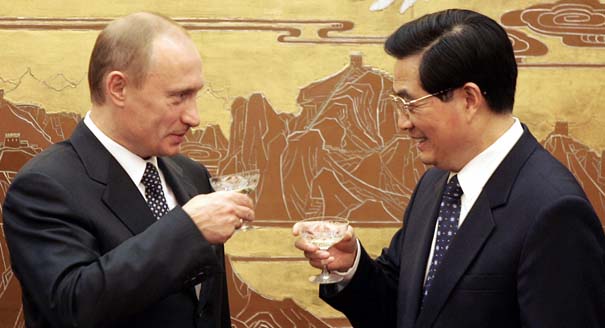
China and Russia share significant common ground on a number of issues, but a number of concerns still shape Sino-Russian bilateral relations.
Source: Voenno-Promyshlennyi Kurier

In terms of Sino-Russian relations, there are quite a few areas of common ground. Both have shown themselves able to cooperate at the UN Security Council, and also elsewhere, to exert their preferences. It’s not to say that both Russia and China have exactly the same preferences, but often there is a cohesion of interests between the two. One example would be their historical opposition to the U.S. ballistic missile defense. So when we see a bit more flexibility in terms of U.S. and Russian potential cooperative framework on ballistic missile defense, I would say that, from the Chinese perspective, this is likely to worry them.
This being said, most of the people that I’ve surveyed within China tend to think that most of these initiatives are unlikely to work. So from their point of view it’s best to wait and see what happens. By voicing public opposition, it might actually embolden the United States to think that these initiatives are effective in worrying China. And also, it might entrench U.S. and Russian cooperation in other areas, unintended areas. So it’s better to let cooperation between the two potentially fail on its own merits, rather than to necessarily give them a reason to cooperate more. I would say that in terms of the Russian view and the Chinese view, this comes largely from my own research in China.
From the Russian side, I would say that the Chinese are well aware that there are some concerns that remain, and they will frequently cite these as being the so-called “China threat,” or this worry over China’s rise, that Russia, among others, might have. Also, there remain concerns in Russia over the issue of a nuclear race to parity, i.e., that as Russia and the United States draw down their nuclear arsenals, China might use this as an opportunity to match them or surpass them. This is a concern often discussed in the U.S. context, but I believe it to also exist among the strategic community in Russia.
Geographical proximity, I think, is another natural concern for the Russians, particularly given Chinese presence in the Russian Far East. From the Chinese side, there’s much less of a public concern regarding Russia. You really don’t see it in most of the writings and discussions. There’s certainly a sense that Russia might be unreliable when they need to count on it, particularly given the experience of the 1960s. In private, some Chinese experts have told me directly that they were more worried about Russia than even the United States, but this applies of course to very isolated cases. You don’t often see it within the general discourse within China, and overall I would argue that both countries have a great deal more in common in terms of how they both perceive the world and the U.S. agenda. Many of the Chinese and Russian responses to the U.S. Nuclear Posture Review that I analyzed in my recent Carnegie Paper, “China & the U.S. Nuclear Posture Review,” have similar views on ballistic missile defense, prompt conventional global strike capability, space weaponization, and actually there’s a tendency for Sino-Russian relations to benefit from strained U.S. relations with either country. However, this whole idea of a “reset button” between Russia and the United States, if it is successful, is not necessarily good news for China. China may find itself isolated on certain issues. So I would argue that the statement that is frequently cited about Russian and Chinese opposition to ballistic missile defense at the Shanghai Cooperation Organization (SCO) this past week was actually more about mutual reassurance between China and Russia than about the outside audience.
On the St. Petersburg forum, and just to preface my statements, I went back and watched Hu Jintao’s speech, and also read the Chinese transcript of it, to measure it against the English version. And what I took particular note of was the fact that he used terms like huxiang zunzhong “mutual respect,” and also this idea of jiti juece, “collective decision making.” I think that the bulk of the statements that you see coming out of the event itself, before we get to the energy issue, tend to be pretty standard fare for an official statement by the Chinese government—in particular, in terms of multipolarity.
However, what I have additionally seen through some of my own research within China is also another issue that causes their concern. When they talk about broadening the number of decisionmakers, they are not only talking about expanding them beyond the United States, per se; it’s also the idea that China doesn’t want to be at the mercy of Russian power politics when it comes to energy supplies, as we saw with Ukraine and Belarus. This remains a concern, and it’s not just a concern necessarily with regard to the government. I think it’s important that, when we look at China, we take a more nuanced view of the relationship between even the state-owned enterprises and the government. The government does exert a large amount of control over these companies, but it’s not all-encompassing. They are still guided by market-driven economics. And so I think that what the Chinese industries are trying to do is to set the tone early in the relationship. And that’s perhaps why you don’t see things moving ahead on the economic front, at least in energy terms, in the way that Russia would like.
However, I think in overall terms that it was a positive assessment that was made by Chairman Hu, in particular when it comes to economic diplomacy. Economic diplomacy is dominating how China looks at Russia and the rest of the world right now, and in fact I would argue that instead of looking for what Western powers call a “democratic peace,” the Chinese are now pursuing an “economic peace,” or an “interdependent peace.” That is to say that by increasing your interdependence with other countries economically, your overall relationship with them will be better. It is not a zero-sum game or win-lose scenario; hence the term “win-win” frequently mentioned in China. Nonetheless, while not being zero-sum, there still appears to be an emphasis on the part of the Chinese energy industry to hold off on signing onto any deals until the best price and conditions are available, particularly in the face of the potential for long-term fluctuations in the market.
In the case of the Sino-Russian relationship, when asymmetry prevails, there’s more of a likelihood that his type of dispute will happen. For example, when the Chinese hold the upper hand due to Russian dependence on their business, the Chinese are more likely to be able to exert their own will and preferences. For the Russians, when they hold the upper hand due to Chinese dependence on their supply, this could also lead to an imbalance—for example, what you just mentioned in terms of Ukraine and Belarus. When I mentioned in my previous statement about China trying to set the tone early, and trying to avoid this idea that if they aren’t exerting their own interests that they will somehow lose out, I think this is the perfect example. Particularly when you have something like a treaty, which is supposed to have twenty years of duration, I see the Chinese as trying to avoid the mistakes of past history, not just this idea that they have of necessarily unequal treaties, but also this idea they have of having lost out in the past. The perfect example, in my own research, comes from the border with India, this idea that when China was not vocal in its stance or opposition, then the other side would take this as tacit acceptance and an opportunity to move ahead, if you will, to have a “forward policy.” This is at the national level. At the scale and level of industry, companies are working to garner the best position they can by setting the tone early. This is a departure from what has heretofore been a more responsive and passive stance taken by Chinese actors and interests. I would once again emphasize that while these companies have national ties within China, it does not necessarily mean that they won’t engage in their own supply-and-demand style behavior. Sometimes this will be a benefit for the Chinese government, and sometimes it will actually act counter to other diplomatic initiatives of the Chinese government.
In terms of whether or not the decision to cede any territory is justified, I think it’s largely determined by the circumstances of the decision. To my knowledge, when it comes to the Sino-Russian border, the decision to cede territory was not made under force or military duress, so there’s not necessarily a reason to see this as being unjustified. But whether or not it’s “unjustified” is in the eye of the beholder.
On the Chinese side, there has been a concerted effort in recent years to emphasize the role of the UN in international law in governing its actions. But even international law can sometimes be subject to domestic conditions and interpretations at home. It could be argued that when it comes to the Amur River, that China has been in a more advantageous negotiating position—economically and strategically—in recent years, leading to its ability to exert its preferences. But once again, I don’t really see this issue necessarily in the 1960s light. It is a very different region today.
The same goes for the porous border issue, as there’s an understandable debate within Russia over the advantages and disadvantages of a large number of Chinese workers in the sparsely populated Russian Far East, and I think that this is natural. We see the debate on immigration going on in the United States, and in a number of countries with foreign workers. From my own view on how the Chinese are looking at this, for the individuals who cross into that region, they’re motivated by mostly economic gain. They aren’t looking at the larger geopolitical implications of their actions. I haven’t seen anything, in any form of Chinese expert writing, which talks about assimilating or acquiring territory within Russia, and bringing it back into the Chinese fold. There’s no discussion of that. I think that the Chinese who are engaged in this migration have been successful, and have stimulated a good deal of trade across the border. The difficulty comes from a number of these communities and areas are isolated from the larger Russian community, and this exacerbates mistrust between the Russians and the Chinese in this region.
But in addition to increased trade, I would also hope that another positive result comes not so much from the Chinese, but from the opportunity that the Russian government would hopefully take this as an impetus for investing more in that region and trying to actually engage that region more, which is frequently viewed as separate from the central territory. And finally, I think that, given the fact, this region could serve as a test case for how two peoples can integrate in a much more beneficial way in terms of culture, language, etc. For better or for worse, China’s not going away from Russia’s borders, and I think it’s important to facilitate and to create better mutual understanding, which can actually take place in an area like this if the local Chinese population is engaged.
I’m fully in support of using legal means to restore peace. And I think that in terms of the way the question is phrased, that’s probably how most people, from any country, would probably answer that question. Not having lived in the United States the past five to six years, and having lived in China on and off since 1997, may affect my view of how experts in the United States might look at this. I would say that, first of all, when you look at how China and Russia have been engaged on something like the Iran issue, there has been a greater confluence of interests with the United States when it comes to Iran, such as the issue of the UN and sanctions and blocking full Iranian membership in the Shanghai Cooperation Organization, as you mentioned. Yet, continuing to allow Iranian leadership to use the Shanghai Cooperation as a platform for criticizing the United States is still probably negatively viewed within the United States, despite these new measures.
My own view is that Chinese and Russian efforts of balancing against the United States, or in expressing displeasure with U.S. policies, are not necessarily negative phenomena. In fact, I think that within a system that, since the Cold War, has been largely dominated by the United States, you need some form of counterweight. And China and Russia serve an important role in drawing attention to acts by the United States that might be damaging to the international equilibrium. My own opinion is that this is necessary, particularly when it comes to lessening the chance of military action against Iran and/or against Syria. In the case of Libya, I think the issue is that both Russia and China were up against more than just the United States on this issue. And this shows that even as these two powers can find areas in which to agree, they’re not always able to outweigh the larger system.
When it comes to the Nuclear Posture Review, one of the things I took away is that the United States needs to be more cautious in trying to push China toward some of its own goals. In doing so, the United States might actually be increasing the chances that China will engage in behavior that the United States wants to prevent. For example—and this brings me to the issue of ballistic missile defense and conventional prompt global strike that I mentioned earlier—the United States is using these two systems as a basis for its disarmament initiative, while at the same time calling for “strategic stability” with China and Russia under the Nuclear Posture Review. My understanding is that these are contradictory pursuits, and if you look at the Chinese writings, they say as much. These two systems are seen as destabilizing and threatening to China’s deterrent. In particular, they have already led to efforts to increase China’s survivability of its nuclear deterrent, and there’s even a debate emerging outside of China as to whether or not China is engaged in discussions over changes in its own posture, whether this be its stance on no-first-use, or even increasing the number of nuclear weapons in its arsenal. A lot of this is still speculative and you hear a number of different reports, but even in some of the conversations I’ve had within China, there have been allusions to this point—if they feel pushed by the United States on ballistic missile defense and conventional prompt global strike, then they will try to remedy this, or take countermeasures in some way. My concern would be also that, with the United States pushing China on the issue of greater transparency, that this is actually threatening the opacity that underpins China’s minimum nuclear deterrent, so such efforts might actually be pushing China in the direction that the United States wishes to avoid.
Now this being said, this touches on the second part of your question, which has to do with the asymmetry. I would say that yes, there is a sense that the United States is not treating China as an equal, but at the same time, too, what they’re arguing to a greater extent is that the United States is trying to force China into a concept predicated in Chinese writings on “balance,” under “strategic stability.” This is an idea that comes from the Cold War and that concerned the U.S.-Russian relationship. Now this is a problem for the Chinese conceptually, because they perceive there to be a huge gap, particularly in nuclear terms. They have worked hard to maintain this stance of a minimum nuclear deterrent, of not engaging in a race for nuclear parity. So the concern is that the United States is doing this to fit China into the Russian mold as a target, the kind of adversary that the former Soviet Union was during the height of the Cold War. And so in drawing this link I find that in any number of the Chinese writings that I’m looking at, and even when we’re not talking about the Nuclear Posture Review, there are concerns over the level of surveillance that the United States is engaged in vis-à-vis China. This is why you see frequent mention of all the efforts involving both space radar and naval vessels in the region that are trying to spy on China and figure out the location of its nuclear deterrent. This all tracks back to this idea of nuclear survivability for China. In potentially being forced into a position where it feels threatened, it may engage in some of the behavior that the United States is trying to forestall.
When we look at the SCO statement on ballistic missile defense, I think a lot of this was done, as far as Russia and China are concerned, as a form of mutual reassurance. Particularly, for China, when facing greater U.S. and Russian discussions on a cooperative framework, it makes sense that the Chinese might actually play the stronger role in trying to get Russia to reassure them.
Now this being said, the concern over ballistic missile defense in terms of negating a country’s nuclear deterrent is actually much more prevalent within China than even within Russia. Why? Because China has a much smaller arsenal by comparison. If ballistic missile defense continues to develop through the Phased Adaptive Approach, which is basically an endless cycle of development, it has a greater potential to threaten China’s nuclear deterrent. Russia’s sheer quantity of nuclear warheads and delivery systems suggests that it would be much more successful at overwhelming ballistic missile defense systems. It’s not the same case for China. So that’s why, in my own read on China, it’s much more concerned than the Russians are on this point, and that’s why the statement reads like much more of a form of Sino-Russian mutual reassurance to me.
Now this being said, ballistic missile defense—you will see quite frequently when it’s referred to in China—is not just about ballistic missile defense in and of itself. It’s also about weaponization of outer space. This is an issue that plays to both the Chinese and the Russian audience, and why there’s a tendency to link it not just with the concerns over negation of their nuclear deterrent but also the overall situation, the next arena of contest, and that would actually be the outer space. Despite these concerns from both countries, Russia and China have shown in developing their own anti-satellite capabilities and their own ballistic missile defense programs that they’re not going to allow themselves to lapse too far behind the United States in this regard. This is what one scholar in China, who was my former Ph.D. advisor, calls avoiding a “science surprise.” In fact, I have just heard it referred to by a Russian analyst at the Asan Plenum in Seoul as avoiding a “technological surprise.” So I would say that both Chinese and Russian strategists and scientists are trying to avoid being “surprised” in any kind of eventuality that the United States is developing technology that they don’t have. They’re trying to keep up to step with that technological development. And that’s why I think for the long run, my greater concern would be in terms of the potential for arms racing in a variety of other arenas, not necessarily in the nuclear realm, but in variety of other arenas, including weaponization of outer space.
I’m not an economist, so this is more from my own experience of having lived in China on and off since 1997. Having been here for the better part of this decade of China’s growth and transition, I’m basing my answer largely upon this experience. There is no doubt a large wealth disparity within China. However, I think that this concept of “two Chinas”—consisting of only a coastal China and a hinterland or a rural China—is often exaggerated. Why? Because I think that there’s a great deal more nuance within the country and how it’s developing in both of these regions. There’s a great diversity of smaller economies running throughout this entire country. When we talk about state-owned enterprises, some are inefficient and some are highly efficient. Some private companies are corrupt, while others are law-abiding. So I think you see a great deal of interplay between these various models of economic growth, and there’s no one unified system within the country. China has largely become a mix of all of the above.
Also, with the mass migration and flow of people within the country, it’s hard to argue that the coast is segregated from the rural areas; in fact, I would argue that it’s never been fully separated. They’re intertwined and there are a number of people from rural areas who come to work in Beijing and then return and take some of their money home. This is the liudong renkou, or “floating population,” within China. When it comes to the issue of what the long-term prognosis is and this issue of stability within the country, protests do occur in China and you probably hear about them quite frequently. But what I think is noteworthy about the protests in China is that they’re largely compartmentalized, and they tend to focus on individual-targeted issues and companies or even local government. But rarely, if at all, do they come back to the central government.
I think that the ability of the Chinese government to keep these things focused on smaller, targeted issues has been part of its strength and resilience. It’s a way to offer people an outlet if they feel disenfranchised from the economic development, which is still uneven in a number of areas. I don’t foresee China’s development as stalling. It’s much more a gradual process of shifting away from industrial development—this is part of the idea that they’ve had over the past five to seven years of chuangxin, or “innovation.” And this whole move within the country is to try to get people to innovate and to create, rather than relying on manufacturing basic goods or reverse engineering. Part of that means that they’re trying to shift away from the economy based entirely on industry to one focused on invention. Along with this comes a rising of wages and benefits that accompany growth, and this also means that some industrial jobs are likely to shift to other regions and countries of the world where the wages are lower. So, while things are likely to slow down somewhat, I do not foresee any abrupt stalling of the Chinese economy or industry.

Natalia Bubnova
Former Head of Content Production, Moscow Center
Natalia Bubnova was head of content production at the Carnegie Moscow Center. She previously served as deputy director for communications at the Carnegie Moscow Center.

Former Nonresident Associate, Nuclear Policy Program
Saalman was a nonresident associate in the Nuclear Policy Program at the Carnegie Endowment for International Peace. Her research focuses on China’s nuclear and strategic policies toward India, Russia, and arms control.
Carnegie does not take institutional positions on public policy issues; the views represented herein are those of the author(s) and do not necessarily reflect the views of Carnegie, its staff, or its trustees.
They face an uphill climb, but they could draw on a strategy that other diplomats have used in the past.


Shana Tabak, Alejandro Martin Rodriguez

Understanding the climatic pain points is necessary for policymakers hoping to minimize the war’s negative environmental consequences.


Alejandro Martin Rodriguez, Joy Arkeh, Sarah Yerkes

The books, podcasts, and films that explain the world it made.

Andrew Leber

With the growth in points of friction between the great powers, organizations like the SCO will continue to play a role in the strategic adaptation of the smaller powers caught between them.

Temur Umarov
Amid celebrations of bilateral ties was a deeper focus on stability in the Middle East.

Amr Hamzawy