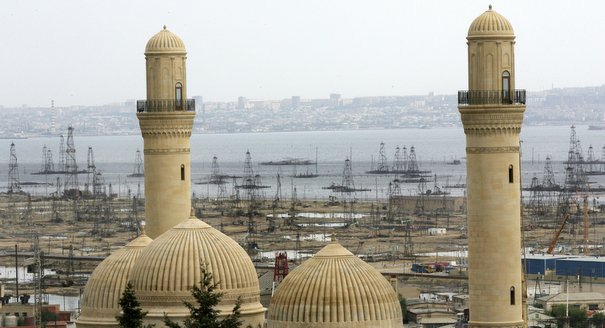
Azerbaijan: Speed Without SystemAzerbaijan gives off a self-confident air nowadays. Its victory in the Eurovision song contest, giving Baku the right to stage the next competition in 2012, was celebrated with dancing in the streets. Money is pouring in from Caspian oil and gas projects.
I had been in Baku only a year before but even so I was shocked by how different it looked. I looked up at the skyline and saw that two glass skyscrapers had landed like spaceships on the hillside above the old city. A city of shabby elegance is fast turning into a new Dubai on the Caspian.
But old Baku is paying a price. The streets of the old Jewish quarter near Fizuli Square, a maze of one- and two-storey buildings, are being torn down, so that new rows of multi-storey towers can spring up in their place. Residents are being evicted in one of two ways. Either a notification letter comes offering them 1,500 Azerbaijani manats ($1,900) for each square metre they own. That is about half the market-rate for property in the centre of Baku - and of course the square metrage that will come after them will be many times bigger. Or residents are offered property in other parts of the city - one businessman who owns a three-storey building is being offered five different apartments in completely different parts of town.
The letters say the evictions are being done for the sake of a new “general plan for the reconstruction of Baku”, but its details have never been made public. They come from an individual, not a company, who is evidently a proxy for one of Azerbaijan’s three or four oligarchic family clans. There are fights, threats. I was told that one Azerbaijani-British couple came back from holiday to find their apartment destroyed.
“Not a step back!”
In the middle of this mayhem stands the office of my old friends Arif and Leila Yunus, which houses three non-governmental organisations: Azerbaijan’s best-known human-rights centre, the Institute of Peace and Democracy; the Women’s Crisis Centre where abused women can receive help and support; and an anti-landmines charity. The Institute of Peace and Democracy is so well known that moving house would not be such a big problem for it: Arif proudly showed me letters, sent from the provinces of Azerbaijan and which the postman had faithfully delivered, in which the address on the envelope said simply “Leila Yunus, Human Rights Centre, Baku.” The women’s centre will be a much bigger loss, as information on its address had been spread mainly by word of mouth.
If, that is, these NGOs do have somewhere to move to. Unlike their neighbours, the Yunuses have not received any letter informing them of their fate. Possibly the authorities know that once the couple do hold a letter in their hands, they will go to the courts and kick up a fuss about the many abuses of the law that this whole eviction process contains. Or perhaps the intention is to punish an organisation which has consistently criticised Azerbaijan’s human-rights record. The Yunuses worry that that a bulldozer could “accidentally” knock in one of the walls of the office, leaving it uninhabitable.
When I visited in early July 2011, I saw a cleared dusty wasteland several blocks wide where there had once been a narrow street. Arif and friends had painted on the front of the office inscriptions that this was private property, invoking the relevant article of the Azerbaijani constitution. In red paint they had daunted the numerals 227, a reference to Stalin’s famous decree of 27 July 1942, “Not a step back!”, invoking the spirit of Stalingrad with dark humour. A few times already, hefty young men had come by with paint-pots to scrub out the inscriptions.
Who is in control of all this? Oil-and-gas revenues are coming in so fast that it seems as though the government doesn’t know fully how to spend them. According to one estimate I heard, the country is earning $64 million a day from the Baku-Tbilisi-Ceyhan oil pipeline alone. There are grandiose plans to build a new bridge across Baku’s bay and to make a special island to house the Eurovision festivities. Dozens of senior people must be billionaires by now. Why, I mused aloud to Arif, did they see the need to squeeze extra cash out of a thousand of their citizens in the centre of Baku and not offer them a decent civilised settlement?
The answer, I suppose, is: “because they can.” It would be misleading to describe Azerbaijan as an unhappy country seething with revolt under the surface. Syria or Tunisia it is not. The new parks, playgrounds and roads constructed in the last few years give ordinary citizens the impression that their country is on the up. But large segments of the population are certainly discontented and feel left behind by the oil boom. While Baku is booming, the rural economy remains very poor. The oil-and-gas sector creates notoriously few new jobs and is good at suppressing other export sectors.
A Strategic Blur
The dangerous part of this entire process is that the governing elite does not seem even to notice those left behind. Perhaps this is the menacing lesson of an authoritarian system - indeed, it is better not described as a “system” at all as by its nature it does not have any mechanism for the lower down to complain to the higher up. The people being evicted from their homes near Fizuli Square have no obvious recourse to justice and the authorities barely register what is happening to them. If - probably a few years down the line - people do take to the streets in Tunisia-style revolt, I predict the Baku authorities will be genuinely taken by surprise.
This also has implications for Baku’s foreign policy and efforts to resolve its biggest issue, the protracted conflict with the Armenians over Nagorno-Karabakh. Azerbaijan is a vastly stronger and more confident state than it was when it declared independence in 1991. It has an effective and professional foreign ministry. But an outsider does not get much impression of a strategic vision, apart from “Get stronger” or “Play a balancing game.” The Karabakh talks are currently deadlocked. Much hope was raised for a breakthrough at the meeting in Kazan in June 2011 but by all accounts the Azerbaijani side blocked it. The evidence suggests that the instinct in Baku is to play for more time and not confront the issue.
All that speedy growth is happening in a kind of strategic blur. I wonder if Azerbaijanis will look back in two decades’ time, when peak oil has long declined, and ask themselves: “What happened to all that money?”
Carnegie does not take institutional positions on public policy issues; the views represented herein are those of the author(s) and do not necessarily reflect the views of Carnegie, its staff, or its trustees.
More Work from Carnegie Endowment for International Peace
Pashinyan’s pro-European party has been re-elected with a decisive victory. But the pro-Russian opposition could still slow Armenia’s progress toward peace with Azerbaijan and rapprochement with Europe.
For all the menacing rhetoric, the Armenian prime minister remains a leader with whom Putin is prepared to interact: not as an ally, but as a partner, albeit a problematic one.
By fueling the arguments of both supporters and opponents of Armenian Prime Minister Nikol Pashinyan, Azerbaijan wants to ensure he is re-elected with a weaker mandate.