

Paper
Matthew Rojansky
{
  "authors": [
    "Matthew Rojansky"
  ],
  "type": "legacyinthemedia",
  "centerAffiliationAll": "dc",
  "centers": [
    "Carnegie Endowment for International Peace",
    "Carnegie Russia Eurasia Center"
  ],
  "collections": [],
  "englishNewsletterAll": "ctw",
  "nonEnglishNewsletterAll": "",
  "primaryCenter": "Carnegie Endowment for International Peace",
  "programAffiliation": "russia",
  "programs": [
    "Russia and Eurasia"
  ],
  "projects": [
    "U.S.-Russia Bilateral Presidential Commission"
  ],
  "regions": [
    "Caucasus",
    "Russia"
  ],
  "topics": [
    "Political Reform",
    "Economy",
    "Foreign Policy"
  ]
}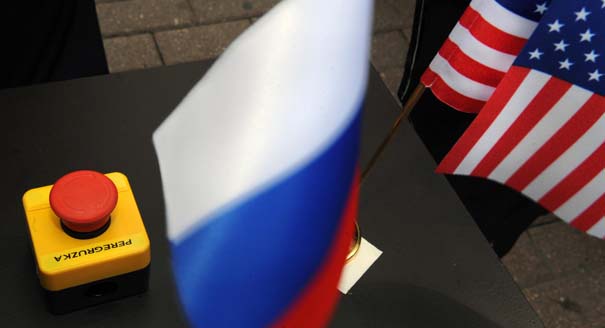
Source: Getty
Putin’s return to the Russian presidency will not undo the U.S.-Russia reset, but it will change the dynamics of the relationship between Moscow and Washington.
Source: International Herald Tribune

Yet the relationship with the West will inevitably change. For one thing, Putin can have nothing like the rapport his protégé developed with President Obama, which was built upon the two leaders’ shared backgrounds as lawyers, their easy adoption of new technologies, and their fundamentally modern worldviews.
The Bilateral Presidential Commission which Obama and Medvedev created and charged with advancing U.S.-Russia cooperation on everything from counterterrorism to health care may suffer. The relationship as a whole is not adequately institutionalized, and depends on the personal attention of Russian officials who will likely avoid taking action without clear direction from Putin, or who may be removed altogether during the transition.
Putin’s return to the presidency will also provide fodder for Western critics bent on portraying Obama and the reset as a failure, or dismissing Putin’s Russia as merely a retread of the Soviet Union.
These critics are wrong — today’s Russia bears little resemblance to what Ronald Reagan dubbed an “evil empire” — but Putin has been far more tolerant of Soviet nostalgia than his junior partner, and his next term will surely bring a new litany of quotations about Soviet accomplishments and Russia’s glorious destiny that will turn stomachs in the West.
Although he has spent his entire career within the apparatus of state power, including two decades in the state security services, Putin is at heart a C.E.O., with a businessman’s appreciation for the bottom line. Western companies already doing business in Russia can expect continuity in their dealings with the state, and it will remain in Russia’s interest to open doors to new business with Europe and the United States. The next key milestone for expanding commercial ties will be Russia’s planned accession to the World Trade Organization, which could come as soon as December.
At home, Putin faces a looming budget crisis. As the population ages and oil and gas output plateaus the government will be unable to continue paying pensions, meeting the growing demand for medical care, or investing in dilapidated infrastructure throughout the country’s increasingly depopulated regions.
This means that while Putin will seek to preserve Russia’s current economic model, which is based on resource extraction and export, he will be forced to assimilate many of his protégé’s ideas for modernizing Russia’s research and manufacturing sectors. Medvedev’s signature initiative, the Skolkovo “city of innovation,” will likely receive continuing support from the Kremlin, although it will have little long-term impact without a thorough nationwide crackdown on corruption and red tape.
Putin’s restored power will be strongly felt in Russia’s immediate neighborhood, which he has called Moscow’s “sphere of privileged interests.” Even though Kiev has renewed Russia’s lease on the Black Sea Fleet’s Sevastopol base through 2042 and reversed nearly all of the previous government’s anti-Russian language and culture policies, Ukraine is unlikely to win a reprieve from high Russian gas prices. Putin will also continue to press Ukraine to join the Russia-dominated customs union in which Kazakhstan and Belarus already participate. He may also take advantage of Belarus’s deepening economic isolation and unrest to oust President Aleksandr Lukashenko in favor of a more reliable Kremlin ally.
Putin and Medvedev have been equally uncompromising toward Georgia. Both are openly contemptuous of Georgian President Mikheil Saakashvili, and it is unlikely that any progress on relations can occur until Georgia’s presidential transition in 2013.
Putin has good reason to continue backing NATO operations in Afghanistan to help stem the flow of drugs, weapons and Islamism into Tajikistan, Uzbekistan and Russia itself. Moreover, as China extends its economic hegemony into Central Asia, he may find America to be a welcome ally.
Putin appreciates the advantages of pragmatic partnerships and will seek to preserve the influence of traditional groupings like the U.N. Security Council and the G-8 while at the same time promoting alternatives like the Shanghai Cooperation Organization and the Brics.
The succession from Putin to Medvedev and back again was decided behind closed doors, and the formal transition of power is likely to take place with similar discipline. This should offer the West and the wider world some reassurance. Putin’s return to the presidency is far from the democratic ideal, but it is not the end of “reset.” Many ordinary Russians support him because he represents stability and continuity of the status quo and, for now, that is mostly good for Russia’s relations with the West.
Former Deputy Director, Russia and Eurasia Program
Rojansky, formerly executive director of the Partnership for a Secure America, is an expert on U.S. and Russian national security and nuclear-weapon policies.
Recent Work
Matthew Rojansky
Matthew Rojansky
Carnegie does not take institutional positions on public policy issues; the views represented herein are those of the author(s) and do not necessarily reflect the views of Carnegie, its staff, or its trustees.

The Bureau of Industry and Security needs to adjust its focus and practices to maintain its position as the U.S. government’s primary champion of international technological competition.

Geoffrey Irving

European Commission President Ursula von der Leyen is about to give her annual address on the state of the EU. Here’s what she won’t—but should—say.

Rym Momtaz

Depleted financial reserves and a shrinking tax base mean it is no longer possible to simultaneously deliver high defense spending, price stability, and economic growth.

Alexandra Prokopenko

The books, podcasts, and films that explain the world it made.

Andrew Leber
Blurring the line between humans and animals is a long-standing tradition in social utopian prose. In his latest novel, Leonid Bershidsky reminds us that in social experiments, people are often treated no differently than animals.

Alexander Baunov