

Commentary
Are Germany’s economic, industrial, and political struggles becoming a liability for the EU’s ability to rise to the geopolitical moment?
Rym Momtaz, ed.
{
  "authors": [
    "Robert D. Kaplan Mr."
  ],
  "type": "questionAnswer",
  "centerAffiliationAll": "",
  "centers": [
    "Carnegie Endowment for International Peace",
    "Carnegie China"
  ],
  "collections": [
    "China’s Foreign Relations",
    "U.S.-China Relations"
  ],
  "englishNewsletterAll": "",
  "nonEnglishNewsletterAll": "",
  "primaryCenter": "Carnegie Endowment for International Peace",
  "programAffiliation": "",
  "programs": [],
  "projects": [],
  "regions": [],
  "topics": [
    "Security"
  ]
}
Source: Getty
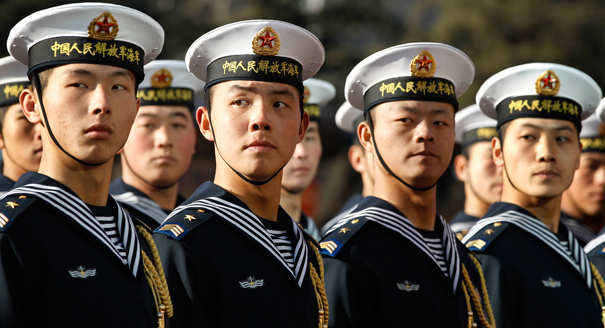
Growing multipolarity in Asia necessitates greater interaction and cooperation between China and the United States if the countries hope to maintain stability in this corner of the world.
President Obama unveiled sweeping defense spending cuts at the Pentagon earlier this month. America is refocusing its military and beefing up its presence in the Asia-Pacific—the much-discussed “pivot” Secretary of State Hillary Clinton, Defense Secretary Leon Panetta, and other administration officials have hinted at for months.
In a Q&A, Robert D. Kaplan, a senior fellow at the Center for a New American Security in Washington, explains that growing multipolarity in the region necessitates greater interaction and cooperation between China and the United States if the countries hope to maintain stability in this corner of the world.
The Chinese are concerned because it may mean that the United States is trying to contain China. They see that the United States is sending 2,500 marines to Australia. Secretary of Defense Panetta said that under no circumstances will there be a smaller U.S. naval commitment in the western Pacific. The Chinese are concerned that means the Americans are ganging up on them.
China will seek to extend its influence into the South China Sea and into the East China Sea. The United States will try to preserve the balance of power as it has existed for the past few decades.
But that balance of power is going to be hard to maintain, as China’s naval and air forces get stronger and stronger and as the U.S. navy slowly starts to get weaker. So there will be a point of tension here. I see naval competition as the hardest part of U.S.-China relationship; economics is the softer part.
The United States and China may also be competitors in Burma, along with India. There will be various countries around the world over which the United States and China are at philosophical odds, for example, over dictatorships in Uzbekistan and Sudan.
The problem with military multipolarity is that there are more points of interaction than there are in a bipolar or unipolar system. That means that there are more opportunities for incidents—destabilizing incidents—to occur. I think that the more multipolar the military environment gets in East Asia, the more crucial it is for the United States and China to keep talking to each other on a daily basis.
Given that we live in a hothouse media environment where there is always the potential for incidents to get out of hand, China and the United States need a strong military-to-military hotline. If an incident were to happen, they could talk to each other and calm down quickly. That’s the most important thing. And I think you need a continuous relationship on the economic front on all levels.
Both at the same time: Their economies have been lifted by more trade with China, because after all, the Chinese economic miracle of the past thirty years has not only benefited China but the countries of Southeast Asia as well. Without the Chinese economic boom, countries like Thailand, Singapore, and Malaysia would not have the standards of living they have today. So on the one hand, they will come under more political pressure from China, but on the other hand, standards of living will rise.
There is a lot of room for Sino-U.S. cooperation because the world’s two largest economies are wrapped in an economic death embrace. The Chinese basically hold America’s debt. But America is also China’s biggest customer, buying more Chinese-produced goods than any other country. So each one needs the other. And it is in each country’s national interest to make sure that issues like naval competition or differing opinions on democracy or influence in other countries like Burma don’t get out of hand.
The two powers can cooperate on antipiracy in the western Pacific and in the Indian Ocean, on international peacekeeping, and on stabilizing Afghanistan. The Chinese seek a stable Afghanistan in order to extract natural resources but also to build pipelines to places from which China needs energy. The United States needs a stable Afghanistan so it can withdraw with honor from that country.
First of all, everyone is worried about an American decline in this part of the world, because it would mean a shift in the balance of power, which could be potentially destabilizing. I don’t think that the United States is going to decline that fast. We are still going to have the dominant naval power for a long time to come.
I think decline as a concept is overrated because the process can take so many decades. Britain started to decline in the 1890s, but it went on to win two world wars over the next fifty years. I think we are getting too upset over decline.
India though will seek to have more and more influence throughout the Indian Ocean and this will bring competition, though not necessarily conflict, with China.
I think the problem with China compensating for a less dominant United States is that China is already in the Indo-Pacific: it has geographical centrality, and its economy dominates the region. If its military comes up to the level of its economy, it will have a real preponderance of power in the region.
What has kept the United States honest in Asia was that it is half a world away and has no territorial ambitions in the region. That in and of itself made the United States less threatening to many Pacific nations. China, because it is geographically central and economically dominant, could be more threatening.
Robert D. Kaplan, Mr.
Center for a New American Security
Carnegie does not take institutional positions on public policy issues; the views represented herein are those of the author(s) and do not necessarily reflect the views of Carnegie, its staff, or its trustees.

Are Germany’s economic, industrial, and political struggles becoming a liability for the EU’s ability to rise to the geopolitical moment?

Rym Momtaz, ed.

China’s police training infrastructure construction projects provide benefits to recipient countries, promote China’s image as a major global security provider, and are likely to reinforce alignment between Beijing’s security priorities and those of countries in the Global South.


Cameron Waltz, Sheena Chestnut Greitens, Kim Nguyen, …
They face an uphill climb, but they could draw on a strategy that other diplomats have used in the past.


Shana Tabak, Alejandro Martin Rodriguez
Understanding the climatic pain points is necessary for policymakers hoping to minimize the war’s negative environmental consequences.


Alejandro Martin Rodriguez, Joy Arkeh, Sarah Yerkes

The books, podcasts, and films that explain the world it made.

Andrew Leber