

Commentary
Judy Dempsey
{
  "authors": [
    "Judy Dempsey"
  ],
  "type": "legacyinthemedia",
  "centerAffiliationAll": "",
  "centers": [
    "Carnegie Endowment for International Peace",
    "Carnegie Europe"
  ],
  "collections": [],
  "englishNewsletterAll": "",
  "nonEnglishNewsletterAll": "",
  "primaryCenter": "Carnegie Europe",
  "programAffiliation": "",
  "programs": [],
  "projects": [],
  "regions": [
    "Middle East",
    "Russia"
  ],
  "topics": []
}
Source: Getty
Russia has lost immense credibility among countries in North Africa and the Middle East that are desperately trying to make the transition from dictatorship to democracy.
Source: Munich Calling

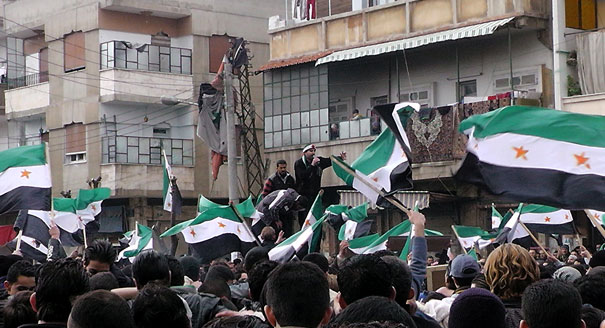
Suddenly, Russia was in the dock. It had just vetoed what was actually a mild United Nations Security Council. Moscow’s no came across particularly badly as U.S. Secretary of State Hillary Clinton had spent a good time of her stay at the MSC trying to persuade her Russian counterpart, Sergei Lavrov, to change the Kremlin’s mind on Syria. The proposed U.N. resolution, sponsored by the Arab League—an institution that Russia had staunchly supported during the Cold War and until recently —did not call for military intervention.
Nor did it call for President Bashir al-Assad to resign. Instead, the Arab League plan called for Mr. Assad to cede power to his vice president and a unity government to lead Syria to democratic election. Arab and Western ambassadors, in a bid to placate Russia, even dropped references in the resolution to Mr. Assad’s ceding power, or calls of a voluntary arms embargo and sanctions. Despite the diluted version, the deaths of at least 6,000 citizens over the past several months and in this past weekend alone, hundreds killed by Syrian security forces, Russia, along with China vetoed the resolution.No wonder the United Nations secretary general, Ban Ki-moon, called the vote “a great disappointment.” “It undermines the role of the United Nations and the international community in this period when the Syrian authorities must hear a unified voice calling for an immediate end to its violence against the Syrian people,” he said in a statement. Leaders and officials from the Arab world were outraged by the Russian veto.
Tawakkul Karman, the Nobel Prize Laureate 2011 and chairwoman of Women Without Chains, Sana, Yemen, told MSC participants: “The Security Council is supposed to protect human rights and protest against violence. Instead, Russia is supporting a dictatorship.” Kenneth Roth, Executive Director of Human Rights Watch, suggested that new norms of behavior on the U.N. Security Council were needed to prevent vetoes on issues concerning crimes against humanity or the kind of violence taking place in Syria.
The implications are clear: Russia has lost immense credibility among countries in North Africa and the Middle East that are desperately trying to make the transition from dictatorship to democracy. It also raises questions about the values the West and Russia’s leadership share.
Why then did Russia use its veto? It is not just because Russia remains a close ally of Syria or that it continues, to this day, to send arms to the Assad regime. It is because Russia is taking a kind of revenge against the U.S and NATO. Dmitri Trenin, director of the Carnegie Endowment for International Peace in Moscow, says Russia, or rather Prime Minister Vladimir Putin, feels betrayed by what happened in Libya.
Nearly a year ago, Russia abstained, not vetoed, a U.N. Security Council Resolution authorizing an international no-fly zone over Libya that was to prevent the late Colonel Muammar Qaddafi’s forces from attacking the rebels. But over time, NATO, which took over the implementation of the U.N. resolution, changed the mandate on the ground. It bombed targets and installations, including ports, buildings and convoys that critics say were not part of its mandate.
Intelligence advisors and military trainers also helped the rebels, which were not included in U.N. mandate, either. Without such support, the Qaddafi regime would not have fallen as soon as it did. “Those at the top in Russia feel betrayed over Libya,” Mr. Trenin said. “Russia is against any Libyan-type scenarios against Syria. But saying No to any action [with regard to Syria] is not enough. Inaction has a price, like action,” Mr. Trenin added.
Yet the longer the fighting continues in Syria, the greater the chances that Europe, the United States and some Arab countries will take some action, however indirect. Joseph Lieberman, Senator and Chairman of the Senate Committee on Homeland Security and Governmental Affairs told the MSC audience there was a range of measures the international community could take.
These included providing medical supplies, intelligence and maybe even weapons to the Free Syrian Army, a group of army defectors trying to topple Mr. Assad. “We are already doing several of these things,” said a European foreign minister. But still the killing continues. Some of the Russian government’s reluctance to allow action over Syria may also stem from domestic reasons.
The Kremlin, Western observers suspect, is very uncomfortable with the democratization movement in the Arab world. Arab protesters risked their lives to end corruption, cronyism and lies, state control of the media and disregard of the rule of law. They succeeded in toppling several of their leaders last year.
Mirroring the demonstrations of the Arab rebellions, tens of thousands of Russians are now taking to the streets, most recently last weekend, and in freezing temperatures, to protest against Mr. Putin’s authoritarian leadership. In that sense, said Mr. Lieberman, Russia is on the wrong side of history. And so is President Assad.
This article was originally published in the Munich Security Conference's Munich Calling.

Nonresident Senior Fellow, Carnegie Europe
Judy Dempsey is a nonresident senior fellow at Carnegie Europe
Recent Work
Judy Dempsey
Judy Dempsey
Carnegie does not take institutional positions on public policy issues; the views represented herein are those of the author(s) and do not necessarily reflect the views of Carnegie, its staff, or its trustees.

European Commission President Ursula von der Leyen is about to give her annual address on the state of the EU. Here’s what she won’t—but should—say.

Rym Momtaz

Depleted financial reserves and a shrinking tax base mean it is no longer possible to simultaneously deliver high defense spending, price stability, and economic growth.

Alexandra Prokopenko
Understanding the climatic pain points is necessary for policymakers hoping to minimize the war’s negative environmental consequences.


Alejandro Martin Rodriguez, Joy Arkeh, Sarah Yerkes

Huawei pushed hard to enter the Egyptian data centers market, until the Americans made a better offer.

Angie Omar

The books, podcasts, and films that explain the world it made.

Andrew Leber