

Article
Frederic Wehrey, Charles H. Johnson
{
  "authors": [
    "Frederic Wehrey"
  ],
  "type": "legacyinthemedia",
  "centerAffiliationAll": "dc",
  "centers": [
    "Carnegie Endowment for International Peace",
    "Malcolm H. Kerr Carnegie Middle East Center"
  ],
  "collections": [],
  "englishNewsletterAll": "menaTransitions",
  "nonEnglishNewsletterAll": "",
  "primaryCenter": "Carnegie Endowment for International Peace",
  "programAffiliation": "MEP",
  "programs": [
    "Middle East"
  ],
  "projects": [],
  "regions": [
    "Middle East",
    "Yemen",
    "Gulf"
  ],
  "topics": [
    "Political Reform",
    "Security",
    "Foreign Policy"
  ]
}
Source: Getty
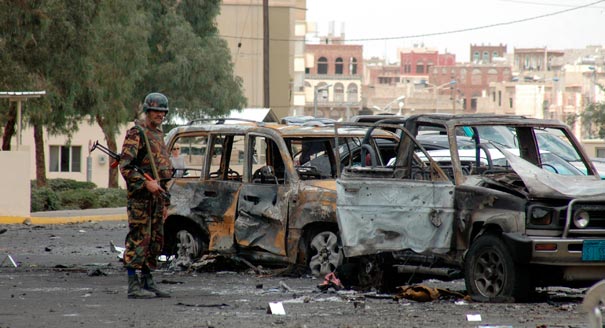
The struggle to root out al-Qaeda in the Arabian Peninsula will require extensive Yemeni and U.S. cooperation, but it is ultimately a problem that the Yemenis must solve.
Source: Fox News
In the continued fight against Al Qaeda in the Arabian Peninsula (AQAP), the Obama administration has relied on a two-track strategy of conducting drone strikes and working to build the capacity of the Yemeni government. Speaking with Fox News, Carnegie's Frederic Wehrey explained that this dual track approach “is the best option given the circumstances and the lessons we’ve learned from Iraq and Afghanistan." Wehrey discussed how AQAP, like other branches of al Qaeda, feeds off the local grievances in a country.
In response to a question regarding whether or not the administration should utilize a larger military campaign, Wehrey noted, “This is ultimately a Yemeni problem that will have to be addressed and solved by the Yemenis.” Indeed, there is mounting evidence that the drone strikes are exacerbating radicalization, he added. Ultimately, the struggle to root out AQAP is destined to be a long battle that will require extensive Yemeni and U.S. cooperation, Wehrey concluded.

Senior Fellow, Middle East Program
Frederic Wehrey is a senior fellow in the Middle East Program at the Carnegie Endowment for International Peace, where his research focuses on governance, conflict, and security in Libya, North Africa, and the Persian Gulf.
Recent Work
Frederic Wehrey, Charles H. Johnson
Frederic Wehrey, Charles H. Johnson
Carnegie does not take institutional positions on public policy issues; the views represented herein are those of the author(s) and do not necessarily reflect the views of Carnegie, its staff, or its trustees.

It should address the shortcomings of previous crisis communication efforts and adapt to the demands of frontier AI.

Lucy Luo

If the Russian-speaking community in Latvia cannot articulate their interests without being seen as disloyal, they could end up embracing a pro-Kremlin agenda.

Sergejs Potapkins
Washington’s decision to support some UN functions while letting others wither is pulling the organization apart at the seams.

Stewart Patrick, Theodore Zaritsky

Are Germany’s economic, industrial, and political struggles becoming a liability for the EU’s ability to rise to the geopolitical moment?

Rym Momtaz, ed.

Russia’s ruling party would have benefited from Putin appearing as its distant patron, but as an active frontman imposing his views on the public, he has done nothing but harm both the party’s election campaign and the ruling system overall.

Andrey Pertsev