

Paper
Matthew Rojansky
{
  "authors": [
    "Matthew Rojansky"
  ],
  "type": "legacyinthemedia",
  "centerAffiliationAll": "dc",
  "centers": [
    "Carnegie Endowment for International Peace"
  ],
  "collections": [],
  "englishNewsletterAll": "ctw",
  "nonEnglishNewsletterAll": "",
  "primaryCenter": "Carnegie Endowment for International Peace",
  "programAffiliation": "russia",
  "programs": [
    "Russia and Eurasia"
  ],
  "projects": [],
  "regions": [
    "Russia",
    "Western Europe"
  ],
  "topics": [
    "Economy"
  ]
}
Source: Getty
Despite Cyprus' favorable fiscal and legal enviroment and the fact that Russian state is one of Cyprus' main creditors, Russia's involvement has generated some surprises.
Source: CNN International
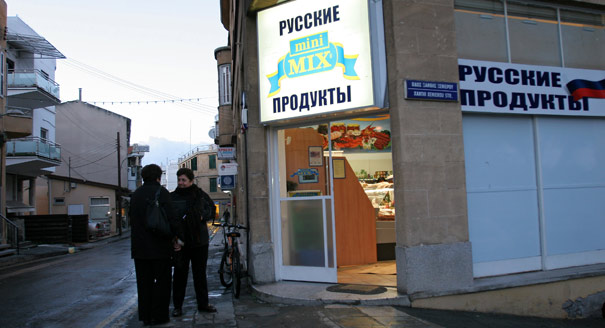
Russia’s deep ties to Cyprus have made the country react quickly to unprecedented EU bailout conditions, involving a simple levy on all deposits. Carnegie’s Matthew Rojansky spoke to CNN International about the relationship between the two countries and the consequences of this still unconfirmed policy.Rojansky characterized the relationship between the two countries as a ‘two-way street’ with lanes of different widths. The size of Russian corporate deposits in Cyprus is comparable to the country’s GDP. Many Russian investors have registered companies on the island to benefit from its favorable fiscal and legal climate. Russia has also become Cyprus’ main creditor over recent years and has offered to grant Cyprus more favorable payback terms, Rojansky added.
To explain rumors concerning a possible geopolitical subtext, Rojansky pointed to the fact that, while investors may not be happy to see 10 to 15 percent of their deposits being withdrawn, this comes at a time when President Putin is trying to convince important civil servants and businessmen to repatriate their funds. Rojansky also noted that such a dramatic step would not have been taken were it not for the EU’s main contributor, Germany, disapproving of Cyprus’ lax attitude to Russian money-laundering.

Former Deputy Director, Russia and Eurasia Program
Rojansky, formerly executive director of the Partnership for a Secure America, is an expert on U.S. and Russian national security and nuclear-weapon policies.
Recent Work
Matthew Rojansky
Matthew Rojansky
Carnegie does not take institutional positions on public policy issues; the views represented herein are those of the author(s) and do not necessarily reflect the views of Carnegie, its staff, or its trustees.

Cargo traffic through Russia’s Northern Sea Route has increased because of the disruption caused by the conflict in the Middle East, the Ukraine war, and U.S.-China tensions.

Mikhail Korostikov
An analysis of traffic accident data suggests that Ukrainian drone attacks caused a material but not disastrous fall in Russian gasoline consumption over the summer.

Sergey Vakulenko

The domestic impacts of how long it is taking to end the war in Ukraine have pushed the French electorate to the political extremes and compromised the country’s diplomatic capacity.

Rym Momtaz

Sergei Kiriyenko used Russia’s parliamentary vote to further hone his strategy of corporate mobilization that is designed to maximize votes for United Russia.

Andrey Pertsev

The Plaza Accord was not an externally imposed punishment of Japan but part of a broader restructuring that Japanese economists and policymakers themselves recognized was necessary. Its effects were undermined, however, when Tokyo responded to the resulting slowdown with policies that exacerbated investment, credit expansion, and the very imbalances the adjustment was intended to resolve.

Michael Pettis