

Paper
Matthew Rojansky
{
  "authors": [
    "Matthew Rojansky"
  ],
  "type": "legacyinthemedia",
  "centerAffiliationAll": "dc",
  "centers": [
    "Carnegie Endowment for International Peace",
    "Carnegie Russia Eurasia Center"
  ],
  "collections": [],
  "englishNewsletterAll": "ctw",
  "nonEnglishNewsletterAll": "",
  "primaryCenter": "Carnegie Endowment for International Peace",
  "programAffiliation": "russia",
  "programs": [
    "Russia and Eurasia"
  ],
  "projects": [],
  "regions": [
    "Eastern Europe",
    "Ukraine",
    "North America",
    "United States",
    "Caucasus",
    "Russia",
    "Western Europe"
  ],
  "topics": [
    "Political Reform",
    "Foreign Policy"
  ]
}
Source: Getty
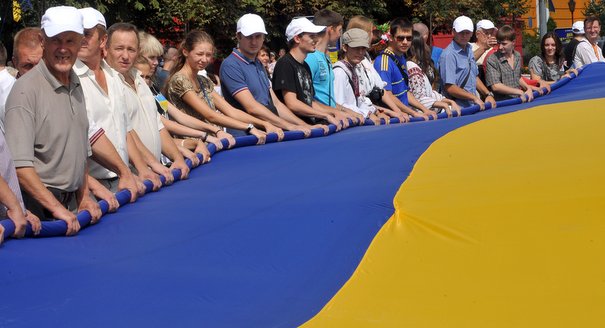
Chairmanship of the Organization for Security and Co-operation in Europe opens a lot of challenges to Ukraine, and at the same time, a window of opportunity.
Source: Day

“Ukraine has unique, very specific potentialities, concerning the very major problem and possibilities of the entire Euro-Atlantic space. This is the key principle of operation of the very OSCE, which strives to improve security, mutual confidence, and the efficiency of institutes in this space.”
“It lies in the ‘gray zone,’ being part of neither NATO nor CSTO. Ukraine is very much interested in the solution of the ‘frozen’ Transnistrian conflict, because this is on its border. Ukraine understands that it is partly responsible for the unpredictability in the energy resources markets on this continent. And last but not least, Ukraine has a domestic problem of historic reconciliation, historic memory. All this can be seen and perceived within the country most of all. This inner argument characterizes the lack of understanding in all of the Euro-Atlantic space. That is why I think Ukraine must assume more ambitious plans for its chairmanship.”
“I’m afraid, this will be useless.”
“I can see that Ukraine’s officials are focused on short-term plans. But why assume responsibility for a problem, for whose solution Ukraine has no particular resources? It is clear that the keys to this problem are in Washington, D.C. and Moscow. I do not mind, but I think it is a good example of an approach which will lead neither to big success, nor to the improvement of Ukraine’s image.
“To get good evaluation of its chairmanship, Ukraine needs to show itself as it did in the preparation for Euro-2012, when it demonstrated its competence. Ukraine will again come into the focus of attention. That is why its main task will be to earn confidence in such key problems as democratic elections, freedom of speech, independence of courts, and protection of minorities’ rights.”
“The situation around this resolution shows that virtually no one at the Capitol is interested in this matter. Lazarenko might be interested in the passing of this resolution, but he is neither a senator nor a congressman. I will not speculate on such questions as who bribed whom. I do not think this is the case. If one senator or congressman assumes the responsibility of writing a resolution, the others take it as a matter of no consequence. If Inhofe wished to write a resolution, he was welcome to it.”
… and then he was joined by Senator Durbin, the second most influential man in the Democratic party.
“In his kindness, Durbin somewhat altered the text of the resolution. The draft was not very well-advised. In contained phrases like ‘recall the ambassador,’ ‘serious sanctions,’ ‘refusal to acknowledge Ukraine’s presiding over OSCE.’ It was horrible. The resolution was improved. But as a result, it showed that there are problems in our relations.”
“Such fears do exist, if Ukraine continues in the same vein. A lot depends on the parliamentary elections in Ukraine and on the reform policy inside the country. For the Congress and the Department of State the most important thing is the continuation of the measures, which were agreed with the Ukrainian party. Washington understands that Ukraine has not fully departed from its commitment to democracy. However, I have fears about Russification of the US policy on Ukraine. If we speak of sanctions, of Tymoshenko case as a sign that Ukraine’s political system has a problem, just as Magnitsky case for Russia, then the high-ranking officials monitoring this region will tend to associate Ukraine with Russia as countries having the same problems.”
“From what I saw I had a good impression of Romney. He behaved as a true presidential candidate. He did not make many mistakes, despite the Republicans’ fears. I am glad that we have a true competition between strong candidates. This is evidence of real democracy.”
“Of course, he can. Millions of Americans watch these debates and read about them, and this could have an impact. At the same time, there are limitations. In our American system, roughly 40 percent are members of either party.”
“For Ukraine?”
“I am a conservative internationalist. That is why I believe that America must be as responsible and careful as possible while using its force, in order to preserve enough power to defend its major interest in case of necessity. It means that we should not constantly think of the world’s problems as of our own, and be a global cop. Unfortunately, I have heard too much from both candidates of such issues as the liberation of the Middle East from dictators.”
Former Deputy Director, Russia and Eurasia Program
Rojansky, formerly executive director of the Partnership for a Secure America, is an expert on U.S. and Russian national security and nuclear-weapon policies.
Recent Work
Matthew Rojansky
Matthew Rojansky
Carnegie does not take institutional positions on public policy issues; the views represented herein are those of the author(s) and do not necessarily reflect the views of Carnegie, its staff, or its trustees.
In an interview, Rozina Ali discusses her new book on the rise and manifestations of Islamophobia in the United States.

Michael Young

While the EU and European governments are embracing the much-lauded middle-power moment, this entails three difficult conundrums.

Richard Youngs
The middle power moment will not be defined by sovereign states alone, and California stands out for its potential contributions to international cooperation.


Ian Klaus, Stewart Patrick

Ex-president Gurbanguly Berdimuhamedov remains interested in politics, but his son Serdar, Turkmenistan’s current president, is becoming increasingly independent and willing to break with his father’s legacy. If their covert rivalry goes too far, both risk losing power.

Galiya Ibragimova

Europe is facing rising populism internally as well as external pressures from Russia, China, Turkey, and the United States.

Dimitar Bechev