

Paper
James M. Acton, Ankit Panda
{
  "authors": [
    "James M. Acton"
  ],
  "type": "legacyinthemedia",
  "centerAffiliationAll": "dc",
  "centers": [
    "Carnegie Endowment for International Peace",
    "Carnegie China"
  ],
  "collections": [
    "China’s Foreign Relations",
    "U.S. Nuclear Policy"
  ],
  "englishNewsletterAll": "ctw",
  "nonEnglishNewsletterAll": "",
  "primaryCenter": "Carnegie Endowment for International Peace",
  "programAffiliation": "NPP",
  "programs": [
    "Nuclear Policy"
  ],
  "projects": [],
  "regions": [
    "North America",
    "United States",
    "East Asia",
    "China"
  ],
  "topics": [
    "Nuclear Policy",
    "Security",
    "Arms Control"
  ]
}
Source: Getty
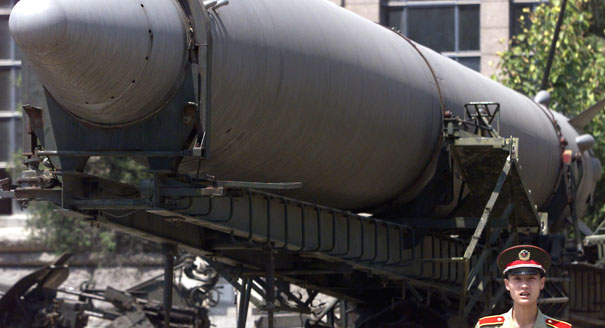
A recent Chinese white paper on defense omits a promise that China will never use nuclear weapons first, an explicit pledge had been the cornerstone of Beijing’s stated nuclear policy for the last half-century.
Source: New York Times
Interpreting any country’s pronouncements about its nuclear weapons can be a study in fine distinctions, but occasionally a state says — or fails to say — something in a clear break from the past. A Chinese white paper on defense, released on Tuesday, falls into this category and now demands our attention, because it omits a promise that China will never use nuclear weapons first.
That explicit pledge had been the cornerstone of Beijing’s stated nuclear policy for the last half-century. The white paper, however, introduces ambiguity. It endorses the use of nuclear weapons in response to a nuclear attack but does not rule out other uses.

Jessica T. Mathews Chair, Co-director, Nuclear Policy Program
Acton holds the Jessica T. Mathews Chair and is co-director of the Nuclear Policy Program at the Carnegie Endowment for International Peace.
Recent Work

James M. Acton, Ankit Panda
James M. Acton
Carnegie does not take institutional positions on public policy issues; the views represented herein are those of the author(s) and do not necessarily reflect the views of Carnegie, its staff, or its trustees.

Why governance of rapidly evolving technology will be distributed and complex.


Stewart Patrick, Scott Singer

It should address the shortcomings of previous crisis communication efforts and adapt to the demands of frontier AI.

Lucy Luo
Washington’s decision to support some UN functions while letting others wither is pulling the organization apart at the seams.
Stewart Patrick, Theodore Zaritsky

While there are notable demographic, economic, and geographic divides over AI, there is also substantial alignment between Republicans and Democrats.



Ian Klaus, Mark Baldassare, Rachel George, …

Are Germany’s economic, industrial, and political struggles becoming a liability for the EU’s ability to rise to the geopolitical moment?

Rym Momtaz, ed.