

Research
- +5
Alper Coşkun, Fatih Ceylan, Tacan İldem, …
{
  "authors": [
    "Sinan Ülgen"
  ],
  "type": "legacyinthemedia",
  "centerAffiliationAll": "",
  "centers": [
    "Carnegie Endowment for International Peace",
    "Carnegie Europe",
    "Malcolm H. Kerr Carnegie Middle East Center"
  ],
  "collections": [
    "Turkey’s Transformation"
  ],
  "englishNewsletterAll": "",
  "nonEnglishNewsletterAll": "",
  "primaryCenter": "Carnegie Europe",
  "programAffiliation": "",
  "programs": [],
  "projects": [],
  "regions": [
    "Middle East",
    "Europe",
    "Türkiye",
    "Levant"
  ],
  "topics": [
    "Democracy",
    "Civil Society"
  ]
}
Source: Getty
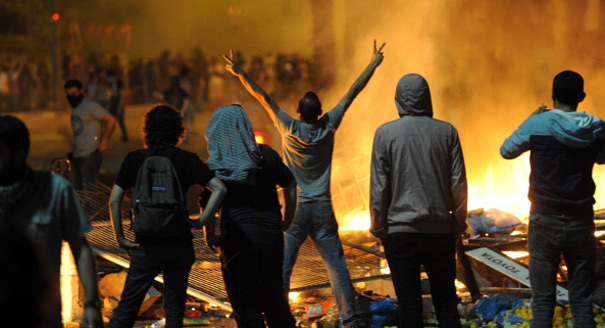
The mass protests in Istanbul are a reaction to Erdogan’s strategy of polarizing Turkish society to cement a pro-government majority.
Source: Foreign Policy
The demonstrations started in Istanbul a few days ago. The initial objective was to protect the park in Taksim, Istanbul's central square, from being demolished and replaced by a shopping mall. But the police intervened with excessive force against a peaceful assembly, liberally using tear gas to disperse protesters. Prime Minister Recep Tayyip Erdogan stated that the project will go ahead regardless of the "few" people that oppose it. As a result, this local dispute was unexpectedly transformed into a city and then a nation-wide mass demonstration against his polarizing style.
The mass protests should be seen as a reaction against the ruling Justice and Development Party (AKP) and Erdogan's style of majoritarian governance. By cementing a pro-government majority and avoiding consensus on sensitive issues, Erdogan's political strategy has polarized Turkish society. This majoritarian approach to decision-making has worked well for him so far. He not only succeeded in setting the agenda for the country, but he also increased his popular support over three successive elections. But it now seems that this style of governance has reached the limit of Turkish society's tolerance. The recent adoption of a law on alcohol that significantly impedes the marketing, sales, and consumption of alcoholic drinks had already stirred a debate in Turkey about the government's negligence to take into account the sensitivities of Turkey's non-conservatives. Moreover, Erdogan's defense of the law by referencing religious principles only served to provoke the law's secular opponents. Instead the decision to transform a public park in the central square of Istanbul into a shopping mall became the rallying theme for many Turks to demonstrate their dissatisfaction with Erdogan's leadership.
Compared to past rallies in Turkey's democratic history, this week's events stand out for a number of reasons. First, the mass demonstrations are against the non-participatory style of decision-making adopted by the Erdogan government, but they are not ideological. They have not been hijacked or led by any single political party or ideology, as the protesters hail from disparate backgrounds and represent the rich diversity of Turkish society. They are composed of youth, women, football club supporters, trade unionists, college students, NGO activists, and urban professionals.Second, there is for the first time a sense of empowerment against a government that has dominated the political scene for the past decade. This sense of popular empowerment stands in stark contrast with the dismal performance of Turkey's parliamentary opposition. The oft-made comparisons to the Tahrir demonstrations are not correct. Turkey is a democracy and there is no call for regime change like in Egypt. The only overlap with Tahrir remains this immense sense of empowerment and emancipation by the ordinary citizens that have seen the impact they can have on the political system if they act in unison.
And then there is the media. Turkey's mainstream media has become the laughing stock of the country. While Istanbul was burning with tear gas, Turkish TV channels were busy broadcasting documentaries, cooking shows, or soap operas. The Saturday edition of the pro-government major daily Sabah has not mentioned the events. The government imposed a blackout and the widespread self-censorship further discredited the mainstream media in the eyes of the Turkish public, which turned to international media outlets or to social media to follow the events on their streets. Indeed, one clear winner has been social media. Many Turks rushed to Twitter and the like to witness the rallies in real time. According to a study conducted by New York University's Social Media and Political Participation Laboratory, the social media response to and the role of social media in the protests has been phenomenal. Within a window of 24 hours, at least two million tweets mentioning hashtags related to the protest, have been posted. Even after midnight on Friday, more than 3,000 tweets about the protest were published every minute.
The way forward is, however, unclear. Erdogan conceded a small victory on Saturday to the protesters by withdrawing the police forces from Taksim square and admitting to their excessive use of force. But more defiantly, he reiterated his willingness to proceed with the disputed Taksim square reconstruction project. Yet regardless of how the events unfold in the coming days, there are two conclusions that can be drawn even now from this episode of unplanned and yet massive protest movements that shook one of Europe's largest cities: one is the glaring need to fundamentally restructure the media in Turkey; and the other the urgency of behavioral change in Erdogan's leadership style.
The blatant failure of the Turkish press to fulfill, even minimally, its role to report events harms the progress of democracy in Turkey. Consequently, new measures should be legislated, such as forcing media companies to shed their non-media activities, to ensure that the independence of the media can be re-established and maintained. Another set of rules should focus on safeguarding media pluralism.
Although they do not represent an immediate threat to Erdogan's rule in Turkey, these mass protests should nonetheless be taken seriously by the Turkish prime minister. Many Turks have grown increasingly disaffected with the top-down, non-inclusive style of decision-making that has characterized the later years of the Erdogan government. They are tired of polarization and strive for more consensual politics. Erdogan needs to understand this yearning and adopt a more conciliatory mode of leadership.
But possibly even more important for Turkey's future political stability is the increasingly visible gap on the acceptable forms of dissent between the Turkish leadership and society. Erdogan seems genuinely to believe that mass protests have no place in a country administered by a strong, stable, and economically successful government. He emphasizes the ballot box as the venue for social and political stakeholders to show their disaffection with the government. "Every four years we hold elections and this nation makes its choice," he said on Saturday. "Those who have a problem with government's policies can express their opinions within the framework of law and democracy." But with its maturing and increasingly pluralistic civil society, Turkey has moved beyond this more limited definition of democratic freedoms. The Turkish political leadership, including the parliamentary opposition, have to readjust their outlook. Otherwise with the newly found sense of empowerment of its citizenry, public turbulence in Turkey will become much more common.

Senior Fellow, Carnegie Europe
Sinan Ülgen is a senior fellow at Carnegie Europe in Brussels, where his research focuses on Turkish foreign policy, transatlantic relations, international trade, economic security, and digital policy.
Recent Work

Alper Coşkun, Fatih Ceylan, Tacan İldem, …
Carnegie does not take institutional positions on public policy issues; the views represented herein are those of the author(s) and do not necessarily reflect the views of Carnegie, its staff, or its trustees.
As the U.S.-led Coalition withdraws, the Kurds’ reliance on Baghdad, and on themselves, will only increase.
Wladimir van Wilgenburg
Fatima El Mansouri is the country’s first female prime minister. She’s also a privileged insider in a largely ceremonial position.

Sarah Yerkes

The European Commissioner for Trade is headed to China. But after President Xi’s bridge-building visit to Washington, can a more isolated EU overcome Beijing’s stranglehold on critical raw materials? Who will blink first?

Rym Momtaz, ed.
European NATO countries are wrestling with the possibility of U.S. disengagement from the alliance. With the continent’s security increasingly uncertain, governments must restore the credibility of their collective defense.



Hans-Dieter Lucas, Adam Thomson, Pierre Vimont

The domestic impacts of how long it is taking to end the war in Ukraine have pushed the French electorate to the political extremes and compromised the country’s diplomatic capacity.
Rym Momtaz