

In The Media
Lilia Shevtsova
{
  "authors": [
    "Lilia Shevtsova"
  ],
  "type": "commentary",
  "centerAffiliationAll": "",
  "centers": [
    "Carnegie Endowment for International Peace",
    "Carnegie Russia Eurasia Center"
  ],
  "collections": [],
  "englishNewsletterAll": "",
  "nonEnglishNewsletterAll": "",
  "primaryCenter": "Carnegie Russia Eurasia Center",
  "programAffiliation": "",
  "programs": [],
  "projects": [],
  "regions": [
    "Eastern Europe"
  ],
  "topics": [
    "Political Reform",
    "Democracy"
  ]
}
Source: Getty
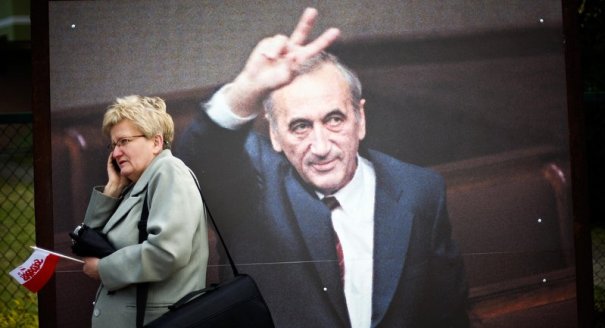
Tadeusz Mazowiecki, who was the first Polish non-communist prime minister, died on October 28. He will be remembered as a Man Who Helped to Open a New Era—and not only for Poland.
Tadeusz Mazowiecki, the prime minister of Poland from 1989 till 1991 and the first non-communist prime minister in Central and Eastern Europe in the post-WWII period, died on October 28. He belonged to the same brilliant generation of courageous individuals always ready for sacrifice, also represented by Vaclav Havel and another Pole, Bronislaw Geremek.
Mazowiecki was one of the founders of the Catholic Intelligentsia Club and the highest moral authority for the Polish political and intellectual circles. After the martial law was declared in Poland in 1981, he was arrested and imprisoned by the Communist authorities. Yet he never tried to take revenge. He always believed that the power was to be taken from the Communist Party through negotiation. He became one of the key participants of the Polish Round Table Talks in 1988 that brought the landslide Solidarity victory on June 4, 1989. In August 1989, the Polish Sejm elected him prime minister, and his government carried out fundamental reforms, returning Poland to Europe.
I am proud that I knew Pan Tadeusz when he was the editor-in-chief of the Tygodnik Solidarnosc. He helped me a lot with his advice and with his ideas when I worked on my book on the Polish Catholic Church…
Now he is gone. But he will be remembered as a Man Who Helped to Open a New Era—and not only for Poland!

Former Senior Associate, Russian Domestic Politics and Political Institutions Program, Moscow Center
Shevtsova chaired the Russian Domestic Politics and Political Institutions Program at the Carnegie Moscow Center, dividing her time between Carnegie’s offices in Washington, DC, and Moscow. She had been with Carnegie since 1995.
Recent Work
Lilia Shevtsova
Lilia Shevtsova
Carnegie does not take institutional positions on public policy issues; the views represented herein are those of the author(s) and do not necessarily reflect the views of Carnegie, its staff, or its trustees.

Ex-president Gurbanguly Berdimuhamedov remains interested in politics, but his son Serdar, Turkmenistan’s current president, is becoming increasingly independent and willing to break with his father’s legacy. If their covert rivalry goes too far, both risk losing power.

Galiya Ibragimova

A notable degree of participative democracy has firmly arrived in Europe. But to have more far-reaching impact, democratic deliberation needs to move into a radically new phase.

Richard Youngs
Today’s global democratic recession is partly rooted in a common perception that democracies have a delivery problem, with many citizens in both autocracies and democracies alike now believing that strongmen can achieve better governance outcomes. But a study of four countries in Africa reveals that democratic-leaning governments have demonstrated better governance performance than autocratic governments.


Sarah Yerkes, Natalie Triche, Amr Hamzawy
Fatima El Mansouri is the country’s first female prime minister. She’s also a privileged insider in a largely ceremonial position.
Sarah Yerkes

The domestic impacts of how long it is taking to end the war in Ukraine have pushed the French electorate to the political extremes and compromised the country’s diplomatic capacity.

Rym Momtaz