

Paper
Renée DiResta, Rachel Kleinfeld, Margot Treadwell
{
  "authors": [
    "Rachel Kleinfeld"
  ],
  "type": "legacyinthemedia",
  "centerAffiliationAll": "dc",
  "centers": [
    "Carnegie Endowment for International Peace"
  ],
  "collections": [],
  "englishNewsletterAll": "democracy",
  "nonEnglishNewsletterAll": "",
  "primaryCenter": "Carnegie Endowment for International Peace",
  "programAffiliation": "DCG",
  "programs": [
    "Democracy, Conflict, and Governance"
  ],
  "projects": [],
  "regions": [
    "North America",
    "United States"
  ],
  "topics": [
    "Political Reform"
  ]
}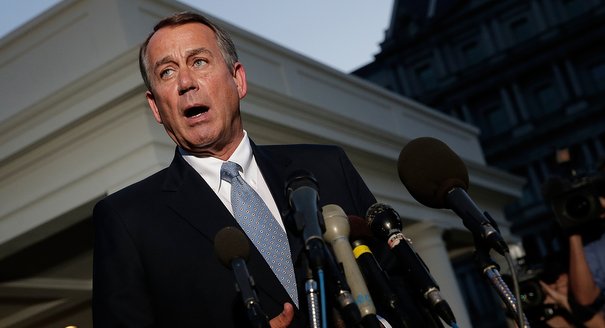
Source: Getty
Boehner’s decision to kill immigration reform will cost his party the Latino vote and harm America’s economy.
Source: San Francisco Chronicle
House Speaker John Boehner might go down in history as the next Abraham Lincoln. Or at least Lyndon Johnson. But not in the way he might wish. Like those illustrious presidents, Boehner might have just made a decision that has scuttled his party's chances for decades to come.
Abraham Lincoln, a Republican, chose to emancipate the country's slaves, handing the former Confederacy to "Southern Democrats" for nearly a century. The tide didn't turn until Johnson, a Democrat, signed the Civil Rights Act knowing that he had just handed the South back to Republicans for a generation.
Boehner's decision to kill immigration reform will cost his party the Latino vote for at least that long. The fastest growing demographic in the country, Latinos don't vote solely on immigration - in fact, given their strong religious and culturally conservative values, many pundits considered them potential swing voters. But no one wants to vote for a party that doesn't want you around.The real loser is America's economy. California has a particular stake in changing the law because the face of immigration is changing. The majority of California's immigrants used to be poorer Latinos. Now the trend is toward college-educated Asians. Both are desperately needed by California's largest employers. But our immigration system, last significantly changed more than a quarter century ago, has become a patchwork of over-regulation and incoherent policies. We now give 75 percent of all visas to those with family members already here, leaving no room for economics. Uniting families is an important value, of course. But there are people who want to work hard, need jobs and don't have family in America - and a lot of people who want to hire them. Those forces will overwhelm the rule of law unless our laws align with our needs.
The world's best and brightest scientific minds aren't going to sneak into a country. They will go somewhere that values them.
Meanwhile, the agricultural industry still needs its seasonal workers, and they want to work here. As America learned the hard way during Prohibition, it's a bad idea to criminalize the forces of supply and demand. By ignoring these forces, our immigration policy - as Prohibition did - is pushing millions of otherwise law-abiding people into criminal activity and generating unintended side effects that hurt our laws, our communities and our economy.
Both parties had fringes that opposed change. The hard left claimed that immigration reform would bring down wages and cost "American" jobs. But the Democratic Senate overcame this opposition by passing a bill that enabled immigrant workers to get paid a decent wage and have benefits. Meanwhile, employers could no longer exploit immigrants here illegally and thereby keep wages down for American citizens. Everyone has to follow the law, so everyone gets a fairer shake.
The bigger myth, of course, is that there is a set number of jobs in the country for either "them" or "us." In reality, growing industries create more jobs: Just think of all those working in Internet-industries that no one imagined 20 years ago.
The hard right claims we need more border security. This is a dodge. The reality is, nearly half of those here illegally came to the United States on legitimate visas and overstayed. The 9/11 bombers came in through airports, and the failed Los Angeles Airport millennium bomber entered through Canada. More fences in the Southwest might feel more secure, but it's the bill's provisions to invest in people and technologies at all of our borders and visa-issuing agencies that make it strong on security.
Meanwhile, the modern Prohibition regime these fringes uphold does increase crime. Not from illegal immigrants themselves - most are law-abiding. But being here illegally creates a thriving market in human traffickers and other criminals who prey on immigrants and get away with it, knowing their victims are afraid to report crimes to American authorities.
California has wisely passed a series of new laws to try to address the spillover effects of our broken laws at the state level, including one that shields immigrants from deportation unless they've committed a violent crime. That should help the police in one state, but it's not enough.
As when he shut down the government, Boehner made another choice that harms America's economy for the sake of politics. Hard-hit Californians are doing their best to fix a leaky boat at the state level. They can't bail fast enough.
This article was originally published in the San Francisco Chronicle.
Senior Fellow, Democracy, Conflict, and Governance Program
Rachel Kleinfeld is a senior fellow in Carnegie’s Democracy, Conflict, and Governance Program, where she focuses on issues of rule of law, security, and governance in democracies experiencing polarization, violence, and other governance problems.
Recent Work
Renée DiResta, Rachel Kleinfeld, Margot Treadwell
Political Violence Researchers, Rachel Kleinfeld, ed., Dalya Berkowitz, ed.
Carnegie does not take institutional positions on public policy issues; the views represented herein are those of the author(s) and do not necessarily reflect the views of Carnegie, its staff, or its trustees.

As the U.S. stumbles in its war with Iran, we are likely to see an acceleration of its disengagement from the region.

Michael Young

Why governance of rapidly evolving technology will be distributed and complex.


Stewart Patrick, Scott Singer

It should address the shortcomings of previous crisis communication efforts and adapt to the demands of frontier AI.

Lucy Luo

If the Russian-speaking community in Latvia cannot articulate their interests without being seen as disloyal, they could end up embracing a pro-Kremlin agenda.

Sergejs Potapkins

Washington’s decision to support some UN functions while letting others wither is pulling the organization apart at the seams.
Stewart Patrick, Theodore Zaritsky