

Q&A
Suzanne Maloney, Aaron David Miller, Karim Sadjadpour
{
  "authors": [
    "Karim Sadjadpour"
  ],
  "type": "legacyinthemedia",
  "centerAffiliationAll": "dc",
  "centers": [
    "Carnegie Endowment for International Peace",
    "Malcolm H. Kerr Carnegie Middle East Center",
    "Carnegie China"
  ],
  "collections": [],
  "englishNewsletterAll": "menaTransitions",
  "nonEnglishNewsletterAll": "",
  "primaryCenter": "Carnegie Endowment for International Peace",
  "programAffiliation": "MEP",
  "programs": [
    "Middle East"
  ],
  "projects": [],
  "regions": [
    "North America",
    "United States",
    "Middle East",
    "Iran",
    "Saudi Arabia",
    "Gulf"
  ],
  "topics": [
    "Foreign Policy",
    "Nuclear Policy",
    "Arms Control"
  ]
}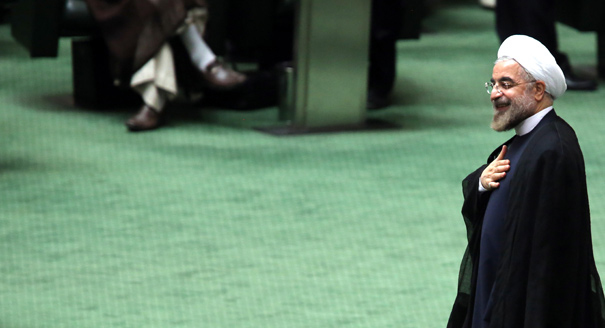
Source: Getty
Iran is one of the few countries in the Middle East where America’s strategic interests and democratic values align, rather than clash.
Source: New York Times
Since the 1979 Iranian revolution replaced an American-allied monarchy with a virulently anti-American theocracy, U.S. foreign policy in the oil-rich Persian Gulf has rested on two strategic pillars: enmity with Iran, and amity with Saudi Arabia. In light of the recent interim nuclear deal with Tehran, are we on the verge of a strategic realignment?
The short answer is not yet.
The anomaly of the U.S.-Iran-Saudi triangle is the fact that Tehran and Washington share common enemies—including the Taliban and Al Qaeda—both of which took inspiration from the intolerant Wahhabi religious sect of Saudi Arabia.Whereas Iran and Saudi Arabia have a genuine geopolitical rivalry, the U.S.-Iran conflict has been driven by an antiquated ideology. Since 1979, Iran’s Islamist leadership has often prioritized revolutionary dogma—namely the rejection of American influence and Israel’s existence—over national interests.
While Supreme Leader Ayatollah Khamenei has seemingly endorsed a tactical nuclear détente in order to alleviate Iran’s economic suffering, a full rapprochement with the United States—which would require Tehran to cease its belligerence toward Israel and support for groups like Hezbollah—would oblige the 74-year-old Khamenei to abrogate the values he’s stood for his entire political career.
U.S.-Iran enmity is not indefinite, however. Indeed, Iran is one of the few countries in the Middle East where America’s strategic interests and democratic values align, rather than clash. Whereas a representative government in Saudi Arabia has the potential to bring about a political system that’s even less tolerant, and less sympathetic to U.S. interests, than the status quo, in Iran a more representative government would likely auger both greater political and social tolerance and a more cooperative working relationship with Washington.
For this reason, it’s eminently possible to foresee a day in which an energy self-sufficient America renews its alliance with Tehran, and downgrades its rapport with Riyadh. In the near future, however, the largest economy in the world (the U.S.) is not going to abandon the world’s key energy producer (Saudi Arabia) to form an alliance with a country (Iran) that remains torn between resistance and reintegration.
This article was originally published in the New York Times.

Senior Fellow, Middle East Program
Karim Sadjadpour is a senior fellow at the Carnegie Endowment for International Peace, where he focuses on Iran and U.S. foreign policy toward the Middle East.
Recent Work


Suzanne Maloney, Aaron David Miller, Karim Sadjadpour

Aaron David Miller, Karim Sadjadpour, Robin Wright
Carnegie does not take institutional positions on public policy issues; the views represented herein are those of the author(s) and do not necessarily reflect the views of Carnegie, its staff, or its trustees.

The EU can impose sanctions but struggles to enforce them without the United States. With Washington increasingly disinterested in backing European interests, the bloc must now fend for itself.


Nicu Popescu, Tiago Antunes
Global and rising powers will need to engage with Africa’s priorities and agency in order to secure the continent’s increasingly attractive partnerships.
Fonteh Akum

Rubio’s recent visit brought welcome attention, but more capital requires governance changes that may be a hard sell for regional governments.

Jennifer B. Murtazashvili

America’s foreign-policy objectives have grown more demanding while Americans have demanded greater focus on their own affairs.

Stephen Wertheim

Japan’s long-term security policy is driven by concerns about China, and there is little appetite for (or interest in) pursuing a confrontation with Moscow.

James D.J. Brown