

Q&A
Dara Massicot, Aaron David Miller, Andrew S. Weiss
{
  "authors": [
    "Andrew S. Weiss"
  ],
  "type": "commentary",
  "centerAffiliationAll": "",
  "centers": [
    "Carnegie Endowment for International Peace",
    "Carnegie Russia Eurasia Center"
  ],
  "collections": [],
  "englishNewsletterAll": "",
  "nonEnglishNewsletterAll": "",
  "primaryCenter": "Carnegie Endowment for International Peace",
  "programAffiliation": "",
  "programs": [],
  "projects": [],
  "regions": [
    "Russia"
  ],
  "topics": [
    "Political Reform"
  ]
}
Source: Getty
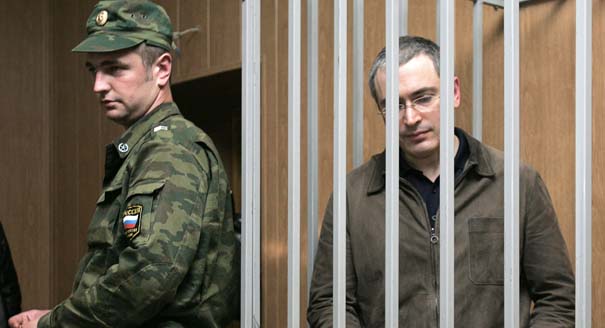
Putin’s announcement about an impending pardon for Mikhail Khodorkovsky at his year-end press conference in the Kremlin today speaks volumes about the state of Russian domestic politics.
Putin’s off-stage bombshell announcement about an impending pardon for Mikhail Khodorkovsky at his year-end press conference in the Kremlin today speaks volumes about the state of Russian domestic politics. After all, it was almost exactly two years ago that the Moscow street demonstrations first gathered steam on Bolotnaya Square, just opposite the Kremlin. Today the energy of the original protests has almost completely dissipated, and there is no sign of any mass movement forming in Russia comparable to the crowds that have been gathering on the Maidan in downtown Kyiv.
Indeed, it’s hard to find anyone in Russian liberal circles today who feels terribly optimistic about their political prospects, barring a dramatic change in the country’s socioeconomic conditions. With the possible exception of Alexey Navalny, there are no serious opposition politicians on the scene who command a serious national following—or who seem able to get under the skin of the Kremlin’s political operatives.
Once again, Putin has shown us that he loves pulling surprises, and this one certainly came out of nowhere. The much-anticipated amnesty bill passed by the Duma yesterday in honor of the 20th anniversary of the Russian Constitution was not aimed at people accused of serious economic crimes and corruption, and government sources had dismissed suggestions in recent weeks that the Kremlin might include Khodorkovsky in its specific pardon requests.
At first blush, the pardon for Khodorkovsky appears to be a rather canny move that will throw Putin’s critics off-balance in the run-up to Sochi while sending a clear message of self-confidence to his domestic political opponents. By releasing Khodorkovsky (and, presumably the Pussy Riot art pranksters and the Greenpeace activists in due course), Putin and his surrogates will soon be able to say to Western audiences, "Why all the fuss about human rights in Russia? Russia doesn’t have any political prisoners after all."
That line has the benefit of actually being, maybe, kind of, sort of, true. Despite constant criticism of Putin’s human rights record, the reality these days is that Russia actually doesn’t have a gulag full of political opponents. Rather, the government uses other methods to deal with its most implacable opponents—namely, Russia’s open borders and the various types of harassment meted out by legions of energetic law enforcement agencies. Anyone who doesn’t like the current environment and restrictions on political activity is free to go elsewhere or take their chances in court proceedings of the type that Navalny has faced. When opponents do choose to stick around, there are all too many tools available to the Kremlin to marginalize or coopt them. Western influences of the NGO and LGBT variety are, of course, in a completely different and most unwelcome category—a point that Putin himself underscored in his marathon Q&A session today.
[Although it gets surprisingly little attention in the West, premium spaces in Russia’s truly ghastly penal system are mostly reserved for people whose businesses are targeted by local law enforcement officials for raiding and expropriation, not run of the mill street protesters and political activists. As of last count, there were approximately 150,000 business people in pre-trial detention as a result of Russian authorities’ attempts to steal their businesses. Attempts to provide relief to these figures or their families, including the naming of a national ombudsman who reports to Putin, have generated only limited results.]
To give him his due, Putin continues to demonstrate a knack for meeting the socioeconomic needs and concerns of the two-thirds of the electorate who voted for him in March 2012. Moreover, he seems to understand that the general public in Russia remains almost completely uninterested in politics. The man in the street these days is convinced that Putin will remain in power indefinitely. Low-information voters in provincial settings or smaller economically distressed cities are all too easily rattled about the prospect of any return to 1990s-style upheaval or external threats.
As Russia descends into its annual winter holiday shutdown and bacchanal, one wonders whether the Kremlin political team feels they have given their boss the biggest gift of all: peace of mind.
James Family Chair, Vice President for Studies
Andrew S. Weiss is the James Family Chair and vice president for studies at the Carnegie Endowment for International Peace, where he oversees research on Russia, Ukraine, and Eurasia. His graphic novel biography of Vladimir Putin, Accidental Czar: the Life and Lies of Vladimir Putin, was published by First Second/Macmillan in 2022.
Recent Work


Dara Massicot, Aaron David Miller, Andrew S. Weiss

Frances Z. Brown, Nate Reynolds, Priyal Singh, …
Carnegie does not take institutional positions on public policy issues; the views represented herein are those of the author(s) and do not necessarily reflect the views of Carnegie, its staff, or its trustees.

Sergei Kiriyenko used Russia’s parliamentary vote to further hone his strategy of corporate mobilization that is designed to maximize votes for United Russia.

Andrey Pertsev

Before the next wave of EU enlargement takes place, the union needs to grapple with thorny questions of how power is distributed among its members.


Emil Sondaj Hansen, Ditte Brasso Sørensen

The European far right might fail to steer EU policy in the direction Russia wants, but they will create enough chaos inside Europe to benefit the Kremlin.

Dimitar Bechev

A summer of escalation in the Black Sea has hurt Ukraine economically and is exacerbating world food security. A truce is needed—as is a broader reframing of Europe’s Ukraine strategy.

Thomas de Waal

If the Russian-speaking community in Latvia cannot articulate their interests without being seen as disloyal, they could end up embracing a pro-Kremlin agenda.

Sergejs Potapkins