To say that emerging markets have had a tough time of it recently would be something of a major understatement. This has been no less true for the Georgian economy, which stagnated for much of 2013. Coming on the heels of the watershed October 2012 parliamentary elections, the new Georgian Dream (GD) coalition government was confident that it could maintain steady levels of economic growth for 2013. Government growth estimates for 2013 ranged from 6-7 percent and the International Monetary Fund (IMF) projected 6 percent growth, but both assessments appeared wide off the mark. Instead, for the first three quarters of 2013, preliminary growth numbers were a sluggish 1.77 percent in a downward trajectory. Bad numbers in GD’s first full year at the helm gave rise to credible assertions from the opposition United National Movement (UNM) that the new government’s management of the economy was lacking.
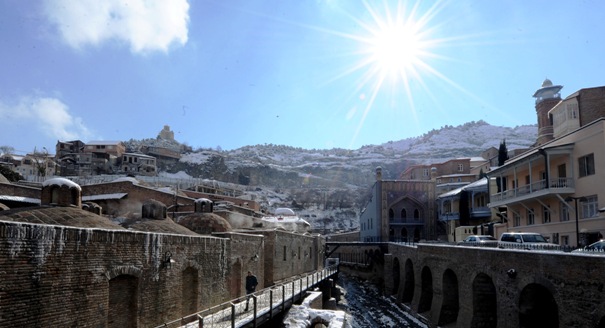
After coming to power, GD comprehensively undid much of the previous UNM government’s economic policies. Contrary to the UNM’s carefully-cultivated international image as a standard-bearer for libertarian economics, it had actually long become accustomed to driving growth through heavy state spending and various economic interventions. Often leveraging foreign direct investment (FDI) and big aid packages from the West, the UNM government presided over a building boom that transformed the capital and centrally planned sites in the regions. Though much of the country remained mired in poverty, state attention yielded radical physical redevelopment in key areas of the country, such as Tbilisi, the balmy Black Sea city of Batumi, the hilltop town of Sighnaghi, and even the beginnings of an unfulfilled plan for a greenfield city called Lazika—to name a few.
The new government came into power with the view that many of these projects, often shrouded in varying layers of opacity, were oftentimes wasteful and at worst corrupt. After coming to power, GD cancelled or paused a number of projects, which resulted in a significant reduction in capital spending. Instead, the GD government focused its attentions to social welfare in 2013—pensions were raised and a comprehensive healthcare system was established. But the practical effects of curtailing state spending almost certainly contributed to reduced economic growth. Meanwhile, bruising political cohabitation between GD and the UNM, which retained the presidency for much of last year, cast a cloud over Georgia’s long-term stability. With a presidential poll set for October 2013, the risk of political upheaval was a legitimate economic concern.
Yet following a successful presidential election, preliminary data shows a fourth quarter 6.9 percent spike in growth, and especially in November and December at 8 percent and 8.4 percent, respectively. On its face, this suggests that the markets responded to signs of long-sought political stability after the generally well-ordered election, a renewed political mandate for GD (its candidate, Giorgi Margvelashvili, won in a landslide), and the prospect of no major national election in the near term.
The election also coincided with GD’s newfound willingness to commit to state spending. The Georgian Partnership Fund, an initiative launched by the UNM to attract FDI, has been reorganized under the new government as a more conventional sovereign wealth fund and recapitalized to the tune of some $4.3 billion. Simultaneously, former Prime Minister Bidzina Ivanishvili has joined with a group of international investors to launch the Georgian Co-Investment Fund (GCF), a massive $6 billion private equity fund to leverage foreign investments and promote economic development. Though there have been concerns about the influential ex-premier’s involvement, perhaps due in part to the previous government’s apparently tight nexus between business and political interests, GCF CEO George Bachiashvili has reported that Ivanishvili involvement is that of a passive investor. Reportedly, hydropower, tourism, transport, and other infrastructure projects have already benefited from the government’s growing comfort with capital investment spending.
The Georgian government has estimated GDP growth for 2014 at a relatively modest 5 percent while the IMF has been a little more sanguine at 6 percent. Yet with signs of a stabler political climate and growing investments facilitated by two big funds (and cheerful tourism numbers), it’s not out of the question that 2014 could see the formal estimates topped and the return of the “Caucasian tiger.”
Michael Hikari Cecire is an associate scholar at the Foreign Policy Research Institute's Project on Democratic Transitions. He is also a former economic development practitioner.