

Commentary
Judy Dempsey
{
  "authors": [
    "Judy Dempsey"
  ],
  "type": "legacyinthemedia",
  "centerAffiliationAll": "dc",
  "centers": [
    "Carnegie Endowment for International Peace",
    "Carnegie Europe"
  ],
  "collections": [],
  "englishNewsletterAll": "ctw",
  "nonEnglishNewsletterAll": "",
  "primaryCenter": "Carnegie Europe",
  "programAffiliation": "EP",
  "programs": [
    "Europe"
  ],
  "projects": [],
  "regions": [
    "Europe",
    "Western Europe",
    "Iran"
  ],
  "topics": [
    "Foreign Policy",
    "EU",
    "Democracy"
  ]
}
Source: Getty
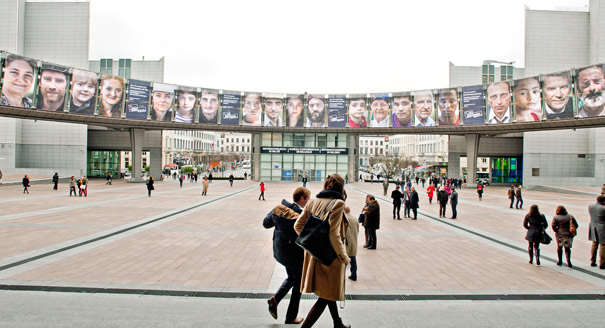
The EU heads to the polls to elect a new European Parliament in a process that, for the first time, will partly influence who becomes the next European Commission president.
Source: Council on Foreign Relations
Millions of voters from twenty-eight member states will take part in the European Parliament elections this week, a process that, for the first time, will partly influence who becomes the next EU chief. Judy Dempsey, an expert on European politics at Carnegie, says that it's been roughly two decades since the EU had a formidable Commission president that could hold sway with the various member states. She says this seems unlikely to change: "At the end of the day, it will be the leaders of the big European countries that will do the backroom deals." Meanwhile, Dempsey says that significant victories for far right or far left parties, which many are anticipating, could install a parliament with "a shrilled anti-American tone, more scepticism regarding the Transatlantic Trade and Investment Partnership (TTIP), and a more restrictive policy with regard to immigrant and human rights."
The two main front-runners are Jean-Claude Juncker, the former prime minister of Luxembourg, who is supported by the conservative grouping of the European People's Party, and Martin Schulz, a German politician and the current president of the European Parliament, supported by the European Parliament's Socialist grouping.
A caveat: Even if either candidate's party manages to get the most votes, there will be a lot of horse-trading between the member states as to who will become Commission president. Much depends on the composition of the next European Parliament. It may be a hung parliament, or it may be a parliament consisting of very different alliances. At the end of the day, it will be the leaders of the big European countries that will do the backroom deals.
The leaders of the EU countries have immense power, particularly German chancellor Angela Merkel. That being said, so much depends on the personality and confidence of the president of the Commission. It has been a long time since the EU had a president that could hold sway over the member states. The last was Jacques Delors (EC president 1985–1994). Since then, the Commission presidents have been generally weak and often beholden to the member states. There is a consensus that the outgoing president, José Manuel Barroso, has been very disappointing. But then it was Germany and France who supported his candidacy; neither Berlin nor Paris wanted a very strong Commission president who could challenge their own national interests.
By the way, don't forget you can have very strong commissioners. The trade and competition commissioners have immense executive powers. Those two have been crucial in giving Europe a big influence when it comes to defending trade and competition policies. And they have worked hard in trying to negotiate TTIP.
The turnout continues to decline. This time around, the recent economic crisis has fed into this sense of disillusionment with Europe and boosted eurosceptic parties across the continent. The two most prominent are Britain's UK Independence Party (UKIP) and France's Front National.
But it must be said too that the mainstream parties standing for the European Parliament have not done the kind of grassroots campaigning necessary to defend Europe. In contrast, the nationalist/populist and fringe parties are exploiting this weakness with their own high-profile campaigning. They are well organized and highly motivated, and they are able to sell a very clear message.
There is a huge disconnect, even though European Parliament deputies keep vowing to bridge this gap even through basic electioneering. This has not happened.
If the fringe parties do well, it could lead to paralysis in the European Parliament. It could also lead to shifting alliances. If—and it's a big if—these fringe parties, left or right, could establish a united front in the parliament, then we could expect a shrilled anti-American tone, more scepticism over agreeing to TTIP, and a more restrictive policy with regard to immigrant and human rights.
Indeed, the European Parliament still lacks legitimacy. Voters across Europe cannot vote for Juncker or Schulz. Pan-European candidates do not exist. Voters can only vote for their own national list; or if they are living and registered in another EU country, they have to choose whether they will vote for the candidates in that country or their own country. Clearly, the gap between European citizens would narrow if there were genuine, pan-European political parties, and if the European Commission president was directly elected.
The Ukraine crisis has in fact exposed deep divisions in the EU over security and foreign policy. A real discussion about Europe's security and foreign policy has yet to begin. The outgoing European Parliament did some excellent analyses on the weaknesses of European foreign policy. But it relies on the member states to make that essential difference when it comes to giving the EU a serious foreign, security, and defense dimension. NATO in fact has been setting the agenda on security issues. Even then, the western European members of NATO cannot agree about deploying troops on a permanent basis to the eastern European members of NATO.
For many of these fringe parties, they find Putin's conservatism, his opposition to the so-called decadent West, and his anti-Americanism and anti-NATO stance appealing.
This interview was originally published by the Council on Foreign Relations.

Nonresident Senior Fellow, Carnegie Europe
Judy Dempsey is a nonresident senior fellow at Carnegie Europe
Recent Work
Judy Dempsey
Judy Dempsey
Carnegie does not take institutional positions on public policy issues; the views represented herein are those of the author(s) and do not necessarily reflect the views of Carnegie, its staff, or its trustees.

Despite a new textbook, an influx of Russian teachers and managers, and an end to the teaching of Ukrainian, the Kremlin is unlikely to have “reprogrammed” locals.

Konstantin Skorkin
Fatima El Mansouri is the country’s first female prime minister. She’s also a privileged insider in a largely ceremonial position.

Sarah Yerkes

The acknowledgment has sparked fears of a new arms race with China and Russia.

Chris O’Meara
Smaller powers cannot go it alone, but Canadian history shows that integration with the United States will not always be benign.
Paul Samson

The European Commissioner for Trade is headed to China. But after President Xi’s bridge-building visit to Washington, can a more isolated EU overcome Beijing’s stranglehold on critical raw materials? Who will blink first?

Rym Momtaz, ed.