

Article
Wang Tao
{
  "authors": [
    "Wang Tao"
  ],
  "type": "legacyinthemedia",
  "centerAffiliationAll": "",
  "centers": [
    "Carnegie Endowment for International Peace",
    "Carnegie China"
  ],
  "collections": [
    "China’s Foreign Relations"
  ],
  "englishNewsletterAll": "",
  "nonEnglishNewsletterAll": "",
  "primaryCenter": "Carnegie China",
  "programAffiliation": "",
  "programs": [],
  "projects": [],
  "regions": [
    "East Asia",
    "China",
    "Central Asia"
  ],
  "topics": [
    "Climate Change"
  ]
}
Source: Getty
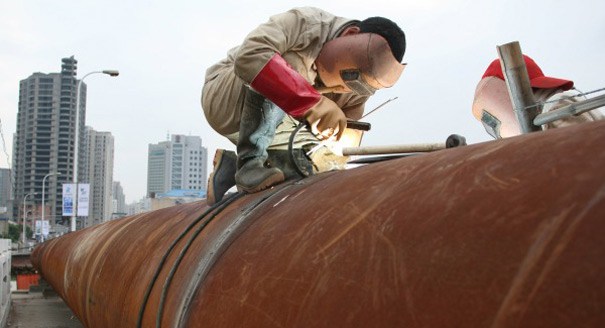
While China has great ambitions in clean energy, the country is still a long way off from transitioning the majority of its power source to renewables.
Source: CCTV English
Speaking on CCTV, Carnegie’s Wang Tao explained that the recent gas deal struck between China and Russia has been met with much excitement. However, until this deal is enacted, the pipeline from Central Asia to China will remain China's only source of imported national gas.
While China has great ambitions in clean energy, the country is still a long way off from transitioning the majority of its power source to renewables, he added. He said that natural gas remains the much more flexible and cheaper energy source and can serve as a transition between China's coal reliance and a greener future.

Former Nonresident Scholar, Carnegie-Tsinghua Center for Global Policy
Wang Tao was a nonresident scholar in the Energy and Climate Program based at the Carnegie–Tsinghua Center for Global Policy.
Recent Work
Wang Tao
Wang Tao, Yang Yifang
Carnegie does not take institutional positions on public policy issues; the views represented herein are those of the author(s) and do not necessarily reflect the views of Carnegie, its staff, or its trustees.

China’s banking crisis in the 2000s was resolved by transferring the costs to households through financial repression—a decision that recapitalized the banks while exacerbating the structural imbalances that continue to shape the Chinese economy today.

Michael Pettis

Japan’s revision of its three strategic documents reflects an intention to keep the United States engaged in the region while Japan fills any vacuums of U.S. power to preserve the Indo-Pacific order.

Ryo Sahashi

Chinese biotech companies have been on the receiving end of U.S. economic coercion. Yet their responses have differed significantly because firm and state interests are not uniformly aligned. For Washington, treating all Chinese tech firms the same, irrespective of their actual interests, risks pushing them farther into Beijing’s corner.

Xue Gong
Over the past decade, China has moved from marginal player to major producer of all things batteries. The United States, Europe, and others are aiming to balance the market.

Milo McBride
Investments in a climate-friendly cooling system known as geothermal district cooling will help rapidly urbanizing societies resist dangerous heat indexes.

Daevan Mangalmurti, Debbra Goh, Milo McBride