

Commentary
Dmitri Trenin
{
  "authors": [
    "Dmitri Trenin"
  ],
  "type": "commentary",
  "centerAffiliationAll": "",
  "centers": [
    "Carnegie Endowment for International Peace",
    "Carnegie Russia Eurasia Center"
  ],
  "collections": [],
  "englishNewsletterAll": "",
  "nonEnglishNewsletterAll": "",
  "primaryCenter": "Carnegie Russia Eurasia Center",
  "programAffiliation": "",
  "programs": [],
  "projects": [],
  "regions": [
    "Russia"
  ],
  "topics": [
    "Security",
    "Foreign Policy"
  ]
}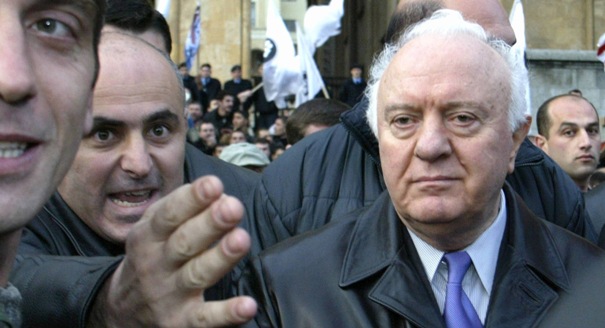
Source: Getty
President Shevardnadze belongs to the people of Georgia. At the same time, Foreign Minister Shevardnadze will forever remain a major figure in Russia’s history, because he helped wind down the Cold War.
President Eduard Shevardnadze belongs to the people of Georgia. Foreign Minister Shevardnadze will forever remain a major figure in Russia’s history. A controversial figure, no doubt, but one that certainly commands respect. In the powerful duo with Mikhail Gorbachev, and in partnership with U.S. and other western leaders, Shevardnadze helped wind down the Cold War. Thus, they did a great service to humanity as a whole, and to those living in the former Soviet Union. We need not ignore the simple fact that among the alternatives to the Cold War there was not only the peace order that some have later come to detest, but a real war directly involving the United States and the Soviet Union. That now, despite the very real U.S.-Russian confrontation over Ukraine, there is no talk—and no likelihood—of a nuclear exchange between Moscow and Washington is also to Shevardnadze’s credit.
This does not mean that Foreign Minister Shevardnadze made no mistakes. Like Gorbachev, he was overly enthusiastic about their “new thinking,” and overly optimistic about the future of relations with the West. The end of the Cold War must have seemed to him the end of history, which of course it was not. The binary construct of the era of confrontation—friend or foe—demanded turning foes into friends, a conversion which proved far from fully satisfactory. “Universal interests of humankind” were not given a proper place among the various echelons of Moscow’s foreign policy, but instead appeared to overshadow the country’s specific national interests. Against that background, the charges that are usually brought against Shevardnadze by his critics, from banning the Oka missile to the Bering Sea settlement, should be seriously discussed by foreign policy historians. Luckily, they have so much more access to the papers of the Gorbachev presidency than of the periods that have followed.
Former Director, Carnegie Moscow Center
Trenin was director of the Carnegie Moscow Center from 2008 to early 2022.
Recent Work
Dmitri Trenin
Dmitri Trenin
Carnegie does not take institutional positions on public policy issues; the views represented herein are those of the author(s) and do not necessarily reflect the views of Carnegie, its staff, or its trustees.

Understanding the climatic pain points is necessary for policymakers hoping to minimize the war’s negative environmental consequences.



Alejandro Martin Rodriguez, Joy Arkeh, Sarah Yerkes

The books, podcasts, and films that explain the world it made.

Andrew Leber
Blurring the line between humans and animals is a long-standing tradition in social utopian prose. In his latest novel, Leonid Bershidsky reminds us that in social experiments, people are often treated no differently than animals.

Alexander Baunov

U.S. trading partners in Asia are closely watching the dispute for signs of how it may affect their own interests.

Barbara Weisel

The aftermath of the Ceuta crisis shows Europe has drawn the wrong lessons. Rather than doubling down on failed migration policies, the EU needs to address the underlying roots of such episodes.

Richard Youngs