

In The Media
David Rothkopf
{
  "authors": [
    "David Rothkopf"
  ],
  "type": "legacyinthemedia",
  "centerAffiliationAll": "",
  "centers": [
    "Carnegie Endowment for International Peace"
  ],
  "collections": [],
  "englishNewsletterAll": "",
  "nonEnglishNewsletterAll": "",
  "primaryCenter": "Carnegie Endowment for International Peace",
  "programAffiliation": "",
  "programs": [],
  "projects": [],
  "regions": [
    "Russia",
    "Eastern Europe",
    "Ukraine",
    "Western Europe",
    "Germany"
  ],
  "topics": [
    "Political Reform",
    "Security",
    "Foreign Policy",
    "Global Governance"
  ]
}
Source: Getty
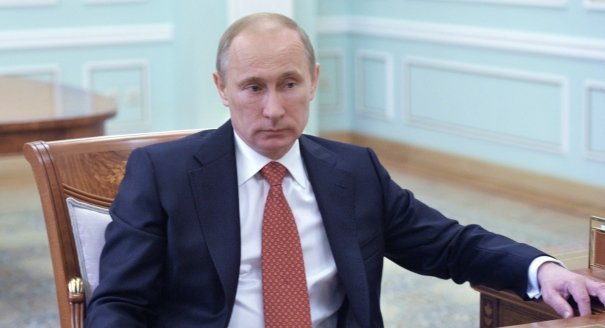
Putin is a distraction with which NATO is ill-prepared to deal.
Source: CNN
President Obama's favorite television shows include "House of Cards" and "Mad Men." One can imagine that when his Russian counterpart Vladimir Putin wants to kick back and relax, all he will need to do is turn on the nightly news and watch the latest reports from the NATO Summit in Wales.
Putin can listen as NATO leaders roll out the latest iteration of their bold responses to his annexation of Crimea and his invasion of Ukraine.Imagine how he'll be tickled as NATO leaders fall all over themselves trying to find ways to refer to his sending Russian troops into a neighboring country without actually calling it an invasion.
Imagine him, no doubt lying shirtless on a polar bear skin that he single-handedly separated from its original owner, laughing as NATO unveils the stockpile of strong adjectives that have been its principle weapons in containing the Kremlin's aggression.
Then, as NATO's Secretary General Anders Fogh Rasmussen rolls out what they call in the political biz "the big deliverable" of the summit -- a Readiness Action Plan that will make 4,000 troops available within two days of a Russian incursion into a member state -- one can only hope that Kremlin doctors are standing by, because Putin could injure himself laughing.
First of all, NATO members are already supposed to be guaranteed protection by virtue of their very membership. One would imagine that each had in mind something considerably more robust and more rapid than this middling unit the alliance has dreamed up.
This is little more than a tepid response gesture, a sign not of strength, but one that shows how the world's most powerful alliance is now utterly adrift.
There will be many speeches suggesting that NATO is re-energized by Putin's threat. There will be lots of self-congratulations on the effectiveness of economic sanctions levied against the Russians. There will be talk of new mega-sanctions that will really keep them in line. But Putin will sit there watching, perhaps munching on pieces of deep fried Siberian tiger that he killed with his bare hands, as he contemplates that everything he wanted he got, and that all he wants he can get -- at a low, low price.
No one even discusses whether Putin can keep Crimea, which he claimed without a shot being fired. Whether he ultimately annexes Eastern Ukraine or simply drives home the message that it has deep ties to Russia and that Moscow will expect to be consulted regarding its fate, he knows he is in the negotiating position of strength.
He knows for two reasons. First, he sees that neither the United States nor its European allies have much appetite to stand up to him. Time after time as he tested them -- in Georgia, in Ukraine, in Syria -- they grumbled and then blinked. They are too self-absorbed and caught up in domestic problems. And frankly, they don't care that much about Georgia or Ukraine or Syria.
Also, he has discovered that NATO and the West are designed to confront extreme threats, not the moderate, incremental, creeping gains he has achieved. NATO effectively has two settings when it comes to aggression in Europe's east: off and global thermonuclear war. He has worked the middle ground and the lack of resolve of his opponents with considerable skill. He also knows the truth. He is merely toying at the periphery of NATO and frankly, rhetoric aside, he is no threat to regions deeper into Europe.
Putin is a distraction with which NATO is ill-prepared to deal. It faces much greater threats: The spread of Islamic extremism is destabilizing the world from Africa to Asia. Although NATO is equally ill at ease in confronting that deepening crisis, with extremist foreign fighters passing through or hailing from NATO member states, it faces an even bigger crisis from within: a leadership void. The European Union lacks the will, the culture and the institutional mechanisms to make real unified foreign policy. The United States is in a moment of seeming confusion about its role in the world. The revitalization of the alliance everyone is calling for is a good idea, urgently needed, but there are few signs it is really on the horizon.
As a consequence, Putin can watch the NATO show and enjoy it for what it is: a diversion. The rhetoric might get heated. Some might suggest that he, for all his cool calculation and his so far effective gambits, is the mad man in this scenario. But watching the current version of this superannuated, divided, leaderless alliance, he knows that when it comes to standing up to him in Ukraine, NATO is the house of cards.
Former Visiting Scholar
David Rothkopf was a visiting scholar at the Carnegie Endowment as well as the former CEO and editor in chief of the FP Group.
Recent Work
David Rothkopf
David Rothkopf
Carnegie does not take institutional positions on public policy issues; the views represented herein are those of the author(s) and do not necessarily reflect the views of Carnegie, its staff, or its trustees.
A leak of Russian gas price data helps establish that China is paying Russia far less than Central Asian countries and Gazprom’s former European customers.

Sergey Vakulenko

China’s political future will be shaped between now and next October. As the Communist Party enters its intense “campaign season” to prepare for a major political transition in 2027, reading Beijing's actions and responses may become more difficult as domestic politics weigh on its behavior more than usual.

Damien Ma

The EU can impose sanctions but struggles to enforce them without the United States. With Washington increasingly disinterested in backing European interests, the bloc must now fend for itself.


Nicu Popescu, Tiago Antunes
Global and rising powers will need to engage with Africa’s priorities and agency in order to secure the continent’s increasingly attractive partnerships.
Fonteh Akum

Rubio’s recent visit brought welcome attention, but more capital requires governance changes that may be a hard sell for regional governments.

Jennifer B. Murtazashvili