

Article
Frederic Grare
{
  "authors": [
    "Frederic Grare"
  ],
  "type": "legacyinthemedia",
  "centerAffiliationAll": "dc",
  "centers": [
    "Carnegie Endowment for International Peace"
  ],
  "collections": [],
  "englishNewsletterAll": "ctw",
  "nonEnglishNewsletterAll": "",
  "primaryCenter": "Carnegie Endowment for International Peace",
  "programAffiliation": "SAP",
  "programs": [
    "South Asia"
  ],
  "projects": [],
  "regions": [
    "South Asia",
    "Pakistan"
  ],
  "topics": [
    "Political Reform",
    "Security",
    "Military"
  ]
}
Source: Getty
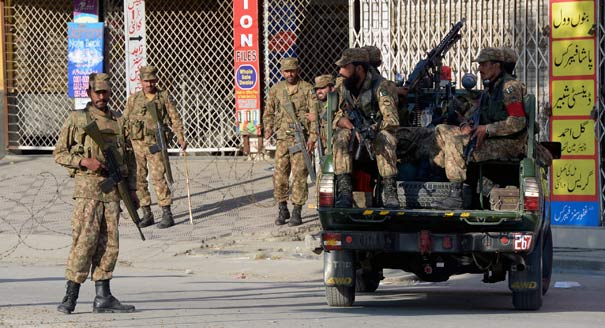
December’s attack on a Peshawar school by the Pakistani Taliban has sparked a public backlash. But the fight will be undermined by the state’s ambivalence toward jihadi movements.
Source: Tony Blair Faith Foundation
The murder of some 145 people (including 132 children) in a Peshawar school on 16 December 2014 was a brutal reminder of the challenges facing the ongoing counter-terrorist operations on the Afghan-Pakistani border. But it also highlights the persistent ambivalence of the security establishment and some parts of Pakistani society toward terrorism.
In the aftermath of the massacre, the Pakistani army escalated its air strikes. The political class was unanimous in their condemnation of the attack and the Prime Minister declared that Pakistan would no longer differentiate between "good and bad Taliban". The military's determination to avenge the killing of the Peshawar students—most of whom had parents within the Pakistani armed forces—may temporarily convey the impression that support for terrorism is no longer acceptable, but questions persist about the objectives of the current offensive beyond eliminating those militants unwilling to support military foreign policy objectives and who instead target the Pakistani state.The resolve of the Pakistani military to eradicate terrorism remains selective.
The Taliban justified the attack as retaliation for Zarb-e-Azb, the military offensive against various militant groups in the North Waziristan tribal region. Since its launch on 15 June 2014 in the wake of the an attack on Jinnah International Airport at Karachi, more than 1,100 militants have been killed. Some analysts have seen it as the beginnings of a fragmentation of the militancy in North Waziristan. Yet despite initial successes, the campaign has so far failed to eradicate the region's jihadi groups. More importantly, Zarb-e-Azb suffers from a fundamental flaw: the resolve of the Pakistani military to eradicate terrorism remains as selective as it has ever been.Officially at least, operation Zarb-e-Azb targeted movements such as the Tehreek-e-Taliban Pakistan (TTP) and the Islamic Movement of Uzbekistan (IMU)—both of which claimed responsibility for the attack on Karachi International Airport—as well as the Lashkar-e-Jhangvi, Jundullah, al-Qaeda, and the East Turkestan Islamic Movement (ETIM). Seven months after the beginning of the offensive, it seems obvious that the operation reflected the political and diplomatic needs of the moment. For example, one of the targets – the Haqqani network – has allegedly been displaced by the army to another part of the country. But the killing of two al-Qaeda leaders about 10 days before the Peshawar attack raises interesting questions about Pakistani objectives.
Adnan Shukrijumah, believed to have been al-Qaeda's external operations chief, was killed in South Waziristan in a Pakistani army raid. The FBI had placed a five million dollar bounty on Shukrijumah's head for recruiting three men in 2008 to receive training in Pakistan with the intention of bombing the New York City subway system. His "neutralisation" by the Pakistani army was therefore a useful contribution to its current effort to restore relations with Washington amid fears that the US withdrawal from Afghanistan and US fatigue vis-à-vis Pakistan could mean a substantial decrease of U.S. assistance to the country.
In contrast, Umar Farooq, allegedly the al-Qaeda spokesman for South Asia, was killed in a US drone strike together with other militants from the Hafiz Gul Bahadur Group, a Taliban faction supported by the Pakistani state and which distanced itself from the TTP. This support casts doubt both on the validity of the government's distinction between 'good' and 'bad' militants and about the extent of the Pakistani commitment to counter-terrorism.
Several factors indicate that the current consensus against the massacre may not extend to a condemnation of the perpetrators. As reported by a former Pakistani ambassador to the US Hussain Haqqani, leaders of various religious and political factions refused to condemn the Taliban by name.
Hafiz Muhammed Saeed, the leader of Lashkar-e-Taiba (LeT) and a protégé of the Pakistani security establishment, went on television to vow revenge against India, which he blamed for the Taliban attack. That somebody like the LeT leader may proffer such insanities publicly should surprise no one. But that in the current security context he may not face any consequences for it does not inspire confidence in the motivations of his sponsors.The Pakistani public is no longer willing to tolerate the quasi-impunity of militant groups.
Several additional factors may impact the effectiveness of Pakistani counter-terrorist operations. On the positive side, a substantial part of the Pakistani public, angry and fearful, is no longer willing to tolerate the quasi-impunity with which militant organisations and their supporters have been operating. In Islamabad, protesters surrounded the Red Mosque after its leader, Maulana Abdul Aziz, refused to condemn the Peshawar attack. The army also seems to expect greater cooperation from its Afghan counterpart to prevent movement across the border. Raheel Sharif, the Chief of Army Staff, flew to Kabul the day following the attack as intelligence indicated that the TTP had been operating from Afghanistan. However, this cooperation will depend on the sustainability of the current improvement in the bilateral relationship.
On the negative side, there is little doubt that the growing "competition" between terrorist groups, in particular with ISIS, is likely to increase the resolve of the TTP. But the main obstacle to eventual success remains the refusal of the security establishment to definitively part with the use of Islamist proxies.
This article was originally published by the Tony Blair Faith Foundation.

Former Nonresident Senior Fellow, South Asia Program
Frédéric Grare was a nonresident senior fellow at the Carnegie Endowment for International Peace, where his research focuses on Indo-Pacific dynamics, the search for a security architecture, and South Asia Security issues.
Recent Work
Frederic Grare
Frederic Grare
Carnegie does not take institutional positions on public policy issues; the views represented herein are those of the author(s) and do not necessarily reflect the views of Carnegie, its staff, or its trustees.

The books, podcasts, and films that explain the world it made.

Andrew Leber

In the tenth year of his presidency, President Mirziyoyev’s system is becoming even more personalized than that of his predecessor Karimov.

Galiya Ibragimova

With the growth in points of friction between the great powers, organizations like the SCO will continue to play a role in the strategic adaptation of the smaller powers caught between them.

Temur Umarov

Amid celebrations of bilateral ties was a deeper focus on stability in the Middle East.

Amr Hamzawy
Moscow is testing Europe’s defenses with drone incursions and could decide to use drones against the continent on a much larger scale once the war in Ukraine pauses. European countries will need Kyiv to help them prepare for such a possibility.
Pavlo Zvenyhorodskyi