

Book
Europe is facing rising populism internally as well as external pressures from Russia, China, Turkey, and the United States.
Dimitar Bechev
{
  "authors": [
    "Eugene Rumer",
    "Thomas Graham"
  ],
  "type": "legacyinthemedia",
  "centerAffiliationAll": "dc",
  "centers": [
    "Carnegie Endowment for International Peace",
    "Carnegie Russia Eurasia Center"
  ],
  "collections": [],
  "englishNewsletterAll": "ctw",
  "nonEnglishNewsletterAll": "",
  "primaryCenter": "Carnegie Endowment for International Peace",
  "programAffiliation": "russia",
  "programs": [
    "Russia and Eurasia"
  ],
  "projects": [],
  "regions": [
    "North America",
    "United States",
    "Russia",
    "Eastern Europe",
    "Ukraine"
  ],
  "topics": [
    "Security",
    "Military",
    "Foreign Policy"
  ]
}
Source: Getty
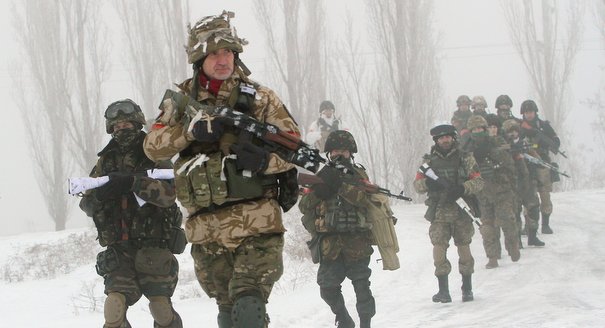
Sending weapons to Ukraine could prolong the country’s agony and distract it from the vital task of reconstruction.
Source: Financial Times
The logic is misguided, but it is easy enough to grasp. Ukraine’s poorly equipped army cannot on its own inflict enough pain on the Russian-backed separatist insurgency to force an effective ceasefire that might lead to a negotiated truce. So America should help by sending defensive weapons, and some lethal ones too. Once body bags start arriving in Russian towns (the theory goes) President Vladimir Putin will relent, fearing a backlash from a public already unnerved by soaring inflation.
This is the case made by a group of former senior US officials, and it is reportedly being discussed within the Obama administration. It is, however, deeply mistaken. Intended to help a stricken country, it could instead prolong Ukraine’s agony and distract it from the vital task of reconstruction. It is highly unlikely to knock Mr Putin off his destructive course. And it would bring the US a step closer to direct military confrontation with Russia.Russians support Mr Putin. The Kremlin has blamed the economic crisis on western sanctions, and it will blame military casualties on the west, too. There is nothing to suggest that Russians do not believe the Kremlin narrative. They are unlikely to abandon Mr Putin in his struggle against the west.
There are practical questions, too. It is pointless to send weapons to troops not trained in their use. Will the US and its allies send trainers to eastern Ukraine? If they do, they will be sending Americans into a war zone with Russia as the enemy. It will be hard to pretend then that the US is not a party to the conflict. What, realistically, are the chances of making sure that only regular Ukrainian troops, and not private militias, have access to western-supplied weapons? If a western non-combatant in uniform is captured by the separatists, does the US try to rescue them? Mark Bowden’s Black Hawk Down chronicled the perils of such an operation in downtown Mogadishu. Imagine what could happen 10 miles from the Russian border, in an area controlled by Russian personnel.
Finally, imagine the response. What do we do if Russia continues to escalate the conflict? Or if the Kremlin launches a cyber attack against an American financial institution, destroying data about asset ownership? Does America then inch closer towards war?
It is not a kindness to kindle unrealistic hopes. Of course Ukraine is a victim of aggression. But, short of a campaign like that fought by the US and its allies in the Balkans in the 1990s — which no one now advocates — no amount of US or Nato assistance can alter the fact that Russia has the upper hand. In August, and again in January, Mr Putin chose to escalate rather than allow the separatists to be defeated. Ukraine will need help rebuilding its army, and the US should provide it. But it will take years, and cannot be done in the middle of a war with a more powerful neighbour.
In contrast to this bold proposal to send arms to Ukraine, western economic assistance for the country has so far been timid. The US has promised $3bn in loan guarantees, a fraction of the tens of billions the country needs. In part, that is because Washington still suspects rampant corruption in Kiev. Will the military function better than the government it serves?
Ukraine cannot win this conflict now. It must be frozen. Ukraine’s leaders should be told as much. It will deepen the tragedy if soldiers are sent to fight a hopeless battle. A free and independent Ukraine, a solid defence of the European order and a firm rebuff of Russian aggression are worthy goals. But they do not absolve us of our responsibility to consider the consequences of our actions. The current proposal to arm Ukraine does not meet that standard.
This article was originally published in the Financial Times.
Director and Senior Fellow, Russia and Eurasia Program
Rumer, a former national intelligence officer for Russia and Eurasia at the U.S. National Intelligence Council, is a senior fellow and the director of Carnegie’s Russia and Eurasia Program.
Thomas Graham
Carnegie does not take institutional positions on public policy issues; the views represented herein are those of the author(s) and do not necessarily reflect the views of Carnegie, its staff, or its trustees.

Europe is facing rising populism internally as well as external pressures from Russia, China, Turkey, and the United States.

Dimitar Bechev

Much has been said of the changes Brussels is trying to make to the EU enlargement process. Here’s why gradual integration might—or might not—be the answer.
Dimitar Bechev

Economic recovery has brought Sri Lanka a modicum of stability, but domestic strains and great-power rivalry could test how long it lasts.

Avinash Paliwal

Despite a new textbook, an influx of Russian teachers and managers, and an end to the teaching of Ukrainian, the Kremlin is unlikely to have “reprogrammed” locals.

Konstantin Skorkin

For every ruble allocated to social policy, health, and education in 2027, double that amount is earmarked for the army, the police, and the security services.

Alexandra Prokopenko