Over the last twelve months, Ukraine has seen a revolution, two invasions, two nationwide elections, and two tenuous peace agreements. Though the country’s economy is in tatters and, according to a recent poll, over half of all Ukrainians believe a “third Maidan” is likely, there are still plenty of reasons to be optimistic about Ukraine’s future.
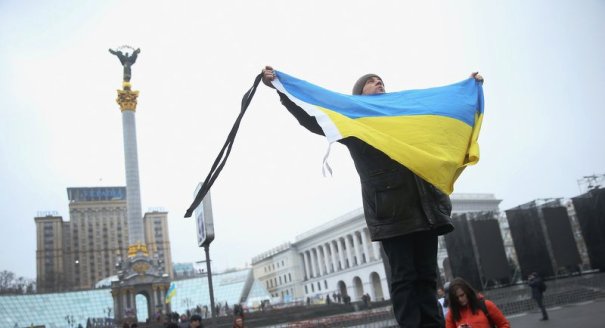
The loss of Crimea and large portions of Donbas has coincided with the emergence of a distinct Ukrainian national identity: a record 90 percent of Ukrainians support the country’s independence. This level of support suggests that Ukraine is finally making a true departure from its Russian and Soviet past. For the first time, the Communist Party holds no seats in the national parliament. Nostalgia for the Soviet Union has also decreased significantly.
Patriotic sentiment has risen even as Ukraine spirals toward a possible default and economic meltdown. Inflation is nearing 30 percent, and the hryvnia has lost two thirds of its value since the beginning of the year. Though the IMF has announced staff-level agreement on an ambitious long-term loan package, the worsening security situation is creating doubts about the program’s viability ahead of a planned vote of the full board.
This newfound patriotism may be responsible for a growing consensus on the necessity of reform. The most zealous proponents of reforms in Ukraine are now not only its Western cheerleaders, but Ukraine’s own citizens. In Kyiv and elsewhere, there is an understanding that the state will collapse if it does not reform.
Despite the country’s financial woes, more than 40 percent of Ukrainians are willing to endure economic troubles for at least another one year if they ultimately lead to future improvements in the standard of living. Paradoxically, the war in the east has given the government in Kyiv some breathing room, diverting attention from the economic crisis. The population has tolerated serious delays in the implementation of reforms because it attributes the hold-up the ongoing conflict in Donbas. (The unanswered question, of course, is whether the Poroshenko-Yatseniuk government is serious about delivering on these hopes.)
Generational change may accelerate the reform process, even though little headway has been made thus far: 32 percent of candidates who participated in the last parliamentary elections were under 35. Many of the most well-known fresh faces in government are articulating a new vision for Ukraine, which is focused on Brussels, not Moscow.
Despite the flood of patriotism that has spread throughout Ukraine over the last year, nationalist and far-right ideas do not play a dominant role in Ukrainian society. Nationalist parties failed to cross the threshold in party list voting for entry into the Verkhovna Rada in the most recent parliamentary elections. (Praviy Sektor’s Dmytro Yarosh is now a Rada deputy, having won a seat in a single mandate district.)
Though Russian officials and some Western analysts have focused attention on the Ukrainian government’s failure to implement protections for the Russian-speaking minority, there is little evidence that Russian speakers have faced discrimination or other types of pressure since the new government took power in early 2014. Five cabinet ministers who served in the post-revolutionary government were actually born in Russia. Speaking Russian and at the same time objecting to Russia’s aggression in Ukraine is a common practice. Language use is not a bar to being a patriotic citizen.
In the short term, Ukraine is on the verge of economic and, perhaps, political collapse. Yet in the longer term, the real question is whether the emergence of a coherent Ukrainian national identity creates a solid consensus for reform of the state and a sustained Western trajectory.
Alyona Getmanchuk is the director of the Institute for World Policy, a Kyiv-based think tank.