

Article
C. Raja Mohan, Darshana M. Baruah
{
  "authors": [
    "C. Raja Mohan"
  ],
  "type": "legacyinthemedia",
  "centerAffiliationAll": "dc",
  "centers": [
    "Carnegie Endowment for International Peace",
    "Carnegie India"
  ],
  "collections": [],
  "englishNewsletterAll": "ctw",
  "nonEnglishNewsletterAll": "",
  "primaryCenter": "Carnegie India",
  "programAffiliation": "SAP",
  "programs": [
    "South Asia"
  ],
  "projects": [],
  "regions": [
    "South Asia",
    "India",
    "East Asia",
    "China"
  ],
  "topics": [
    "Foreign Policy"
  ]
}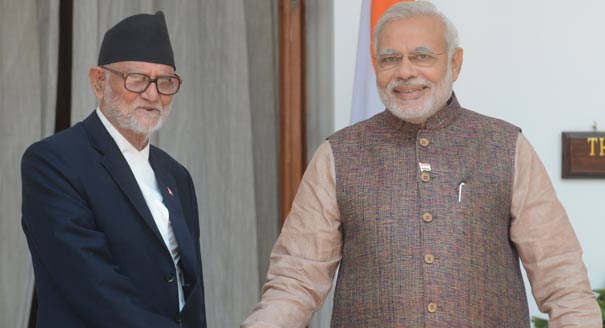
Source: Getty
Although Kathmandu is currently being flooded with media and relief teams from around the world, the cameras will soon leave Nepal. But India must stick around for the long haul.
Source: Indian Express
New Delhi did well to respond decisively when tragedy struck Nepal. But India is at the very beginning of a long and demanding process of delivering relief to victims, assisting their rehabilitation and contributing to the reconstruction of Nepal. While Kathmandu is now being flooded with media and relief teams from around the world, the cameras will soon leave Nepal. The world’s attention will turn to the next crisis. But India must stick around for the long haul.
Geographic proximity, cultural intimacy and economic interdependence means Nepal’s problems are also India’s. Prime Minister Narendra Modi is aware of this reality and has devoted special attention to revitalising ties after he took charge as PM. Nepal is the only country Modi has visited twice. On both occasions, he underlined the unique bond between the two countries.
If there was a moment to lend substance to the claim that the neighbourhood ranks first in India’s foreign policy, it is now and in Nepal. Signalling goodwill is easy, as Modi did immediately. He must now follow through and initiate a comprehensive strategy to support Nepal’s rapid recovery. This will involve a significant commitment of resources. Even more important is a credible long-term strategy for Indian participation in Nepal’s efforts to rise from the rubble. Central to that is the political recognition that any framework for external assistance must be supportive of, but subordinate to, the initiatives of the Nepali people.It is a matter of time before politics intrudes on the management of the aftermath. Delhi must be acutely conscious of two pitfalls. The Indian government must avoid any real or seeming violation of Nepal’s sovereignty. In humanitarian assistance and disaster relief, India has insisted on absolute respect for the host government. It should not forget that principle. Most political elites are touchy about external assistance during a national calamity. The political classes in Kathmandu are even touchier, especially when it comes to India’s role. India has much goodwill among Nepal’s people. But Delhi could easily squander it by being politically insensitive.
Delhi must also insulate its relief effort from India’s domestic politics. Nepal has long been a tempting theatre for various Indian groups to play their own political games. It is essential for the government to stay on top of the discourse. Given the long-term commitments involved, Modi must reach out to all parties and take them into confidence on India’s aid strategy. Equally important is the need to draw in the chief ministers of the states bordering Nepal. That fits in with the PM’s emphasis on federalism, as well as the challenges that Nepal and its neighbouring Indian regions share.
Delhi must not forget that the crisis in Nepal is not just about India and its support for a special neighbour. Many countries and international institutions will be involved in assisting Nepal. Instead of thinking in exclusive terms, Delhi must actively promote greater regional and international cooperation in rebuilding Nepal.
Although Saarc has agreements on disaster management, they have not really been effective. Delhi must focus on accelerating sub-regional cooperation between Bangladesh, Bhutan, India and Nepal. India must also engage China, Europe and America on making the Himalayan regions less vulnerable to natural disasters. Beijing has often talked about a triangular trans-Himalayan cooperation among India, Nepal and China. As Modi prepares to travel to China, this is an opportune moment to explore that proposition.
This article was originally published in the Indian Express.
Former Nonresident Senior Fellow, Carnegie India
A leading analyst of India’s foreign policy, Mohan is also an expert on South Asian security, great-power relations in Asia, and arms control.
Recent Work

C. Raja Mohan, Darshana M. Baruah


Alexander Gabuev, Paul Haenle, C. Raja Mohan, …
Carnegie does not take institutional positions on public policy issues; the views represented herein are those of the author(s) and do not necessarily reflect the views of Carnegie, its staff, or its trustees.

Minsk clearly expected the dialogue with Washington to yield more results, in particular the lifting of EU sanctions and permission to export potash.

Artyom Shraibman

A summer of escalation in the Black Sea has hurt Ukraine economically and is exacerbating world food security. A truce is needed—as is a broader reframing of Europe’s Ukraine strategy.

Thomas de Waal

Why governance of rapidly evolving technology will be distributed and complex.


Stewart Patrick, Scott Singer
It should address the shortcomings of previous crisis communication efforts and adapt to the demands of frontier AI.

Lucy Luo
Washington’s decision to support some UN functions while letting others wither is pulling the organization apart at the seams.
Stewart Patrick, Theodore Zaritsky