

Paper
Ashley J. Tellis
{
  "authors": [
    "Ashley J. Tellis"
  ],
  "type": "other",
  "centerAffiliationAll": "dc",
  "centers": [
    "Carnegie Endowment for International Peace"
  ],
  "collections": [],
  "englishNewsletterAll": "ctw",
  "nonEnglishNewsletterAll": "",
  "primaryCenter": "Carnegie Endowment for International Peace",
  "programAffiliation": "SAP",
  "programs": [
    "South Asia"
  ],
  "projects": [],
  "regions": [
    "North America",
    "United States",
    "South Asia",
    "India",
    "East Asia",
    "China"
  ],
  "topics": [
    "Security",
    "Military",
    "Foreign Policy"
  ]
}
Source: Getty
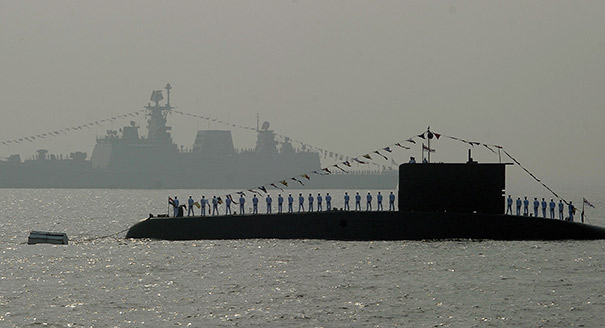
India’s next-generation carrier, if properly designed, will bolster India’s capability to control the Indian Ocean in the face of China’s growing naval power
Source: Ananta Aspen Center
Carnegie’s Ashley Tellis spoke about his new monograph, Making Waves: India's Next-Generation Aircraft Carrier, at the Ananta Aspen Center in New Delhi. In it, Tellis proposes that India partner with the United States to jointly develop the new carrier. In this way, India would benefit from the United States’ deep knowledge of carrier construction and advanced technology, while also laying the groundwork for future operational partnerships in the Indian Ocean. India's next-generation carrier, if properly designed, will bolster India’s capability to control the Indian Ocean in the face of China’s growing naval power, he concluded.
Former Senior Fellow
Ashley J. Tellis was a senior fellow at the Carnegie Endowment for International Peace.
Recent Work
Ashley J. Tellis
Ashley J. Tellis
Carnegie does not take institutional positions on public policy issues; the views represented herein are those of the author(s) and do not necessarily reflect the views of Carnegie, its staff, or its trustees.
They face an uphill climb, but they could draw on a strategy that other diplomats have used in the past.


Shana Tabak, Alejandro Martin Rodriguez

European Commission President Ursula von der Leyen is about to give her annual address on the state of the EU. Here’s what she won’t—but should—say.

Rym Momtaz
Understanding the climatic pain points is necessary for policymakers hoping to minimize the war’s negative environmental consequences.

Alejandro Martin Rodriguez, Joy Arkeh, Sarah Yerkes

Huawei pushed hard to enter the Egyptian data centers market, until the Americans made a better offer.

Angie Omar

Radical-right parties are expected to do well in upcoming elections in four of the EU's biggest member states. If successful, they could prevent the union from addressing key challenges ahead.

Stefan Lehne