

Commentary
Thomas de Waal
{
  "authors": [
    "Thomas de Waal"
  ],
  "type": "commentary",
  "centerAffiliationAll": "",
  "centers": [
    "Carnegie Endowment for International Peace",
    "Carnegie Europe",
    "Carnegie Russia Eurasia Center"
  ],
  "collections": [],
  "englishNewsletterAll": "",
  "nonEnglishNewsletterAll": "",
  "primaryCenter": "Carnegie Europe",
  "programAffiliation": "",
  "programs": [],
  "projects": [],
  "regions": [
    "Caucasus",
    "Russia",
    "Azerbaijan",
    "Western Europe"
  ],
  "topics": [
    "Political Reform",
    "Democracy",
    "Civil Society",
    "Foreign Policy"
  ]
}
Source: Getty
Baku’s European Games may be following a pattern set by the Sochi Olympics. The end result of the games is likely to be an even less pro-European and pro-Western Azerbaijan.
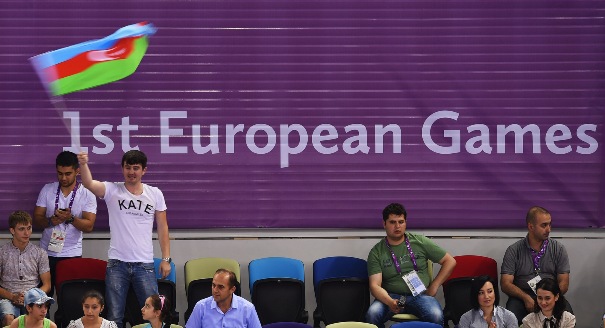
If Azerbaijan’s President Ilham Aliev had intended the inaugural European Games in Baku to be the occasion in which the world finally showered admiration and attention on his country, he will be disappointed.
The sporting event, with an extraordinarily lavish opening ceremony, has received only light media coverage across Europe, while a lot of the reporting on Azerbaijan has focused on its dismal human record. At least three of the activists and journalists who campaigned against the games or who highlighted its shortcomings—Khadija Ismailova, Rasul Jafarov, and Leyla Yunus—have been jailed in the past year.
President Vladimir Putin, who missed Russia’s National Day to attend the opening of the games in Baku will know how President Aliev feels. Last year he evidently felt insulted by the large number of no-shows to the Sochi Winter Olympics. That pique against the West may have helped propel Putin into his aggressive behavior in Ukraine, once Sochi was over.
No major politicians from the European Union made the trip to the European Games. The three highest-profile European leaders who made the trip were, alongside Aliev himself, probably the most authoritarian rulers in Europe: Putin, Turkey’s Recep Tayyip Erdogan, and the president of Belarus, Alexander Lukashenko. Two Central Asian autocrats, the leaders of Turkmenistan and Tajikistan, also showed up to an event in which their countries were not actually participating.
When Putin and Erdogan met, the Turkish leader expressed his surprise on camera about the EU no-shows, to which Putin responded “As an EU accession candidate, Turkey represented the whole of the European Union.”
The EU no-show reflects a cultural divide which was also displayed in the recent FIFA row. The European democracies are increasingly reluctant to put up money for big sporting events. When they do hold them, they try to make it all about public participation from below.
Authoritarian countries by contrast are keen to host these big sporting galas and have a grand patriotic spectacle that rallies the public around the flag. When things go off script, the authorities are furious. (Azerbaijan’s foe Armenia learned the same lesson last week when the Armenia-Portugal soccer game in Yerevan was disrupted by a young man dashing on to the pitch, protesting about his father, a jailed radical opposition leader.)
So the reaction to the games will only redouble President Aliev’s feeling that Western nations do not show him due respect. The question now is whether this further deepens the split between Azerbaijan and the West, which has been obvious since Aliev’s third term in 2013.
Azerbaijan is now rivalling Russia for the status of the most anti-American nation in the former Soviet space. In the last month and a half the government of Azerbaijan has launched a personal attack on U.S. Secretary of State John Kerry, accusing him of running an “anti-Azerbaijan campaign” from his office in Congress. It has ordered the closure of the OSCE office in Baku. It has accused U.S. organizations like the National Endowment for Democracy of trying to instigate a coup d’etat in Azerbaijan.
The post-games calendar does not promise much a respite from this spiral down in relations. A number of events will invite more critical statements from Western governments. There are fears of another hot summer on the ceasefire line around Nagorny Karabakh. The trial of three well-known pro-Western figures in Baku—Arif and Leyla Yunus and Rauf Mirkadirov—on preposterous espionage charges is due to take place in the late summer or early fall. And parliamentary elections, with all the associated controversy, are due in Azerbaijan in November.
Despite Putin and Lukashenko’s visit to Baku, it is unlikely that Azerbaijan is moving comprehensively into the Russian camp. A more likely model is prickly isolation with Russia as a more privileged partner. But the ironic result of the European Games looks like being an even less pro-European and pro-Western Azerbaijan.

Senior Fellow, Carnegie Europe
Thomas de Waal is a senior fellow at Carnegie Europe, specializing in Eastern Europe and the Caucasus.
Recent Work
Thomas de Waal
Thomas de Waal
Carnegie does not take institutional positions on public policy issues; the views represented herein are those of the author(s) and do not necessarily reflect the views of Carnegie, its staff, or its trustees.

With its public finances in shambles, the far right polling at 35 percent ahead of the 2027 presidential election, and a growing protest movement, is France’s crisis a threat to the EU’s geopolitical awakening?

Rym Momtaz, ed.

Putin’s conservative staffing policies and search for ever greater control have cemented parliament’s transformation into a bureaucratic appendage of the executive branch.

Andrey Pertsev

Russia’s AI-driven propaganda campaigns operate in a fragmented, chaotic, and often illogical manner. That’s not necessarily a problem for the Kremlin, though: It’s much easier to mimic genuine public debate that way.

Ilya Klishin

Ahead of a tough winter for Ukraine, Donald Trump’s swing back toward Russia bodes ill. But instead of panicking, Kyiv’s European allies are focusing on action.
Rym Momtaz

Without a ceasefire with Ukraine on attacking each other’s energy infrastructure—to which the Kremlin is unlikely to agree—the diesel agreement between Putin and Trump is largely for show, rather than representing a genuine increase in the volumes of Russian diesel on the global market.

Sergey Vakulenko