

Commentary
- +1
Lina Khatib, Shi Han, Ulrich Speck, …
{
  "authors": [
    "Shi Han"
  ],
  "type": "legacyinthemedia",
  "centerAffiliationAll": "",
  "centers": [
    "Carnegie Endowment for International Peace",
    "Carnegie China"
  ],
  "collections": [],
  "englishNewsletterAll": "",
  "nonEnglishNewsletterAll": "",
  "primaryCenter": "Carnegie China",
  "programAffiliation": "",
  "programs": [],
  "projects": [],
  "regions": [
    "East Asia",
    "China"
  ],
  "topics": [
    "Economy"
  ]
}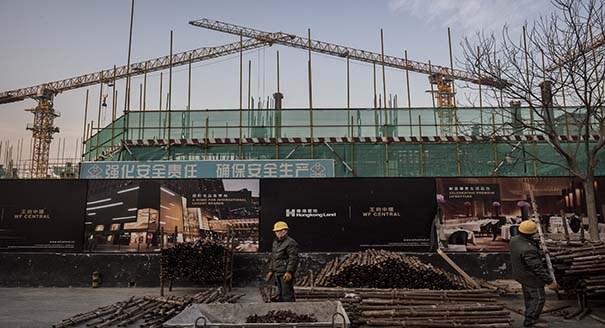
Source: Getty
Chinese state-owned enterprises distort traditional price mechanisms to maximize profits, a practice that hinders economic efficiency and inflates GDP figures.
Source: Diplomat
Chinese business executives often don’t make money the same way their Western counterparts do. Instead of adhering to the fundamental capitalist practice of buying low and selling high, many state-owned enterprises (SOE) deceive the government by doing the reverse – buying products at high prices then selling them at prices lower than competitive rates. This allows the business executives to make substantial sums in the form of kickbacks.
This illicit buy-high, sell-low business scheme is inconspicuous yet widespread in China and has troubling implications with respect to the proper working of the market signals. The popularity of the practice takes on systemic significance, since state companies generate as much as one-third of China’s GDP.
In a buy-high, sell-low situation, the SOE’s purchasing managers receive part of the additional revenue that the private seller gained by selling at the jacked-up prices. When SOE sales managers sell products at a low price, they receive a portion of the profit that the private buyer makes after he or she resells the low-priced items at higher prices on the free market.For example, a SOE purchasing manager at a petrochemical plant may instruct a processing equipment provider to sell a piece of $1 million equipment to them for the price of $5 million. In this case, the difference of $4 million would be split between the purchasing manager and the supplier. The purchasing manager has little interest in driving down the purchase price since he makes money by haggling the price up. On the sales front, an SOE sales manager at a chemical plant may intentionally sell a marketable chemical to a customer at half the going rate in exchange for a kickback after the chemical is sold again at the higher rate elsewhere. Since a lower sales price for the private buyer would increase his margin and the kickback, the sales manager is financially motivated to drive the sales price down.
Aside from enriching culprits, the buy-high, sell-low loop creates little economic benefit. The engine is running at full speed but the car is not going anywhere. The busy system is idling. The loop hurts the economy by keeping state companies in the red and makes them incapable of delivering products and services in a financially viable manner. It disables the market’s mechanism of balancing supply and demand in a way that eradicates inefficiencies.
Buy-high, sell-low transactions turn the system of rewards and punishments upside down. Buying high rewards those who spend lavishly and maintain excessive purchasing costs. Selling low takes away the financial return that the state organization should have accrued and instead puts the money in the pockets of scheming individuals.
As the state company continues this unlawful practice, the economic benefits it is supposed to deliver are compromised and the financial subsidies the state gives to keep the unprofitable business afloat drain the state budget and weaken state banks’ balance sheets. In energy and materials sectors, where corruptive schemes are more common, SOE losses are staggering.
A recent survey of state corruption cases suggests that buying high occurs more frequently than selling low, since spending a lot of money on purchases is always easier than making even a little money by making something marketable. Because this happens frequently, costs are driven up and result in higher prices across the industry. Financial subsidies extended by the government to the state companies prevent the inefficient cost structures from being threatened by competitive forces. As a result, China experiences high prices in SOE-dominated sectors that are close to or exceeding the levels seen in high-income countries even while China’s per capita income is lower than many countries.
The buy-high transaction prices, initially secretive but recently made public, also send the wrong signals to the rest of the economy. It’s no coincidence that many private companies prefer to do business with an SOE. With the choice of selling to customers who always want to pay a low price or to an SOE readily accepting prices several times higher, they are going to choose the far more lucrative option of the SOE. Scarce economic resources are getting sucked into the buy-high, sell-low black hole. The more China has these criminal transactions and “fake GDP”, the less efficient its economy is.
The current anti-corruption campaign taking place in China is attempting to curb buy-high, sell-low transactions. While it may have the short-term effect of lowering the GDP growth rate, it’s good for the economy in the long run. The goal of this campaign should be to correct the reward system and bring back an efficient, market-enhancing mechanism. In order to allow the system to be self-sustaining after the current anti-corruption campaign, it must be understood that buy-high and sell-low does not work with a competitive market. Non-state shareholders in state-dominated joint stock companies, as well as private and international partners in mixed ownership companies, should be given greater control over the companies’ finances and greater legal remedies to reign in perpetrators who harm shareholders’ interests.
The abolition of government approvals for many business activities is a healthy step toward the goal of a free market system. Scaling back government promotion of specific industries and letting competitive market forces play a decisive role would help strengthen financial discipline and subdue corruption, especially the buy-high, sell-low type.
International companies doing business in or with China should reexamine their strategies after taking the mechanics of buy-high, sell-low into consideration. It’s wise for an American company seeking to enter the Chinese market, for instance, to be able to distinguish a real customer base that has unmet needs from a fake one whose demand is deceitfully hyped up by buy-high, sell-low schemers.

Former Nonresident Scholar, Carnegie-Tsinghua Center for Global Policy
Shi Han was a nonresident scholar at the Carnegie–Tsinghua Center for Global Policy concentrating on international business issues. His economic research addressed challenges arising from interactions between American and Chinese businesses and the competition and cooperation between state and non-state economic entities.
Recent Work
Lina Khatib, Shi Han, Ulrich Speck, …
Shi Han
Despite public disputes over trade and immigration, the strategic partnership’s foundations remain sturdy.

Sameer Lalwani

With its public finances in shambles, the far right polling at 35 percent ahead of the 2027 presidential election, and a growing protest movement, is France’s crisis a threat to the EU’s geopolitical awakening?

Rym Momtaz, ed.

Russian strikes are weakening the economy sustaining Ukraine’s war effort. Closing the growing funding gap will require more European support and politically contentious reforms in Kyiv.

Balázs Jarábik

While the EU and European governments are embracing the much-lauded middle-power moment, this entails three difficult conundrums.

Richard Youngs

Europe is facing rising populism internally as well as external pressures from Russia, China, Turkey, and the United States.

Dimitar Bechev