

Commentary
Judy Dempsey
{
  "authors": [
    "Judy Dempsey"
  ],
  "type": "legacyinthemedia",
  "centerAffiliationAll": "dc",
  "centers": [
    "Carnegie Endowment for International Peace",
    "Carnegie Europe"
  ],
  "collections": [],
  "englishNewsletterAll": "ctw",
  "nonEnglishNewsletterAll": "",
  "primaryCenter": "Carnegie Europe",
  "programAffiliation": "EP",
  "programs": [
    "Europe"
  ],
  "projects": [],
  "regions": [
    "Europe",
    "Western Europe",
    "Germany",
    "Iran"
  ],
  "topics": [
    "EU",
    "Migration"
  ]
}
Source: Getty
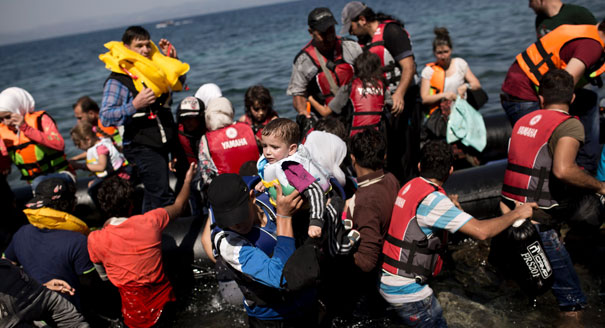
As Europe struggles to find a solution to the refugee crisis, Angela Merkel seems to have very few allies. Are EU leaders turning their backs on Germany?
Source: Deutsche Welle
Barbara Wesel, Deutsche Welle: The mood in the EU is dramatic and deadlines are now being set. Some talk about the February summit, others mention the next two months, when the Europeans will have to find a solution and refugees figures need to come down. How much time have we really got?
Judy Dempsey: This issue of two months is ridiculous; it's quite meaningless. Do you really want to stop people at the borders and then wait for the TV pictures of them freezing out there? We can only stop the flow if we can stop the war in Syria. Now as for the current talks - the only good thing about them is that the situation with the Iranians is better and that the Saudis are quite weak. But even if there is some success in those talks, the fighting will not stop overnight. Frankly, this is not about the time issue.Wesel: Angela Merkel always used to have plenty of allies in the EU to push through her agenda. Where have they all gone?
Dempsey: She has very few allies at the moment, because other than in the euro crisis, the arrival of all these refugees is really tangible for many people. It is the perception of all these people coming to Europe, that makes for their sense of crisis. So the other heads of government think of their voters and act in the national interest only. And also there is a real sense that Merkel should not have opened the borders. Many of them really blame her for what is happening.,/p>
This blame comes even though the euro would have collapsed without Merkel and Schäuble, and we would not have an agreement on Ukraine either. They are in fact now turning their backs on the leader that has kept the EU stable. She has really miscalculated. What feeds into this is a lot of propaganda where the IS issue plays a role and the events in Cologne. Plus this has been used for a lot of propaganda coming from Eastern Europe, particularly Russia, Poland and Hungary.
Wesel: Austria has now set upper limits for refugees in the country. Is this blackmail towards the EU or are they in fact helping Germany to follow course?
Dempsey: This is really a poisoned chalice and very ambiguous. What will happen if we see people freezing in the Balkans? Closing the borders is not going to achieve anything and we have really been sleepwalking into this crisis. We are beginning to see refugees now as objects to be pushed around, as political instruments and this is morally unacceptable.
Wesel: Everybody in the EU is now talking about a plan B. That means closing borders and setting upper limits to asylum seekers. Germany's finance minister Wolfgang Schäuble has warned that this would mean the end of the EU as we know it. The end of Schengen, the common market and the euro. Do you think he's right?
A plan B would mean pushing back the refugees into the Balkan countries. And what would be the consequences? Serbia has already said that they would not let people in unless they are allowed to move onward. For them and their neighbors it would really be destabilizing.
The promised hotspots for processing refugees are not working and the positions on many sides have now become quite hardened if we look at the Danes and others. And I cannot see Merkel getting any help from any side. Not from Obama because there are elections on and not from anybody. And the Turks, whom the EU had put their hopes on are not delivering. And after the attacks 10 days ago in Istanbul they will be even less keen to keep the refugees in their country.
The only way to stop the influx now would be to throw huge amounts on money at Syria's neighbors to really improve the situation for refugees there. And at the same time you would need to start a huge social media campaign and tell people, that they should not come to Europe because they are not welcome any more.
Wesel: If the EU's plans to manage the refugee crisis are falling apart, what will happen next? Will we face a doomsday scenario for Europe? Or would that be exaggerating the situation?
Dempsey: No. It really is very serious. If things go on like this, Schäuble will, in the end, press ahead with his idea of a two-speed Europe. We really do risk losing the euro and the common market.
This is about Europe's future. We are not exaggerating if we talk like that. And it looks as if in the end there will be no support for Merkel and this situation shows how weak we really are. The whole thing, everything we have built during the last decades, can come tumbling down. And I am not sure whether the majority of the other heads of government have understood what this would mean. We don't know what could actually happen in Europe in the near future.

Nonresident Senior Fellow, Carnegie Europe
Judy Dempsey is a nonresident senior fellow at Carnegie Europe
Recent Work
Judy Dempsey
Judy Dempsey

The EU can impose sanctions but struggles to enforce them without the United States. With Washington increasingly disinterested in backing European interests, the bloc must now fend for itself.


Nicu Popescu, Tiago Antunes

Russia is testing the waters of NATO’s mutual defense clause. What do strikes in Romanian territorial waters mean for the alliance’s posture toward Moscow?

Dimitar Bechev

The truth of the strategic situation is that Europe and Russia are extremely unlikely to be able to “turn the page” on their confrontation within the next two decades.
Arkady Moshes
Protests in Iran follow a similar pattern: Economic grievances turn into political protests that spread nationwide. But increased state repression has begun to shift the arrangement.

Eric Lob

It signals a new era of tech diffusion and warfare.

Steve Feldstein