

Commentary
Judy Dempsey
{
  "authors": [
    "Judy Dempsey"
  ],
  "type": "legacyinthemedia",
  "centerAffiliationAll": "dc",
  "centers": [
    "Carnegie Endowment for International Peace",
    "Carnegie Europe"
  ],
  "collections": [
    "EU Integration and Enlargement",
    "Brexit and UK Politics"
  ],
  "englishNewsletterAll": "ctw",
  "nonEnglishNewsletterAll": "",
  "primaryCenter": "Carnegie Europe",
  "programAffiliation": "EP",
  "programs": [
    "Europe"
  ],
  "projects": [],
  "regions": [
    "Europe",
    "Western Europe",
    "United Kingdom",
    "Iran"
  ],
  "topics": [
    "EU",
    "Political Reform"
  ]
}
Source: Getty
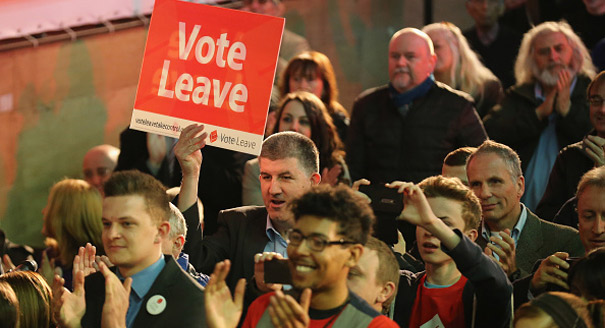
If Britain votes to leave the EU on June 23, Brexit will have an impact on the security, economy, and stability of Ireland.
Source: Washington Post
In my childhood, my mother would drive up once a year to Northern Ireland. The main stretch from Dublin up to the border was a slow two-lane road. Ireland was not yet in the E.U. so it didn’t have any access to its generous structural and development funds to modernize its poor infrastructure.
Once the security checks at the border crossing were over, we entered what seemed a foreign world. Everything was new and modern from the fast and wide motorway to Belfast to the big department stores offering so much choice. The prices were also low. Britain, not yet in the E.U. either, was heavily subsidizing its Northern Ireland province that in the late 1960s was about to become engulfed in a long sectarian conflict.
After stocking up with an abundance of British goods, we headed back south. The border police checked that we were bona fide shoppers and not smugglers.During a recent visit to Ireland, I saw how those heavily fortified border crossings had disappeared; how one could seamlessly crisscross the island; how fighting between the pro-unification Irish Republican Army and the pro-British Ulster Volunteer Force had ended; how the once poisonous relationship between Ireland and Britain had blossomed beyond all recognition into one of trust, confidence and genuine warmth.
All this was because of the 1998 Good Friday peace agreement negotiated by former U.S. senator George Mitchell (D-Maine), then-Prime Minister Tony Blair and his Irish counterpart, Bertie Ahern. That agreement, nurtured all along by President Bill Clinton, brought to Ireland security, prosperity and stability.
But Irish government officials, economists and security experts all agree that those big gains would be jeopardized if on June 23 Britain votes to leave the E.U. “You can’t underestimate the impact a Brexit would have on security, on the economy and on stability here,” said Ben Tonra, head of University College Dublin’s School of Politics and International Relations.
Take the security issue.
Since curbing immigration has been a major topic of the Brexit campaign, an exit would mean that border controls would be reintroduced between Northern Ireland and the Republic of Ireland. Forget the idea of young Poles and Estonians, Hungarians and Romanians, or Irish for that matter, living and working in the republic being able to continue commuting to jobs in Northern Ireland.
Theresa Villiers, Britain’s secretary for Northern Ireland who has joined the Brexit camp, had the nerve to say that in the event of a Brexit the border between Ireland and Northern Ireland would remain unchanged.
“That’s simply not true,” said an Irish diplomat, who spoke in an interview on condition of anonymity. “Border controls of some sort will be introduced.” In fact, in strictly legal E.U. terms, Brexit would mean that the Northern Ireland-Irish border would represent an external border to the E.U. As an E.U. member, Ireland would be required to protect its border.
As for trade, a Brexit would mean ending the E.U.’s free flow of capital and goods between Ireland and Britain and between Northern Ireland and the republic. Establishing border controls would also mean reintroducing customs controls — as well as smuggling and criminality. Even though Ireland has benefited enormously from joining the E.U. in 1973 (at the same time as Britain) and has diversified its export markets, in Europe Britain is still its biggest trading partner. Hence the economic fallout from Brexit.
A joint report by Ireland’s Economic and Social Research Institute and the Department of Finance makes sober reading. “A Brexit would reduce bilateral trade flows between Ireland and the UK by 20 per cent or more,” it states. Bilateral trade at present amounts to 1 billion euros a week (about $1.1 billion). With the expected reduction in trade, economists reckon the negative impact on gross domestic product could be about 1.5 percent. The knock-on effect on an economy slowly emerging from its own euro crisis is easy to see.
Then there’s the stability issue.
Brexit would give pro-Europe Scotland the green light to hold another referendum about its future inside the United Kingdom. “It would be the unraveling of Britain,” a senior Irish diplomat said on condition of anonymity. “Scotland would want its say about its future in Europe.”
In Northern Ireland, the unionists are split over Britain remaining in the E.U. while Sinn Fein, the political wing of the provisional Irish Republican Army, opposes Brexit. And not only that. Were Brexit to happen, Sinn Fein leader Martin McGuinness said there would be a “democratic imperative” to allow people on the island of Ireland to vote on reunification.
“If Britain votes to leave the European Union then that could have huge implications for the entire island of Ireland and, given all the predictions, would run counter to the democratic wishes of the Irish people,” McGuinness said. Irish and British diplomats are extremely nervous if McGuinness pursued that goal. “Brexit will change the landscape profoundly,” Tonra said.
Over in Brussels, Britons working in E.U. institutions are becoming nervous, too. Desperate to hold onto their jobs — in almost all cases, permanent employees in the institutions must belong to a member state— they are applying for Irish passports. The Irish embassy in Brussels has been inundated with applications. And according to the Department of Foreign Affairs in Dublin, requests for Irish passports jumped by 33 percent between 2014 and 2015 with British applications apparently topping the list. And just like my childhood days, if Brexit happens, they will have to endure border controls on the island when they visit their newly adopted country.
This article was originally published by the Washington Post.

Nonresident Senior Fellow, Carnegie Europe
Judy Dempsey is a nonresident senior fellow at Carnegie Europe
Recent Work
Judy Dempsey
Judy Dempsey
Carnegie does not take institutional positions on public policy issues; the views represented herein are those of the author(s) and do not necessarily reflect the views of Carnegie, its staff, or its trustees.

China’s political future will be shaped between now and next October. As the Communist Party enters its intense “campaign season” to prepare for a major political transition in 2027, reading Beijing's actions and responses may become more difficult as domestic politics weigh on its behavior more than usual.

Damien Ma

The EU can impose sanctions but struggles to enforce them without the United States. With Washington increasingly disinterested in backing European interests, the bloc must now fend for itself.


Nicu Popescu, Tiago Antunes

Russia is testing the waters of NATO’s mutual defense clause. What do strikes in Romanian territorial waters mean for the alliance’s posture toward Moscow?

Dimitar Bechev

The truth of the strategic situation is that Europe and Russia are extremely unlikely to be able to “turn the page” on their confrontation within the next two decades.

Arkady Moshes
Protests in Iran follow a similar pattern: Economic grievances turn into political protests that spread nationwide. But increased state repression has begun to shift the arrangement.

Eric Lob