

Article
C. Raja Mohan, Darshana M. Baruah
{
  "authors": [
    "C. Raja Mohan"
  ],
  "type": "legacyinthemedia",
  "centerAffiliationAll": "dc",
  "centers": [
    "Carnegie Endowment for International Peace",
    "Carnegie India"
  ],
  "collections": [],
  "englishNewsletterAll": "ctw",
  "nonEnglishNewsletterAll": "",
  "primaryCenter": "Carnegie India",
  "programAffiliation": "SAP",
  "programs": [
    "South Asia"
  ],
  "projects": [],
  "regions": [
    "Asia",
    "South Asia",
    "India"
  ],
  "topics": [
    "Foreign Policy",
    "Security"
  ]
}
Source: Getty
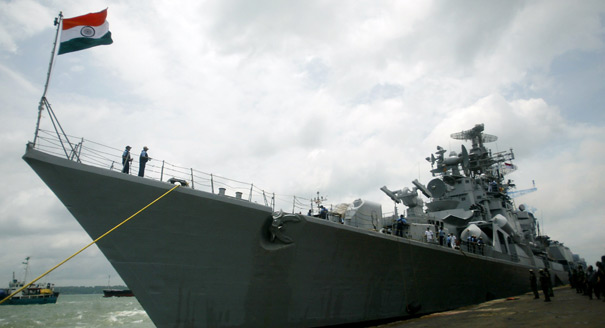
The rapid resurgence of China and the slower emergence of India are compelling a reframing of their shared spaces into the composite notion of the Indo-Pacific.
Source: Indian Express
At an international security forum in Singapore on Friday, the defence minister, Manohar Parrikar, offered arguably the first substantive articulation of Delhi’s conception of the “Indo-Pacific”.
That the Indian and Pacific Oceans are two different worlds has long been the conventional wisdom. The rapid resurgence of China and the slower emergence of India, however, are compelling a reframing of their shared spaces into the composite notion of the Indo-Pacific.That geography is unchanging is a common misconception. Seen from the perspective of geological time, natural features of the earth are ever changing. Political and economic geography evolves much faster. When the internal and external orientation of large territorial units changes, so does the nature of the physical space around them.
Although Prime Minister Narendra Modi and his predecessor, Manmohan Singh, have often used the term in their speeches over the years, there has been much resistance to the idea of the “Indo-Pacific” in the Indian establishment. A few in Delhi suspected that the term was an American “ruse” to “entrap” India into a containment ring against China. While many liked the idea of India gaining a larger role in the Pacific, they worried that Delhi’s use of the term might offend China.
The Indian discourse on the Indo-Pacific was less about geography and reflected Delhi’s hypersensitivity to the unfolding political contestation between America and China and India’s own role in shaping it.
Parrikar’s peroration on the Indo-Pacific at the Shangri La Dialogue in Singapore organised by the International Institute of Strategic Studies (IISS), therefore, was a big surprise. But his formulation was quite simple.
“For India”, Parrikar said, “located as we are at the centre of the Asian landmass astride the Indian Ocean, any reference to Asia implies its fullest geography ranging from the Suez to the shores of the Pacific”. For India, the Indo-Pacific is about expanding the geopolitical sphere of interest and a new strategic aspiration to influence its evolution.
In laying out India’s interests, Parrikar was careful in navigating the turbulent waters of the US-China rivalry. Yet, he pointed to India’s growing economic interests in the tension-ridden South China Sea, called for a peaceful resolution of the maritime territorial disputes, and outlined interest in expanding maritime engagement with all major powers, including the US, Japan and China. Parrikar also affirmed India’s commitment to assist the smaller nations in capacity building and supported multilateral security arrangements.
Parrikar’s propositions should help move Delhi away from picking nits in the Pacific. Contrary to the perception that the Indo-Pacific is an American construct, Washington’s commitment to the idea has hardly been consistent.
Hillary Clinton, when she was the secretary of state during the first term of the Obama Administration, certainly popularised the term Indo-Pacific. John Kerry, her successor at the state department in Obama’s second term, had little time for the Indo-Pacific. At the Pentagon, Sectetary of Defence Ash Carter prefers the term, “Indo-Asia Pacific”.
Meanwhile, there is little evidence of official Chinese disapproval of “Indo-Pacific”. As Chinese interests grow in the Indian Ocean, Beijing has begun to reclaim its historic association with the littoral and is determined to shape the regional future. Even more important, Beijing is acquiring the means to do so.
Consider, for example, the Chinese navy’s sustained operations in the Gulf of Aden since 2008 and the recent acquisition of a military base in Djibouti. Or the ambitious Chinese plans to connect the Pacific Ocean with the Indian Ocean through the 21st century Maritime Silk Road.
More than America and China, the middle powers in Asia are the ones now driving the idea of the Indo-Pacific. The first one to speak about it was Prime Minister Shinzo Abe, when he addressed the Indian Parliament way back in 2007. Indonesia, which sees itself as the “maritime nexus” between the Indian and Pacific Oceans, is now an enthusiastic proponent of the Indo-Pacific. Australia, with massive coastlines facing both the oceans, is another champion.
There is no better testimony to the idea of the Indo-Pacific than India’s legacy of the British Raj. From the beginning of the 19th to the middle of the 20th century, armies of undivided India ensured regional stability in a vast swathe of territory stretching from the eastern Mediterranean to southern China. In the Second World War, Britain and America mobilised Indian resources for the liberation of China and South East Asia from the Japanese occupation.
During the economic globalisation of the 19th century, India provided vast armies of labour and significant amounts of capital for the economic modernisation of the littoral. The idea that India’s security perimeter extends from Aden to Malacca or the Suez to the South China Sea is very much part of modern India’s strategic tradition.
As Delhi’s economic weight grows and its strategic footprint widens, the return of the Indo-Pacific was inevitable. While Atal Bihari Vajpayee and Manmohan Singh dipped their toes into the waters of the Indo-Pacific, Modi and Parrikar are preparing to sail.
Former Nonresident Senior Fellow, Carnegie India
A leading analyst of India’s foreign policy, Mohan is also an expert on South Asian security, great-power relations in Asia, and arms control.
Recent Work

C. Raja Mohan, Darshana M. Baruah


Alexander Gabuev, Paul Haenle, C. Raja Mohan, …
Carnegie does not take institutional positions on public policy issues; the views represented herein are those of the author(s) and do not necessarily reflect the views of Carnegie, its staff, or its trustees.
Japan’s revision of its three strategic documents reflects an intention to keep the United States engaged in the region while Japan fills any vacuums of U.S. power to preserve the Indo-Pacific order.

Ryo Sahashi

Chinese biotech companies have been on the receiving end of U.S. economic coercion. Yet their responses have differed significantly because firm and state interests are not uniformly aligned. For Washington, treating all Chinese tech firms the same, irrespective of their actual interests, risks pushing them farther into Beijing’s corner.

Xue Gong
Lee’s tour shows how Seoul is reorganizing its diplomacy away from Pyongyang and toward industrial networks and the geography of the compute economy.

Darcie Draudt-Véjares

Most migrants may have left Ceuta, but the effects may linger.


Alejandro Martin Rodriguez, Sarah Yerkes
There is a transnational far-right populist movement that links middle powers in a global movement that extends well beyond Trump.



Christopher S. Chivvis, Rohan Mukherjee, Milan Vaishnav