

Research
- +5
Alper Coşkun, Fatih Ceylan, Tacan İldem, …
{
  "authors": [
    "Sinan Ülgen"
  ],
  "type": "other",
  "centerAffiliationAll": "dc",
  "centers": [
    "Carnegie Endowment for International Peace",
    "Carnegie Europe"
  ],
  "collections": [
    "Turkey’s Transformation"
  ],
  "englishNewsletterAll": "ctw",
  "nonEnglishNewsletterAll": "",
  "primaryCenter": "Carnegie Europe",
  "programAffiliation": "EP",
  "programs": [
    "Europe"
  ],
  "projects": [],
  "regions": [
    "Europe",
    "Türkiye",
    "Middle East",
    "Iran"
  ],
  "topics": [
    "Foreign Policy"
  ]
}
Source: Getty
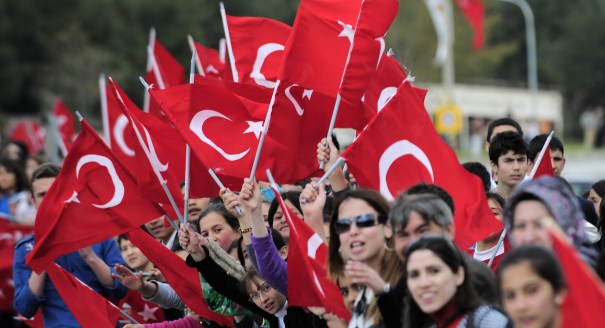
Situated at the nexus of Asia, Europe, and the Middle East, Turkey is in a geostrategic context that is becoming increasingly volatile.
Source: Diplomat
Mercy A. Kuo, The Diplomat: Situated at the nexus of Asia, Europe and the Middle East, Turkey’s geostrategic context is becoming increasingly volatile. Explain Ankara’s strategic calculus behind the “no problems with neighbors” policy.
Sinan Ülgen: The rationale behind the “no problems with neighbors” policy was a desire to enhance Turkey’s set of bilateral relationships with its own neighbors. It was believed that in the past, mostly due to the geopolitical context of the region, Turkey’s relationship with its own neighborhood had not reached its potential. So a real diplomatic drive was launched to build a stronger neighborhood policy underpinned by a vision of economic collaboration. It was hoped that the increase in economic interdependence would also positively impact the political relationships. This diplomatic campaign was captured with the much popularized slogan of “zero problems with neighbors.” But this policy which actually had started to bring visible benefits for Ankara in the form of growing prestige and regional influence was eventually sidelined with the onset of the Arab Spring which encouraged Turkish policy makers to adopt a more ambitious, assertive and interventionist approach as they started to develop a neo-Ottomanist vision and rhetoric. The former Foreign Minister and Prime Minister Ahmet Davutoglu wanted to transform Turkey as the order-setter of the Middle East.
Mercy A. Kuo, The Diplomat: Assess the viability of Turkey’s recent restoration of relations with Israel and Russia.
Sinan Ülgen: Turkey’s post-Arab Spring policies have failed to advance the country’s national interest. On the contrary they have led to a weakening of bilateral ties and to an erosion of Turkey’s regional influence. Eventually Turkish policymakers were forced to re-evaluate their approach to regional issues. An effort to recalibrate Turkish foreign policy had been initiated two years ago. A key element of this foreign policy readjustment was the negotiations with Israel with a view to the normalization of the relationship. This objective was successfully achieved with a formal agreement with Tel Aviv this past month. At the same time, Ankara strived to normalize its relationship with Moscow that suffered significantly after the downing of a Russian plane by Turkey last November. The normalization with Israel and Russia will however proceed at a different pace and with different expectations. With Israel, the aim is to rebuild a mutually beneficial framework for security and intelligence cooperation against the backdrop of region beset by growing instability and shaken by the emergence of the Islamic State. Another objective is the joint leveraging of the off shore gas resources in the Eastern Mediterranean. With Russia the more short-term aim is to end the current level of confrontation and acrimony as well as the economic sanctions imposed by Russia which have affected the Turkish economy and more particularly the domestic tourism industry quite severely.Mercy A. Kuo, The Diplomat: Amid ongoing ISIS attacks, how might Turkey and the EU effectively manage the Syrian refugee situation?
Sinan Ülgen: Turkey and the EU have negotiated an ambitious cooperation package on refugees. The agreement has several components. Turkey agrees to take back the Syrian refugees from the Greek islands as well as other illegal migrants back from Europe. In return the EU is to provide a sizeable financial assistance to the tune of 6 billion euros over two years for Turkey to better address the needs of 2.8 million Syrian refugees currently in Turkey. EU and Turkey are to progress with the accession talks with the opening of new chapters. The EU is also expected to grant visa freedom to Turkish citizens. But this promise is conditional on Turkey fulfilling a set of pre-established criteria. It is this last component, which for many is seen as the main factor motivating the Turkish government to agree to this deal, which is the most fragile element of the package. Indeed the Turkish government now seems unwilling to comply with a few of the remaining criteria which involve changes in the country’s anti-terror legislation. Negotiations are ongoing in order to concoct a mutually agreeable formula to overcome this stumbling block. Ankara expects the EU to deliver visa freedom by October.
Mercy A. Kuo, The Diplomat: Explain how President Erdogan’s leadership ambitions impacts domestic political dynamics and foreign policy decision-making.
Sinan Ülgen: Erdogan’s aspiration to introduce an executive presidency in Turkey’s Constitution is shaping both the domestic and foreign policy agenda of the country. At the domestic level, the country continues to operate in pre-electoral mood given that either a referendum or snap elections can be held in the near future to change the constitution. This expectation prevents long term policy making and perpetuates the high degree of political polarization. With the former prime minister having been forced to step down, Erdogan is increasingly inclined to operate as a de facto executive president with almost no scope of independent policy making left to the new prime minister. This also means that foreign policy making has shifted to a significant degree to the presidential palace.
Mercy A. Kuo, The Diplomat: What are three priorities for the next U.S. president in advancing relations with Turkey?
Sinan Ülgen: A new U.S. president should aim to maintain and solidify Turkey’s Western anchor. This would mean giving more scope for NATO to help with Turkey’s security concerns. It also means including Turkey in the Transatlantic Trade and Investment Partnership which is set to constitute the economic pillar of the transatlantic partnership. Finally Ankara and Washington should seek to develop a common frame of analysis on the regional situation and particularly the future of Syria and Iraq including the Kurdish issue.

Senior Fellow, Carnegie Europe
Sinan Ülgen is a senior fellow at Carnegie Europe in Brussels, where his research focuses on Turkish foreign policy, transatlantic relations, international trade, economic security, and digital policy.
Recent Work

Alper Coşkun, Fatih Ceylan, Tacan İldem, …
Carnegie does not take institutional positions on public policy issues; the views represented herein are those of the author(s) and do not necessarily reflect the views of Carnegie, its staff, or its trustees.

Before the next wave of EU enlargement takes place, the union needs to grapple with thorny questions of how power is distributed among its members.


Emil Sondaj Hansen, Ditte Brasso Sørensen

The real test may come after the leaders leave the room.



Sheena Chestnut Greitens, Oriana Skylar Mastro, Yukon Huang, …

The Horn of Africa countries are among those facing a new security calculus.


Andrew Leber, Lesley Anne Warner

The European far right might fail to steer EU policy in the direction Russia wants, but they will create enough chaos inside Europe to benefit the Kremlin.

Dimitar Bechev

The new U.S.–Denmark–Greenland agreement will help Washington exert political, economic, and financial dominance under the guise of security. Yet, it acknowledged Copenhagen’s and Nuuk’s sovereignty on the island.

Marc Pierini