• Research
  • Emissary
  • About
  • Experts
Carnegie Global logoCarnegie lettermark logo
DemocracyIran
  • Donate
{
  "authors": [],
  "type": "legacyinthemedia",
  "centerAffiliationAll": "dc",
  "centers": [
    "Carnegie Endowment for International Peace",
    "Malcolm H. Kerr Carnegie Middle East Center"
  ],
  "collections": [],
  "englishNewsletterAll": "menaTransitions",
  "nonEnglishNewsletterAll": "",
  "primaryCenter": "Carnegie Endowment for International Peace",
  "programAffiliation": "MEP",
  "programs": [
    "Middle East"
  ],
  "projects": [],
  "regions": [
    "Middle East",
    "Levant"
  ],
  "topics": [
    "Political Reform",
    "Economy"
  ]
}
Source: Getty

In The Media

On ISIL and Oil

ISIL's oil production maybe in decline but that does not mean the group will simply disappear.

Link Copied
Published on Sep 12, 2016
Program mobile hero image

Program

Middle East

The Middle East Program in Washington combines in-depth regional knowledge with incisive comparative analysis to provide deeply informed recommendations. With expertise in the Gulf, North Africa, Iran, and Israel/Palestine, we examine crosscutting themes of political, economic, and social change in both English and Arabic.

Learn More

Source: CCTV America

 
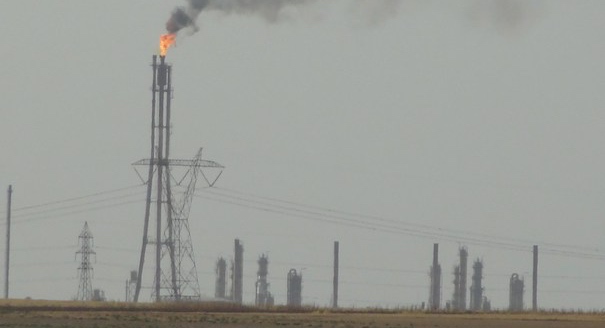
Carnegie Middle East Center's Carole Nakhle joined CCTV America's Mike Walter to discuss ISIL's oil producing capabilities. Nakhle argued that we can only speculate how much oil ISIL is producing and for how much the group is selling it for on the black market.  The group's revenue is decreasing due to a decrease in production and the continued bombing of allied forces. According to Nakhle, ISIL's oil was only sought after on the black market and now the group is focusing more on refined oil products like heating oil or diesel. She stated that allied bombings had an impact on the drilling for and selling of oil but not on its refinement.  She also argued that the oil is not ISIL's but the people of Syria and Iraq and America cannot seize it.  Nakhle finally noted that even if ISIL lost its oil supplies, it would not spell the end of the group as its ideology still attracts followers. 
 
This interview was originally broadcast on CCTV America. 
Political ReformEconomyMiddle EastLevant

Carnegie does not take institutional positions on public policy issues; the views represented herein are those of the author(s) and do not necessarily reflect the views of Carnegie, its staff, or its trustees.

More Work from Carnegie Endowment for International Peace

  • US President Donald Trump presides over the inaugural meeting of the âBoard of Peace,❠a newly established body focused on efforts for Gaza, at the US Institute of Peace in Washington, DC, United States, on February 19, 2026.
    Article
    The Board of Peace and Funding for Gaza Reconstruction: On Whose Account?

    Stakeholders must demand major restructuring of the Board of Peace and robust oversight and transparency before engaging with it. Until then, rights-respecting existing platforms and mechanisms for multilateral peacemaking should be supported.

      Zaha Hassan, Charles H. Johnson

  • Commentary
    Diwan
    Syria Skirts the Conflict With Iran

    In an interview, Kheder Khaddour  explains that Damascus is trying to stabilize its borders, but avoiding war isn’t guaranteed. 

      Michael Young

  • Commentary
    Diwan
    Israel’s Forever Wars

    The country’s strategy is no longer focused on deterrence and diplomacy, it’s about dominance and degradation.

      Nathan J. Brown

  • Commentary
    Diwan
    An Extension Under Fire

    The decision of Lebanon’s parliament may look exceptional, but in reality it is not.

      Issam Kayssi

  • One man tossing a sack to another to stack on a truck
    Commentary
    Emissary
    The Other Global Crisis Stemming From the Strait of Hormuz’s Blockage

    Even if the Iran war stops, restarting production and transport for fertilizers and their components could take weeks—at a crucial moment for planting.

      • Noah  Gordon ​​​​

      Noah Gordon, Lucy Corthell

Get more news and analysis from
Carnegie Endowment for International Peace
Carnegie global logo, stacked
1779 Massachusetts Avenue NWWashington, DC, 20036-2103Phone: 202 483 7600Fax: 202 483 1840
  • Research
  • Emissary
  • About
  • Experts
  • Donate
  • Programs
  • Events
  • Blogs
  • Podcasts
  • Contact
  • Annual Reports
  • Careers
  • Privacy
  • For Media
  • Government Resources
Get more news and analysis from
Carnegie Endowment for International Peace
© 2026 Carnegie Endowment for International Peace. All rights reserved.