

Commentary
Dmitri Trenin
{
  "authors": [
    "Dmitri Trenin"
  ],
  "type": "legacyinthemedia",
  "centerAffiliationAll": "",
  "centers": [
    "Carnegie Endowment for International Peace",
    "Carnegie Russia Eurasia Center"
  ],
  "collections": [],
  "englishNewsletterAll": "",
  "nonEnglishNewsletterAll": "",
  "primaryCenter": "Carnegie Russia Eurasia Center",
  "programAffiliation": "",
  "programs": [],
  "projects": [],
  "regions": [
    "North America",
    "United States",
    "East Asia",
    "China",
    "Russia"
  ],
  "topics": [
    "Foreign Policy"
  ]
}
Source: Getty
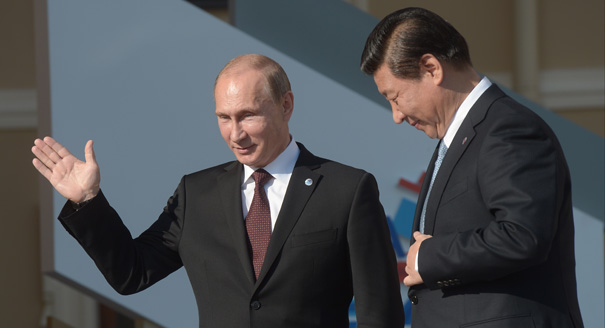
Going forward, Xi, Putin and the next US President will be largely responsible for the state of the world. China's and Russia's leaders will not only work closely with each other, but also learn from each other, in economics as well as in politics.
Source: China Daily
Intensifying competition among the world's major powers raises the issue of political leadership to a new level. The obvious lack of strong leadership in the European Union has not only led it to crises, but has also disqualified the EU from being a global strategic actor.
The three major powers of today's world, the United States, China and Russia, have very different political systems and very different leadership styles. The US rests on divided government, with intricate checks and balances; China formally has collective leadership; and Russia lives under personalist rule that enjoys the consent of most people. Things, however, are changing.
The Communist Party of China has just named Xi Jinping its "core" leader.
In societies going through transformational processes, like China's and Russia's, strong and responsible leadership is required more than in established ones, which are largely self-governing. In the US, it is Congress, state and municipal authorities that take care of the domestic agenda, while the president's powers are most important in the field of foreign and security policy. With the global environment getting more competitive, it is relations among the leaders of the US, China and Russia that will have a decisive impact on global politics through the rest of this decade, and beyond.
So far, the mutual empathy and closeness of world views between Putin and Xi has greatly promoted Sino-Russian cooperation and cemented the new "entente" - something more than partnership and less than an alliance - between Moscow and Beijing. By contrast, Putin's rocky relations with US President Barack Obama have aggravated, rather than mitigated the fundamental US-Russian differences. Xi's connection to Obama, by contrast, has been generally businesslike, but hardly warm, even as the two countries have raised the level of their competition.
Going forward, Xi, Putin and the next US President will be largely responsible for the state of the world. China's and Russia's leaders will not only work closely with each other, but also learn from each other, in economics as well as in politics. They will probably continue to resolve their differences in a friendly and reasonably accommodating manner.
This will strengthen Beijing's hand in relations with Washington, and provide Moscow with a much-needed partner in constructing Greater Eurasia, Russia's newest geopolitical blueprint. The triangle which former US president Richard Nixon and his top aide Henry Kissinger - the two very strong and insightful foreign policy leaders - built in the early 1970s and which put the US on top is now standing on its head.
Former Director, Carnegie Moscow Center
Trenin was director of the Carnegie Moscow Center from 2008 to early 2022.
Recent Work
Dmitri Trenin
Dmitri Trenin
Carnegie does not take institutional positions on public policy issues; the views represented herein are those of the author(s) and do not necessarily reflect the views of Carnegie, its staff, or its trustees.

The Plaza Accord was not an externally imposed punishment of Japan but part of a broader restructuring that Japanese economists and policymakers themselves recognized was necessary. Its effects were undermined, however, when Tokyo responded to the resulting slowdown with policies that exacerbated investment, credit expansion, and the very imbalances the adjustment was intended to resolve.

Michael Pettis

Trump has promised Belarus a massive potash deal. But Minsk is seeking something greater: restored Western transit and greater room for maneuver from Russia.

Balázs Jarábik
The real test may come after the leaders leave the room.


Sheena Chestnut Greitens, Oriana Skylar Mastro, Yukon Huang, …

The Horn of Africa countries are among those facing a new security calculus.


Andrew Leber, Lesley Anne Warner

The European far right might fail to steer EU policy in the direction Russia wants, but they will create enough chaos inside Europe to benefit the Kremlin.

Dimitar Bechev