

Commentary
If the Russian-speaking community in Latvia cannot articulate their interests without being seen as disloyal, they could end up embracing a pro-Kremlin agenda.
Sergejs Potapkins
{
  "authors": [
    "Amr Hamzawy",
    "Nathan J. Brown"
  ],
  "type": "legacyinthemedia",
  "centerAffiliationAll": "dc",
  "centers": [
    "Carnegie Endowment for International Peace",
    "Malcolm H. Kerr Carnegie Middle East Center"
  ],
  "collections": [
    "Arab Awakening"
  ],
  "englishNewsletterAll": "menaTransitions",
  "nonEnglishNewsletterAll": "",
  "primaryCenter": "Carnegie Endowment for International Peace",
  "programAffiliation": "MEP",
  "programs": [
    "Middle East"
  ],
  "projects": [],
  "regions": [
    "North Africa",
    "Egypt"
  ],
  "topics": [
    "Political Reform",
    "Democracy"
  ]
}
Source: Getty
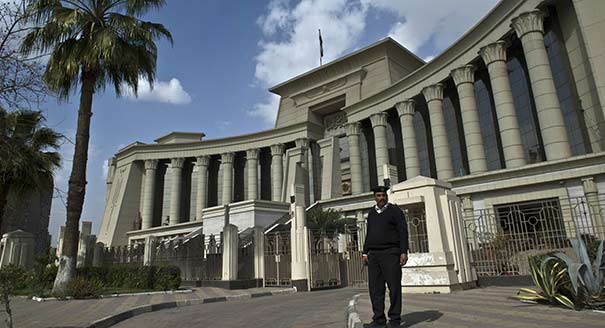
Egypt’s Supreme Constitutional Court struck down a portion of the country’s protest law this week. While that may have long-term significance, the ruling is likely to have little short-term effect.
Source: Washington Post
Egypt’s Supreme Constitutional Court (SCC) struck down a portion of the country’s protest law this week — one issued by decree by its own chief justice (then-interim president) in 2013. When that law was issued, Egyptian officials explained that the intent and content of the law was no different from that in liberal democracies, all of which allow demonstrations but place the burden on public authorities to ensure that they do not take place in a manner that threatens the public order.
The text of the law did bear resemblance to those of liberal democratic systems. But the law was written and applied with vague standards, draconian punishments, activists reluctant to “notify” authorities as required and prosecutors extremely zealous. Essentially, it became part of an effective legalization of authoritarianism in the country, one that shuts down almost any avenue for organized expressions of dissent.
In stirring prose about the right to demonstrate alongside democratic and constitutional values, the SCC ruled that the ability of security authorities to regulate and prevent demonstrations was unconstitutional. If authorities wish to restrict a demonstration or prevent it on public security grounds, the demonstrators’ constitutional rights and the principle of separation of powers require that the matter be referred to a competent court to adjudicate the issue. The SCC held that only a court could balance competing rights claims between those seeking to express themselves and those concerned for public order.
Is this a significant reversal for the Egyptian regime and a sign that the authoritarian tide in the country is receding? In a word, no. The ruling may indeed pack some long-term significance, but it is likely to have little short-term effect.
Those already imprisoned, including many leading activists of the 2011 uprising, will find the ruling useless. They rejected the law in principle and therefore refused to comply with its provisions to notify authorities. Had they notified the authorities, but been barred from demonstrating, they could use the SCC ruling to appeal their convictions. But since they did not take that step — and because the court upheld the rest of the protest law — the ruling offers them nothing.
Security bodies have all kinds of tools to shut down a demonstration — not all of which through formal legal channels. They can use plainclothes thugs to beat demonstrators, arrest protest organizers on other charges (for instance, by finding that they are in possession of controlled substances or that they have complained about a leading official or a court verdict). They can shut down access to an area without explanation (or with an improvised one) if they expect a demonstration to take place.
If the authorities wish, they still have a legal tool that will survive the SCC ruling: going to court. The process will be a bit more cumbersome, and in the current climate, it would be a bold court that would take it on itself to reject a security agency’s statement that public security is in danger. Other components of the law that will survive the SCC ruling give the security authorities wide ranging powers to undermine the rights of demonstrators legally. They can ask a court to ban peaceful demonstrations in squares, roads and work sites claiming that they will disrupt public order or damage production efforts. They can also demand to bar citizens from assembling close to state buildings and public offices to peacefully protest bad policies or human rights abuses. The law also legalizes the use of batons, rubber and actual bullets to disperse permitted marches and demonstrations that the security authorities can deem with vague standards as “departing from the peaceful nature.”
Over the long term, the SCC may have inserted elements that could, under different circumstances, have a liberalizing effect. In the past, the SCC has signaled that the justices take the liberal and democratic commitments of the 2014 constitution seriously, a document that proponents insists it is more democratic than its predecessors.
Previous constitutions have come with controversy. The 1971 constitution, famously described by one Egyptian legal adviser as “a joke that became serious,” had vaguely liberal language undermined by specific authoritarian content. The SCC, especially in the 1980s and 1990s, sometimes worked to give a liberal reading to its clauses.
The 2012 constitution, written under Muslim Brotherhood rule, closed some of the loopholes in the 1971 document, but was tainted by the divisive way it was written and approved. When the SCC had to deal with that document, it did so with clear distaste, referring to Egyptian constitutional traditions at times to avoid anchoring its rulings solely in a controversial text. But its ruling on the protest law, similar to the previous ruling in 2015 regarding the unconstitutionality of baring dual nationals from candidacy in the country’s parliamentary elections, singles out the 2014 constitution not as part of that tradition but as a democratic departure, thus signaling that they may take some of its vague but fulsome promises seriously.
Additional cases scheduled before the SCC in the coming months can enable the court to push the envelope further — from defining the scope of oversight practiced by the administrative court system over government decisions including the so-called acts of sovereignty, to the constitutionality of the labor unions law, which bans independent unions in light of the principle of freedom of association enshrined in the 2014 constitution.
The SCC suggests that the “notification” of the security authorities required by the law from citizens intent on demonstrating is one that is designed to compel the government to accept a constitutional right, not to impose regulation of it — such regulation could only take place by a competent court in accordance with due process. This could have implications in other areas, most notably NGO registration, forcing the government to go to court to prevent an organization from gaining official status — rather than current practice of rejecting registration applications and forcing the applicants to engage in lengthy litigation to reverse the decision.
Finally, by insisting the courts have a strong role to play in adjudicating rights claims and in subjecting the executive to judicial oversight, the SCC has inserted the judiciary into the process in a manner that might work differently in the future. Courts today show strong deference to the executive in general and security bodies most specifically. And the current regime has returned the favor, rendering many of its fearsome authoritarian tools into regular legal form and working with existing courts, relying much less on emergency law and special tribunals as was done in the past.
But if the judiciary’s deference is notable, it may not be boundless over time. While the SCC has done little to stop authoritarian measures now, it has left some tools intact that might be used at a later date.
This article was originally published by the Washington Post.

Director, Middle East Program
Amr Hamzawy is a senior fellow and the director of the Carnegie Middle East Program. His research and writings focus on Egypt’s and other middle powers’ involvement in regional security in the Middle East, particularly through collective diplomacy and multilateral conflict resolution

Nonresident Senior Fellow, Middle East Program
Nathan J. Brown, a professor of political science and international affairs at George Washington University, is a distinguished scholar and author of nine books on Arab politics and governance, as well as editor of five books.
Carnegie does not take institutional positions on public policy issues; the views represented herein are those of the author(s) and do not necessarily reflect the views of Carnegie, its staff, or its trustees.

If the Russian-speaking community in Latvia cannot articulate their interests without being seen as disloyal, they could end up embracing a pro-Kremlin agenda.

Sergejs Potapkins

Russia’s ruling party would have benefited from Putin appearing as its distant patron, but as an active frontman imposing his views on the public, he has done nothing but harm both the party’s election campaign and the ruling system overall.

Andrey Pertsev
Despite myriad challenges and occasional stumbles, the new Hungarian government is moving ahead with energy and conviction to uproot years of illiberalism and corruption and rebuild Hungarian democracy.

Thomas Carothers

Huawei pushed hard to enter the Egyptian data centers market, until the Americans made a better offer.

Angie Omar

Radical-right parties are expected to do well in upcoming elections in four of the EU's biggest member states. If successful, they could prevent the union from addressing key challenges ahead.

Stefan Lehne