

Commentary
Amr Hamzawy
{
  "authors": [
    "Amr Hamzawy"
  ],
  "type": "legacyinthemedia",
  "centerAffiliationAll": "dc",
  "centers": [
    "Carnegie Endowment for International Peace"
  ],
  "collections": [
    "Arab Awakening"
  ],
  "englishNewsletterAll": "menaTransitions",
  "nonEnglishNewsletterAll": "",
  "primaryCenter": "Carnegie Endowment for International Peace",
  "programAffiliation": "MEP",
  "programs": [
    "Middle East"
  ],
  "projects": [],
  "regions": [
    "North Africa",
    "Egypt"
  ],
  "topics": [
    "Political Reform",
    "Democracy"
  ]
}
Source: Getty
Egypt’s new NGO law is another step toward autocratic governance and may lead to further instability and radicalization.
Source: Washington Post
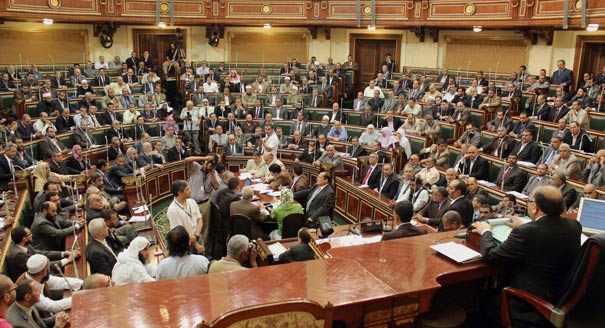
Last week, an overwhelming majority of the Egyptian parliament passed repressive legislation regulating nongovernmental organizations (NGOs), with virtually no debate. The vote once again emphasizes how the rubber-stamp role of parliament enables Egypt’s new autocracy under President Abdel Fatah al-Sissi’s government.
Similar to legislation passed in the past three years such as the protest law and the anti-terrorism law, the new legislation practically eliminates freedom of association and freedom of expression, both of which are enshrined in the Egyptian constitution. It subjects NGOs to draconian government control, threatens to wipe out civil society and leaves citizens who engage in peaceful activism in paralyzing fear of immediate state repression.
Although the legislation acknowledges the right of Egyptians to establish and register NGOs by notifying the Ministry of Social Solidarity, it erodes this very right by giving the ministry the power to decline registration based on malleable reasons, such as a founder’s alleged involvement in prohibited and punishable activities.
The legislation exceeds the traditional ban on NGOs engaging in activities reserved for political parties, such as running election campaigns and nominating candidates in elections. The legislation goes further and bans NGOs from “interfering” with professional syndicates and labor unions, and it also stipulates a ban on activities that are characterized as “harmful” to the nation. The autocratic objective behind these additional bans aims is twofold: First, to stop the support NGOs have been giving to syndicates, unions and labor activists struggling to preserve their freedom of association and the right to freely and peacefully express opposition to government policies. In doing so, the legislation will separate NGOs from the wider societal web by drying up links between them and organizations that aim to represent key segments of the Egyptian population and champion their demands. Second, in the absence of a clear and objective legal definition of what makes specific activities “harmful” — the legislation uses elusive references to threatening security, public order, public morality and public health — the stipulated ban on harmful activities serves to subject NGOs to government surveillance, keeping the repressive blade of criminal punishment hanging over their members. The legislation does not shy away from stipulating hefty administrative penalties, fines and periods of imprisonment in case of violations that remain to a terrifying extent unspecified legally, such as engagement in “harmful” activities.
The legislation creates a new government body: the National Agency for Organizing the Operation of Foreign NGOs. The composition of the agency has the ministries of defense, interior, foreign affairs and justice, as well as the intelligence institutions, represented. Despite the jurisdiction over foreign NGOs, the legislation gives the agency a sweeping mandate with regard to Egyptian NGOs as well. The agency is put in charge of monitoring domestic fundraising efforts of Egyptian NGOs, of allowing or stopping foreign grants and donations directed to Egyptian organizations and of scrutinizing their activities and spending — in spite of the fact that NGOs are already subjected to the scrutiny and oversight of the Central Auditing Agency. In reality, this newly created national agency becomes the main government body tasked to potentially starve Egyptian NGOs, cut off their ties with foreign organizations and make it impossible for all of them to operate safely and freely.
The new NGO legislation takes Egypt another step down the dangerous road of autocratic governance, making the most populous country in the Arab world more vulnerable to instability and radicalization. Although I do not expect him to do it, Sissi can still stop the enactment of the legislation into law by refusing to sign it and pushing it back to parliament for new deliberations. I sincerely hope he proves me wrong.
This article was originally published by the Washington Post.

Director, Middle East Program
Amr Hamzawy is a senior fellow and the director of the Carnegie Middle East Program. His research and writings focus on Egypt’s and other middle powers’ involvement in regional security in the Middle East, particularly through collective diplomacy and multilateral conflict resolution
Recent Work
Amr Hamzawy
Amr Hamzawy
Carnegie does not take institutional positions on public policy issues; the views represented herein are those of the author(s) and do not necessarily reflect the views of Carnegie, its staff, or its trustees.

By abandoning past U.S. pro-democracy policies and adopting several lines of pro-autocratic action, the Trump administration has fundamentally repositioned the United States vis-à-vis democracy in the world.

Thomas Carothers

In the tenth year of his presidency, President Mirziyoyev’s system is becoming even more personalized than that of his predecessor Karimov.

Galiya Ibragimova

To remain effective, organizations need to master new media and legitimacy markers to make a once-in-a-century shift.


Renée DiResta, Rachel Kleinfeld, Margot Treadwell

An overwhelming victory by a far-right-wing party in a small state in eastern Germany will have major repercussions for Chancellor Friedrich Merz’s coalition.

Judy Dempsey
Amid celebrations of bilateral ties was a deeper focus on stability in the Middle East.
Amr Hamzawy