

Paper
Christopher S. Chivvis, Rohan Mukherjee, Milan Vaishnav
{
  "authors": [
    "Milan Vaishnav"
  ],
  "type": "other",
  "centerAffiliationAll": "dc",
  "centers": [
    "Carnegie Endowment for International Peace"
  ],
  "collections": [],
  "englishNewsletterAll": "ctw",
  "nonEnglishNewsletterAll": "",
  "primaryCenter": "Carnegie Endowment for International Peace",
  "programAffiliation": "SAP",
  "programs": [
    "South Asia"
  ],
  "projects": [],
  "regions": [
    "North America",
    "United States",
    "South Asia",
    "India"
  ],
  "topics": [
    "Political Reform",
    "Democracy"
  ]
}
Source: Getty
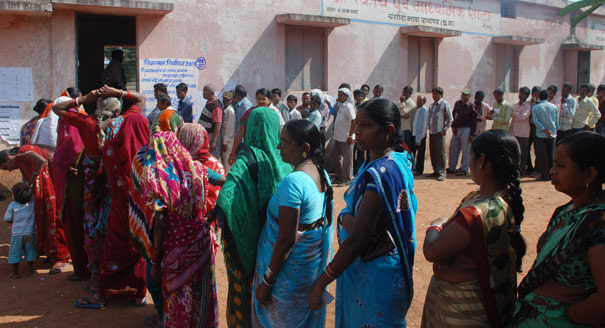
Rather than being uninformed, voters in India strategically elect politicians who are tied to criminal activity.
Source: Democratic Audit UK
A candidate with criminal allegations hanging over them will repel voters – or will they? Not necessarily. In India, a third of the MPs elected in 2014 faced an ongoing criminal case. Milan Vaishnav, the author of a new book about the nexus of crime and democracy in India, talks to Ros Taylor about the appeal of a strongman who can ‘get things done’, even if it means breaking the law – and considers whether some US voters share the same instincts.
Out of the 543 MPs elected in 2014, 34 percent faced an ongoing criminal case at the time of their election. However, it is important to interpret this number cautiously since many of these cases consist of minor charges that could arguably be related to a politician’s daily vocation or machinations during election time. Many of these cases involve infractions such as unlawful assembly, libel, or disobeying public servants.
But even if we set aside these cases as minor or politically motivated, 21 percent of MPs faced cases of a serious nature. These cases involve charges that, if a conviction were obtained, would merit hard jail time. Here, we are speaking of allegations of attempted murder, assaulting public officials, or theft. Indeed, of the most frequent violations parliamentary candidates are accused of (using data from the last three national election cycles), three of the top five are crimes against the “human body.” Suffice it to say, the severity of the charges lodged against elected and aspiring politicians in India is striking. What’s more, the numbers seem to be roughly similar at the state level.
In the broader political economy literature, the conventional wisdom suggests that voter ignorance is a prime factor for why criminal or corrupt politicians win elections. There are many good reasons for suspecting this might be true in India as well. After all, poverty and illiteracy continue to be widespread in modern India. Although India boasts a vibrant media, its penetration is still patchy, especially in rural or far-flung locales. Since 2003, candidates are required to publicly disclose their criminal records, in addition to their educational qualifications and financial details. However, one could argue most citizens cannot easily access this data. Despite the plausibility of this “ignorant voters” hypothesis, my research points in the opposite direction; that is, voters are quite knowledgeable about candidates’ backgrounds. But, in spite of the availability of this information, voters still lend their support to candidates with criminal reputations.
The main argument I make in the book is that voters have a strategic rationale for backing candidates with criminal records. In settings where two conditions are present—weak or unevenly enforced rule of law and highly salient social divisions—politicians can use their criminality as a signal of their credibility when it comes to protecting constituents’ interests. In other words, when social tensions are rife and the credibility of the state is weak, many voters might seek refuge in the hands of a strongman who can fill in for the state’s various governance deficits in service of his particular social or ethnic community. This turns the traditional “information asymmetry” argument on its head; information about politicians’ criminal reputations is hardly invisible—it is integral to voters’ calculations.
The nexus of crime and politics is certainly not India-specific. There are similar examples from a range of democracies, from Pakistan to the Philippines. The West is hardly immune. In addition to the example of the United States, in Italy the symbiosis of crime and politics has a long history. In short, I think a very similar dynamic could be going on in the U.S., but with a twist.
There are some scholars who argue that voters, when making electoral choices, often make a mental trade-off between honesty and competence. If you encounter a politician who is corrupt or dishonest, you might be willing to look the other way when it comes to allegations of malfeasance because you rate him or her to be highly effective. There are many American politicians we could think of whose success is probably a result of this sort of calculation. In India, and in other developing democracies, the situation is a bit more complex, I think. It is not simply that voters are making a trade-off between honesty and competence; it is that a lack of honesty or probity actually signifies competence. The difference between the two equilibria probably has a lot to do with the weakness of the state’s writ in many developing societies. In these settings, there might be a premium on having a representative who is willing to run foul of the law in order to “get things done.”
I’ll admit that I did not think about the connection between the book’s main messages and the 2016 US election at the time, but I have reflected on this a bit after November 8. Fundamentally, many American voters perceive government as broken and decided it was time to blow up the system by electing someone who is willing to do whatever it takes to represent their interests—even if that means skirting legal norms. Furthermore, the 2016 election was highly polarized, both along class as well as racial/ethnic lines. If you take the two ingredients—dysfunctional government and deep social cleavages—they go a long way to explaining the popularity of the “strongman”-rule that Trump seems to offer.
This article was originally published in Democratic Audit UK.

Director and Senior Fellow, South Asia Program
Milan Vaishnav is a senior fellow and director of the South Asia Program and the host of the Grand Tamasha podcast at the Carnegie Endowment for International Peace. His primary research focus is the political economy of India, and he examines issues such as corruption and governance, state capacity, federalism, and electoral behavior. He also conducts research on the Indian diaspora.
Recent Work
Christopher S. Chivvis, Rohan Mukherjee, Milan Vaishnav



Sophia Besch, Eric Ciaramella, Steve Feldstein, …
Carnegie does not take institutional positions on public policy issues; the views represented herein are those of the author(s) and do not necessarily reflect the views of Carnegie, its staff, or its trustees.

With the growth in points of friction between the great powers, organizations like the SCO will continue to play a role in the strategic adaptation of the smaller powers caught between them.

Temur Umarov

Canadian Prime Minister Mark Carney has twice inspired praise for standing up to U.S. President Donald Trump: at the 2026 World Economic Forum in Davos and on Canada-U.S. trade negotiations. Is Carney showing a third way better than the EU has in dealing with the Trump administration?

Rym Momtaz, ed.

Middle Eastern states should welcome an accelerated U.S. disengagement from their region.

Michael Young
Xi, Putin, and other regional leaders are back-slapping in Bishkek, but the SCO has yet to answer the most serious questions about continental Asia's economic future.

Evan A. Feigenbaum

In an interview, former ambassador Charles Freeman assesses the Trump administration’s war against Iran.
Michael Young