

Commentary
Judy Dempsey
{
  "authors": [
    "Judy Dempsey"
  ],
  "type": "legacyinthemedia",
  "centerAffiliationAll": "dc",
  "centers": [
    "Carnegie Endowment for International Peace",
    "Carnegie Europe"
  ],
  "collections": [
    "Transatlantic Cooperation",
    "EU Integration and Enlargement",
    "Brexit and UK Politics"
  ],
  "englishNewsletterAll": "ctw",
  "nonEnglishNewsletterAll": "",
  "primaryCenter": "Carnegie Europe",
  "programAffiliation": "EP",
  "programs": [
    "Europe"
  ],
  "projects": [],
  "regions": [
    "Europe",
    "North America",
    "United States",
    "Western Europe",
    "United Kingdom",
    "Iran"
  ],
  "topics": [
    "EU",
    "Security",
    "Economy",
    "Foreign Policy"
  ]
}
Source: Getty
U.S. President Donald Trump could be in for a big surprise if he thinks he has found a loyal and willing ally from across the pond.
Source: Washington Post
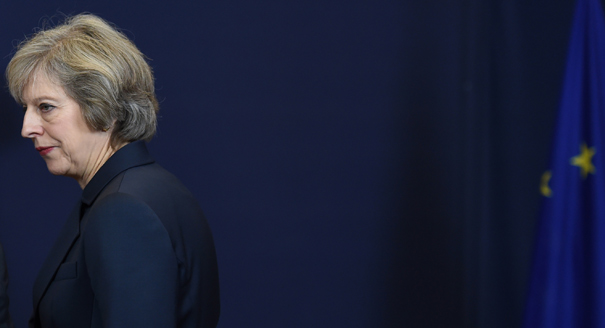
If President Donald Trump hopes he has found a loyal and willing ally from across the pond in Theresa May, who visits him on Friday, he could be in for a big surprise.
Yes, its an honor that the British prime minister becomes the first leader to meet Trump since his inauguration on Jan. 20. The symbolism itself ought to help rekindle the once special Anglo-American relationship.
But May is not going to Washington for any feel-good factor or to sign on to the administration’s controversial trade, energy and foreign policies.
She is going with her own shopping list that could be good news for Europe, good news for NATO and good news for those who want to promote multilateral trade deals. All the above may seem paradoxical as Britain prepares to leave the European Union.
But it is precisely because Britain is quitting the bloc that it joined back in 1973 that May, more than ever, needs a strong European Union, a strong NATO underpinned by the United States and an open trading system. Without all three, a post-E.U. Britain could find itself vulnerable.
“The linkage between Britain and the United States is going to be very important not only for Britain but for NATO and the E.U.,” Rem Korteweg, a foreign and security policy expert at the Center for European Reform, said in an interview.
It’s also because Trump sees things very differently.
When Britain voted to leave the union, Trump asked which country was next in line to quit the organization that the United States helped to build after World War II in order to strengthen a Western liberal order.
May, however, does not want a European community that is set on the path toward fragmentation.
“I know many fear that this might herald the beginning of a greater unraveling of the E.U.,” May said when setting out in a major speech this month the government’s negotiating objectives to leave the E.U. “But let me be clear: I do not want that to happen. It would not be in the best interests of Britain. It remains overwhelmingly and compellingly in Britain’s national interest that the E.U. should succeed.”
May’s second task is to convince Trump that NATO must remain the cornerstone of Western security and the transatlantic alliance. Trump is no fan of NATO. He has described the alliance as “obsolete.” That must be music to the ears of Vladimir Putin, who knows that NATO is the bastion of the Euro-Atlantic relationship.
May sees it differently. As Britain leaves the E.U., NATO will be London’s link to Europe. And since the E.U. is in no shape to establish its own security and defense structures, the Europeans are going to need Britain more than ever to persuade Trump that NATO matters for America’s European allies.
“May will seek to defend NATO,” Eamonn Butler, lecturer in Central and East European studies at the University of Glasgow, said in an interview. “NATO is Britain’s link to Europe and she understands its importance. She’ll want to make sure the Americans — meaning Trump — is on board,” Butler added. May has already spoken to NATO Secretary General Jens Stoltenberg about the “continued importance of the alliance.”
The third item on May’s list is trade. This is where Britain and the Trump administration are ideologically at odds. Britain has traditionally opposed any kinds of protectionism, while Trump is tearing up or renegotiating trade deals. In addition, Trump has warned American and foreign companies that he will impose heavy tariffs if they build plants outside the United States and then sell their goods to American markets. This is the last thing May wants as she negotiates her way out of the E.U.
Leaving the E.U. means Britain abandoning the single market, which is anchored on the free movement of people, labor, capital and goods. In its place, May will, as she said in her speech about leaving the E.U., “seek the greatest possible access to it through a new, comprehensive, bold and ambitious free-trade agreement.”
In the meantime, she added, she will look to Trump for a new trade deal. “President-Elect Trump has said Britain is not at the back of the queue for a trade deal with the United States, the world’s biggest economy, but front of the line,” she boasted. Korteweg said May was trying to use such a new trade accord as leverage in her exit talks with the E.U.
Don’t be so sure about any quick trade agreement, argued Andrew Sentance, senior economic adviser at PwC. “A more protectionist attitude to world trade following Donald Trump’s victory could limit these opportunities … if a change in U.S. policy starts to undermine the global trading system based on the WTO [World Trade Organization].”
It’s a scenario that Britain, the E.U and America’s other democratic trading partners fear. China would step in to set new rules and standards to replace the post-1945 Western multilateral institutions — designed by Washington — which, to May’s dismay, America’s new president is challenging.
This article was originally published by the Washington Post.

Nonresident Senior Fellow, Carnegie Europe
Judy Dempsey is a nonresident senior fellow at Carnegie Europe
Recent Work
Judy Dempsey
Judy Dempsey
Carnegie does not take institutional positions on public policy issues; the views represented herein are those of the author(s) and do not necessarily reflect the views of Carnegie, its staff, or its trustees.

The Plaza Accord was not an externally imposed punishment of Japan but part of a broader restructuring that Japanese economists and policymakers themselves recognized was necessary. Its effects were undermined, however, when Tokyo responded to the resulting slowdown with policies that exacerbated investment, credit expansion, and the very imbalances the adjustment was intended to resolve.

Michael Pettis

Trump has promised Belarus a massive potash deal. But Minsk is seeking something greater: restored Western transit and greater room for maneuver from Russia.

Balázs Jarábik

Before the next wave of EU enlargement takes place, the union needs to grapple with thorny questions of how power is distributed among its members.


Emil Sondaj Hansen, Ditte Brasso Sørensen

The real test may come after the leaders leave the room.



Sheena Chestnut Greitens, Oriana Skylar Mastro, Yukon Huang, …

The Horn of Africa countries are among those facing a new security calculus.


Andrew Leber, Lesley Anne Warner