

Commentary
Despite its flop at the box office, the film raises important questions for the climate community to answer.
Leonardo Martinez-Diaz
{
  "authors": [
    "Marc Grossman",
    "Tom West"
  ],
  "type": "legacyinthemedia",
  "centerAffiliationAll": "dc",
  "centers": [
    "Carnegie Endowment for International Peace"
  ],
  "collections": [],
  "englishNewsletterAll": "ctw",
  "nonEnglishNewsletterAll": "",
  "primaryCenter": "Carnegie Endowment for International Peace",
  "programAffiliation": "SAP",
  "programs": [
    "South Asia"
  ],
  "projects": [],
  "regions": [
    "North America",
    "United States",
    "South Asia",
    "Afghanistan"
  ],
  "topics": [
    "Security",
    "Foreign Policy"
  ]
}
Source: Getty
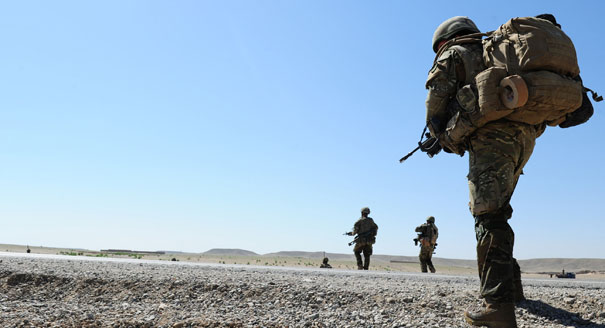
Sending more U.S. troops to Afghanistan is a risk worth taking in the U.S. national interest, so long as it is as part of an integrated strategy for Central and South Asia.
Source: Yale Global Online
WASHINGTON: President Donald Trump is the third US commander in chief in 16 years to consider a surge of American forces into Afghanistan. He has delegated authority to Secretary of Defense James Mattis to decide whether – and if so, how many – more US troops should join the approximately 8,400 already in Afghanistan. As Mattis contemplates this decision, he must recall the observation of baseball legend Yogi Berra – “It’s déja vu all over again.”
In deciding whether to deploy additional troops, Mattis will take as his starting point recommendations of US commanders in the field and surely consider the following questions:
The authors believe Secretary Mattis should commit up to 5,000 additional US troops, without setting a timeline for ending their deployment, to do two jobs: First, keep Afghanistan and the region from again becoming the platform for an attack on the US homeland, or US interests abroad including its friends and allies. And second, train, equip and support the Afghan security forces in their struggle with the Taliban. The fight against the Taliban should remain the Afghans’ fight, but the United States should have the patience and courage to support them.
Much could go wrong, and quickly. For example, sustained attacks on US forces by Taliban infiltrators – the so-called “green on blue killings” – could undermine American public support for an increased US presence.
If Mattis decides to deploy additional troops, he should make clear to his cabinet colleagues that an increase in military effort requires a national, “whole of government strategy.” Diplomats, US Agency in International Development specialists and others in the government must keep doing their part to support those in Afghanistan committed to maintaining gains and making more progress while keeping the region focused on its responsibilities toward Afghanistan.
For example, the US agencies involved must structure policies, including specific disincentives if required, to end Pakistan’s toleration of Taliban safe havens on Pakistani territory and to keep the Kabul government from devolving into an endless and unproductive struggle for power and patronage, especially leading up to the 2019 presidential election.
Finally, to return to a theme highlighted by Marc Grossman in YaleGlobal, the United States can work with China on Belt and Road Initiative projects that support a sustainable Afghan economy. The Trump administration was right to send a delegation to the Belt and Road Initiative Summit in Beijing in May. A good next step would be for the United States to join the Asian Infrastructure and Investment Bank.
The authors have both worked to support US goals in Afghanistan and the region, but this is a close call even for us. We are not slaves to the “credibility” argument, especially when so many lives are put at risk. There are consequences for action or inaction. It is not in America’s interests to leave Afghanistan to its current trajectory, with the Taliban controlling ever larger swaths of the country, seeking to topple the Kabul government and allowing growing safe havens for both ISIS and al Qaeda.
On a visit to Pakistan and Afghanistan in early July, US senators John McCain and Lindsey Graham expressed support for additional troops, but added that “throwing more bombs” is not enough. The United States must engage and influence regional leaders, rallying them to provide more support to the struggling government in Kabul.
The senators are right. Sending more US troops is a risk worth taking in the US national interest, so long as it is as part of an integrated strategy for Central and South Asia – Yogi Berra’s warning notwithstanding.
This article was originally published in Yale Global Online.
Marc Grossman
Ambassador Marc Grossman is a vice chairman of the Cohen Group. A US Foreign Service Officer for 29 years, he retired in 2005 as Under Secretary of State for Political Affairs. The ambassador was the US Special Representative for Afghanistan and Pakistan, 2011 to 2012, and a Kissinger Senior Fellow at Yale in 2013.
Former Nonresident Scholar, South Asia Program
Tom West was a nonresident scholar in the South Asia Program at the Carnegie Endowment for International Peace and an associate vice president at the Cohen Group.
Carnegie does not take institutional positions on public policy issues; the views represented herein are those of the author(s) and do not necessarily reflect the views of Carnegie, its staff, or its trustees.

Despite its flop at the box office, the film raises important questions for the climate community to answer.

Leonardo Martinez-Diaz

Funding Ukraine remains a priority for European leaders. As Russia’s war of aggression heads into another winter, two feasible options to mobilize support for Kyiv should be fast-tracked.


Vladyslav Rashkovan, Gregory P. Wilson

Russian strikes are weakening the economy sustaining Ukraine’s war effort. Closing the growing funding gap will require more European support and politically contentious reforms in Kyiv.

Balázs Jarábik

In an interview, Rozina Ali discusses her new book on the rise and manifestations of Islamophobia in the United States.

Michael Young

While the EU and European governments are embracing the much-lauded middle-power moment, this entails three difficult conundrums.

Richard Youngs