

Research
- +6
Yasmine Farouk, Nathan J. Brown, Maysaa Shuja Al-Deen, …
{
  "authors": [
    "Anouar Boukhars"
  ],
  "type": "other",
  "centerAffiliationAll": "dc",
  "centers": [
    "Carnegie Endowment for International Peace",
    "Malcolm H. Kerr Carnegie Middle East Center"
  ],
  "collections": [
    "Arab Awakening"
  ],
  "englishNewsletterAll": "menaTransitions",
  "nonEnglishNewsletterAll": "",
  "primaryCenter": "Carnegie Endowment for International Peace",
  "programAffiliation": "MEP",
  "programs": [
    "Middle East"
  ],
  "projects": [],
  "regions": [
    "North Africa",
    "Tunisia",
    "Maghreb"
  ],
  "topics": [
    "Political Reform",
    "Democracy",
    "Security"
  ]
}
Source: Getty
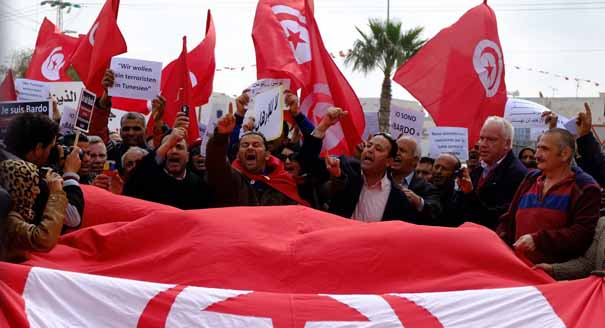
Tunisia’s unemployment rate and sharp regional economic inequalities are undermining faith in elite settlements and state institutions.
Source: African Security Review
Six years after the revolution that ousted Zine El-Abidine Ben Ali, Tunisia remains in flux. On the face of it, the country should be celebrated for transitioning from political ferment to consensual normalcy. Unfortunately, there is more to Tunisia’s transition to consensual politics than meets the eye. The country is still caught in a turbulent grey zone where strong authoritarian tendencies threaten to pull down the country’s tortuous march towards democratic stability. Some developments are particularly worrisome. The old authoritarian discourse emphasising stability and law and order has regained credence. The repressive habits of the police and security services are also back in full swing. The outlook for democratic stability darkens as the chasm between ordinary citizens and political elites expands. The lurch towards illiberalism and the failure of the successive postrevolutionary governments to make even the slightest dent in Tunisia’s dreadful unemployment rate and sharp regional economic inequalities are undermining faith in elite settlements and state institutions...
The full text of this article can be found at the African Security Review.
Former Nonresident Fellow, Middle East Program
Boukhars was a nonresident fellow in Carnegie’s Middle East Program. He is a professor of countering violent extremism and counter-terrorism at the Africa Center for Strategic Studies, National Defense University.
Recent Work



Yasmine Farouk, Nathan J. Brown, Maysaa Shuja Al-Deen, …

Frederic Wehrey, Nathan J. Brown, Bader Al-Saif, …
Carnegie does not take institutional positions on public policy issues; the views represented herein are those of the author(s) and do not necessarily reflect the views of Carnegie, its staff, or its trustees.
Fatima El Mansouri is the country’s first female prime minister. She’s also a privileged insider in a largely ceremonial position.

Sarah Yerkes

The domestic impacts of how long it is taking to end the war in Ukraine have pushed the French electorate to the political extremes and compromised the country’s diplomatic capacity.

Rym Momtaz

Sergei Kiriyenko used Russia’s parliamentary vote to further hone his strategy of corporate mobilization that is designed to maximize votes for United Russia.

Andrey Pertsev

Before the next wave of EU enlargement takes place, the union needs to grapple with thorny questions of how power is distributed among its members.


Emil Sondaj Hansen, Ditte Brasso Sørensen

The Horn of Africa countries are among those facing a new security calculus.


Andrew Leber, Lesley Anne Warner