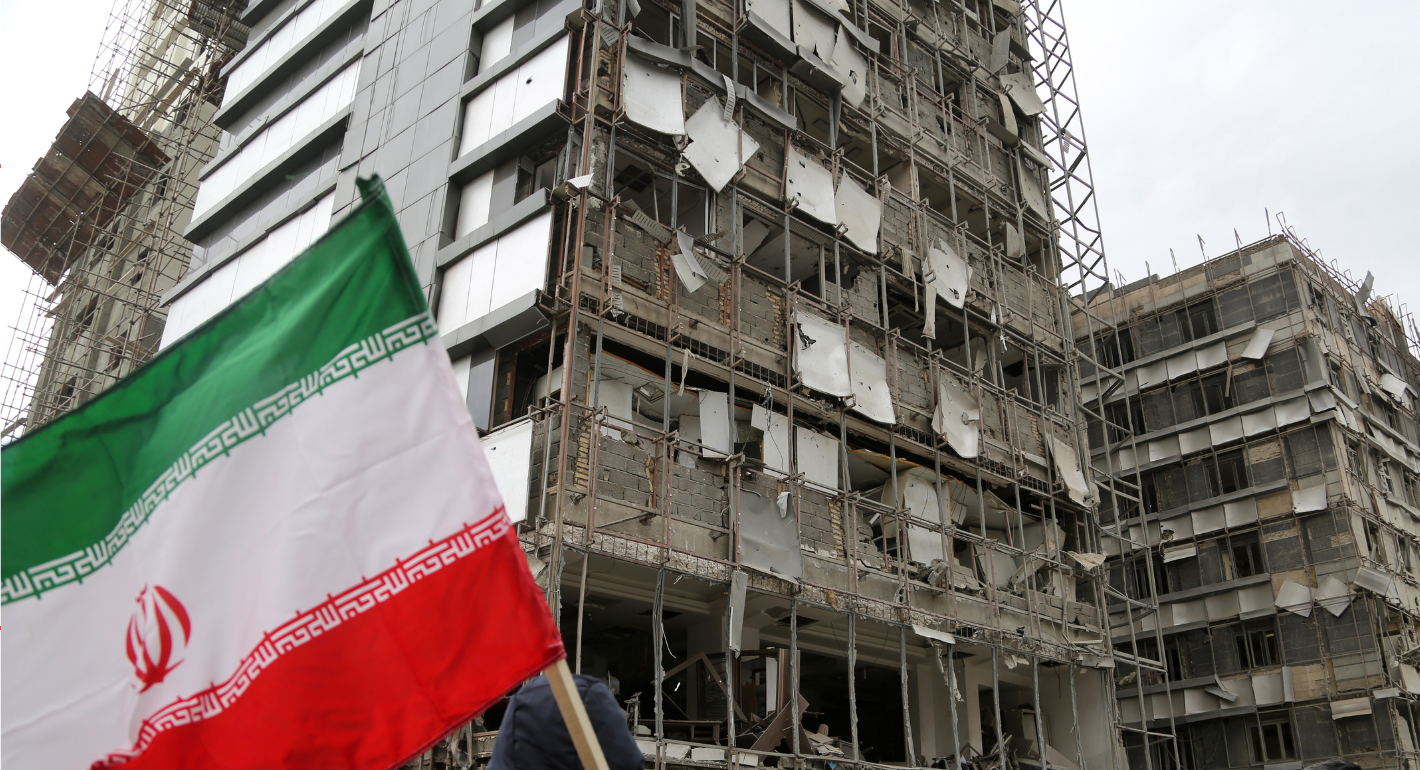
Tehran may conclude that its ability to disrupt the global economy via the Strait of Hormuz provides enough deterrence to begin quietly rebuilding its nuclear program.
Jane Darby Menton, Mohammad Ayatollahi Tabaar
{
"authors": [
"Vipin Narang",
"Ankit Panda"
],
"type": "other",
"centerAffiliationAll": "dc",
"centers": [
"Carnegie Endowment for International Peace"
],
"collections": [
"Korean Peninsula"
],
"englishNewsletterAll": "ctw",
"nonEnglishNewsletterAll": "",
"primaryCenter": "Carnegie Endowment for International Peace",
"programAffiliation": "NPP",
"programs": [
"Nuclear Policy"
],
"projects": [],
"regions": [
"East Asia",
"North Korea"
],
"topics": [
"Nuclear Policy"
]
}Source: Getty
Could a president’s overconfidence in U.S. defensive systems lead to deadly miscalculation and nuclear armageddon? Yes, it could.
Source: War on the Rocks
Could a president’s overconfidence in U.S. defensive systems lead to deadly miscalculation and nuclear armageddon? Yes. Yes, it could. Last Wednesday, referring to potential American responses to North Korea’s missile and nuclear program, President Donald Trump told Sean Hannity “We have missiles that can knock out a missile in the air 97 percent of the time, and if you send two of them it’s gonna get knocked out.” If Trump believes — or is being told — that American missile defenses are that accurate, not only is he factually wrong, he is also very dangerously wrong. This misperception could be enough to lead the United States into a costly war with devastating consequences.
Here’s why: If Trump believes U.S. missile defenses work this effectively, he might actually think a first strike attempt to disarm North Korea of its missile and nuclear forces would successfully spare U.S. cities from North Korean nuclear retaliation. They probably wouldn’t. Believing that each ground-based midcourse missile defense (GMD) interceptor can provide anything close to a 97 percent interception rate against retaliation raises the temptation to attempt a so-called “splendid first strike” based on the assumption that missile defenses can successfully intercept any leftover missiles North Korea could then fire at the United States.
In this article, we first lay out the complexity of American missile defenses and explain why it’s way off the mark to believe U.S. ground-based missile defense interceptors are even close to as effective as Trump suggested. We then explain how overconfidence in national missile defense may tempt the president to consider a first strike with no actual guarantee that it can spare an American city — or multiple cities — from potential North Korean thermonuclear retaliation. For a president who has already expressed an inclination to visit “fire and fury” on Kim Jong Un and threatened to “totally destroy” his country, we’re obligated to take Trump’s misplaced confidence in GMD very seriously. His attraction to attempting a first strike will only grow if he is blind to an important gap in U.S. defenses. Not only might he still want to denuclearize North Korea by force, he might think it is actually possible to do so without putting the U.S. homeland at risk.
This article was originally published in War on the Rocks
Former Nonresident Scholar, Nuclear Policy Program
Vipin Narang was a nonresident scholar in the Nuclear Policy Program at the Carnegie Endowment for International Peace.
Stanton Senior Fellow in the Nuclear Policy Program at the Carnegie Endowment for International Peace
Ankit Panda is the Stanton Senior Fellow in the Nuclear Policy Program at the Carnegie Endowment for International Peace.
Carnegie does not take institutional positions on public policy issues; the views represented herein are those of the author(s) and do not necessarily reflect the views of Carnegie, its staff, or its trustees.
Tehran may conclude that its ability to disrupt the global economy via the Strait of Hormuz provides enough deterrence to begin quietly rebuilding its nuclear program.
Jane Darby Menton, Mohammad Ayatollahi Tabaar
Tokyo would have to surmount a lot of obstacles—not least Western sanctions—if it wanted to return Russian oil imports to even modest pre-2022 volumes.
Vladislav Pashchenko
The 1986 incident showed that a nuclear accident anytime is a nuclear accident for all time.
Corey Hinderstein
The debate over AI and work too often centers on displacement. Facing aging populations and shrinking workforces, East Asian policymakers view AI not as a threat, but as a cross-sectoral workforce strategy.
Darcie Draudt-Véjares, Sophie Zhuang
In its version of an AI middle power strategy, Seoul is pursuing alignment with the United States not as an endpoint but as a strategy to build industrial and geopolitical leverage. Whether this balance holds remains an open question.
Darcie Draudt-Véjares, Seungjoo Lee