

Commentary
Russian strikes are weakening the economy sustaining Ukraine’s war effort. Closing the growing funding gap will require more European support and politically contentious reforms in Kyiv.
Balázs Jarábik
{
  "authors": [
    "Maxim Vikhrov"
  ],
  "type": "commentary",
  "centerAffiliationAll": "",
  "centers": [
    "Carnegie Endowment for International Peace",
    "Carnegie Russia Eurasia Center"
  ],
  "collections": [],
  "englishNewsletterAll": "",
  "nonEnglishNewsletterAll": "",
  "primaryCenter": "Carnegie Russia Eurasia Center",
  "programAffiliation": "",
  "programs": [],
  "projects": [
    "Eurasia in Transition"
  ],
  "regions": [],
  "topics": [
    "Economy"
  ]
}
Source: Getty
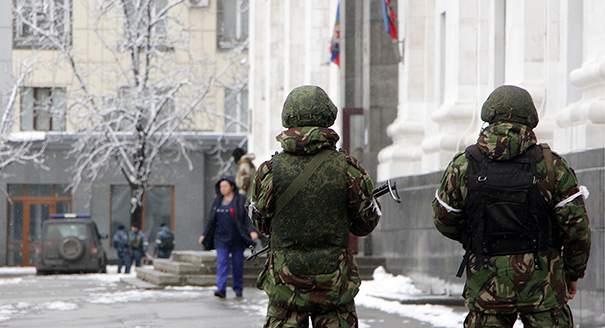
Last week’s events change little on the ground in the so-called “Luhansk People’s Republic.” They do, however, demonstrate the degree to which Moscow cannot control the strategically important region. Despite the Kremlin’s best efforts, conflict between local authorities grew so out of hand that Moscow was forced to send armed reinforcements.
The past week’s events in the rebel-held Luhansk region of eastern Ukraine caught many observers off guard and sparked a wave of rumors and interpretations. The theories ranged from a special operation by the Ukrainian security services to a merger between the unrecognized Luhansk People’s Republic (LPR) and the neighboring Donetsk People’s Republic (DPR).
Reality, however, is much simpler: for over two years, LPR leader Igor Plotnitsky has been in conflict with the siloviki (representatives of the security agencies). Despite all the commotion, last week’s “Luhansk coup” will not meaningfully alter the situation on the ground. Rather, it demonstrates the limits of Moscow's control over the LPR.
Plotnitsky’s open conflict with the siloviki dates back to October 2015, when the LPR’s “State Security Ministry” (MGB) arrested Dmitry Lyamin, the LPR “energy minister” and a Plotnitsky associate. As is standard practice in the “republic,” they accused him of working for Ukraine.
Plotnitsky came to Lyamin’s defense and accused the MGB of acting arbitrarily. He dismissed “State Security Minister” Leonid Pasechnik until the situation could be clarified, publishing this order on local internet resources. In response, the MGB announced that government websites had been attacked by Ukrainian hackers and labeled Pasechnik’s firing fake news designed to provoke conflict between the siloviki and the republic’s leadership.
The LPR’s “Interior Ministry”—led by Igor Kornet—took the MGB’s side. Both law enforcement ministries pressed new charges against Lyamin and announced plans to fight corruption among the LPR authorities. LPR “Prime Minister” Gennady Tsypkalov, field commander Pavel Dryomov, and also the “mayors” of several Luhansk region towns backed law enforcement.
Next, the siloviki attempted to bring the conflict into the public sphere. The MGB issued a permit for a marginal LPR civic organization to hold an improvised protest against corruption in the “republic.” However, Plotnitsky loyalists prevented the demonstration. The situation was headed for an armed conflict when suddenly—and possibly after the LPR’s Russian curators intervened—the two sides managed to halt the confrontation. Plotnitsky and the siloviki announced they would fight corruption together.
Nonetheless, the conflict continued backstage. Plotnitsky’s enemies accused Lyamin of appropriating several gas stations and kept him under arrest. In response, the LPR “Prosecutor General”—a Plotnitsky loyalist—arrested a local MGB branch chief.
Over a month later, in December 2015, field commander Dryomov was killed in a car bombing. Then, in August 2016, Plotnitsky’s car was bombed in Luhansk. He survived with relatively light wounds, but it was clear that someone wanted to kill or scare the LPR leader.
Shortly thereafter, Plotnitsky announced that the “republic” had managed to prevent an attempted coup. The Donetsk separatists sent reinforcements to Luhansk, and the LPR launched a series of reprisals against the alleged conspirators. Among the victims was LPR “Prime Minister” Gennady Tsypkalov. He was tortured and eventually killed. The confrontation continued in 2017. In February, Oleg Anashchenko, chief of the LPR “People’s Militia,” was killed in a car bombing.
The current round of conflict began in September, when the LPR “parliament” criticized the “Interior Ministry” and accused its leader, Kornet, of residing in an illegally appropriated house. Plotnitsky publicly evicted Kornet from the house and, on November 20, sacked the “minister.” However, the next day, the “Interior Ministry” announced that its officers recognized only Kornet as their chief. The “ministry” also called the accusations against Kornet fabricated.
Kornet himself denied being fired and accused officials close to Plotnitsky of working with the Ukrainian security services. He also alleged that the 2016 coup attempt was invented to justify repressions.
This time, the siloviki took decisive action. On November 21, armed men blocked off the city center and temporarily cut television, radio, and mobile service. That evening, a convoy of military vehicles from the DPR entered Luhansk. Later, the DPR’s “State Security Ministry” announced that it was conducting joint “anti-diversion measures” with LPR law enforcement.
On November 22, the siloviki seized the LPR “State Prosecutor’s Office” building and started detaining functionaries close to Plotnitsky. In a press conference, Kornet announced a special operation to neutralize Ukrainian agents who had infiltrated the highest echelons of the LPR and were preparing to return the “republic” to Kiev’s control. Additionally, the detained officials were accused of fabricating the 2016 coup attempt.
Although the siloviki never targeted Plotnitsky directly, on November 22, the Luhansk leader described their actions as an attempted coup in a video address. In response, the “Interior Ministry” declared the video a fake. Then, on November 23, the MGB took Kornet’s side and Plotnitsky departed for Moscow.
Broadly speaking, the situation in Luhansk is clear: since 2014, Plotnitsky has struggled to build his own power vertical, using extremely harsh methods in the fight to eliminate competitors. Moscow backed his efforts in order to make the “republic” more manageable.
However, the exact nature of Plotnitsky’s conflict with the Luhansk siloviki remains murky. It could be a power struggle or a fight for control over financial flows into the LPR. Regardless, given both sides’ tendency toward violence, there was never a meaningful chance that the conflict would stay behind the scenes. The only deterrent was the fact that Plotnitsky, Kornet, and the local siloviki are all components of the puppet regime established by Moscow.
Since 2014, Moscow has exerted enormous efforts to grant the “republic” and Plotnitsky himself a veneer of legitimacy. It staged a “referendum” and “elections,” and created a “parliament” and other nominal state structures. After all, it’s one thing when the two separatist “republics” are represented in the Minsk negotiations by people who have—at least formally—been elected to office. It’s quite another when these people came to power in a coup. Perhaps this is why Plotnitsky was not killed.
Nonetheless, the damage has been done: during the struggle, neither side shied away from releasing compromising information on the other. The public now knows Kornet lived in a stolen home and that torture and false charges are widespread practices in the LPR.
The Luhansk events demonstrate that Moscow cannot maintain order in this strategically important city. In fact, the situation grew so bad that Russia’s Luhansk puppets could only be pacified with the help of an armed contingent from Donetsk.
Moscow may have prevented an internal war in Luhansk, but Plotnitsky isn’t coming back to power. On November 25, he resigned (formally for health reasons) and was appointed as the LPR’s plenipotentiary to the Minsk process. Power in the “republic” was transferred to the siloviki, with MGB head Leonid Pasechnik becoming the acting LPR leader. But don’t expect meaningful changes in Luhansk. The “republic” will remain under Moscow’s general administration, awaiting denouement in the Donbas.
Maxim Vikhrov
Carnegie does not take institutional positions on public policy issues; the views represented herein are those of the author(s) and do not necessarily reflect the views of Carnegie, its staff, or its trustees.

Russian strikes are weakening the economy sustaining Ukraine’s war effort. Closing the growing funding gap will require more European support and politically contentious reforms in Kyiv.

Balázs Jarábik
Economic recovery has brought Sri Lanka a modicum of stability, but domestic strains and great-power rivalry could test how long it lasts.
Avinash Paliwal
Policy proposals on sovereign debt must both match the scale of the challenge and be implementable within existing political constraints.
David McNair

For every ruble allocated to social policy, health, and education in 2027, double that amount is earmarked for the army, the police, and the security services.

Alexandra Prokopenko

The European Commissioner for Trade is headed to China. But after President Xi’s bridge-building visit to Washington, can a more isolated EU overcome Beijing’s stranglehold on critical raw materials? Who will blink first?

Rym Momtaz, ed.