

Commentary
Marc Lynch
{
  "authors": [
    "Marc Lynch"
  ],
  "type": "legacyinthemedia",
  "centerAffiliationAll": "dc",
  "centers": [
    "Carnegie Endowment for International Peace",
    "Malcolm H. Kerr Carnegie Middle East Center"
  ],
  "collections": [],
  "englishNewsletterAll": "menaTransitions",
  "nonEnglishNewsletterAll": "",
  "primaryCenter": "Carnegie Endowment for International Peace",
  "programAffiliation": "MEP",
  "programs": [
    "Middle East"
  ],
  "projects": [],
  "regions": [
    "North America",
    "United States",
    "Middle East",
    "Israel",
    "Palestine",
    "Levant"
  ],
  "topics": [
    "Political Reform",
    "Foreign Policy"
  ]
}
Source: Getty
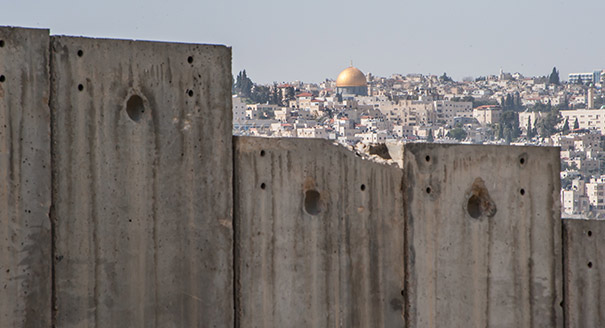
President Trump announced a radical departure in U.S. Middle East policy by declaring the United States’ recognition of Jerusalem as the capital of Israel.
Source: Washington Post
President Trump announced a radical departure in U.S. Middle East policy on Wednesday by declaring the United States’ recognition of Jerusalem as the capital of Israel. This recognition fulfilled a campaign promise and delivered on a long-standing Israeli demand, while infuriating Palestinians, Arabs and most of the international community. Although it will take years for a new U.S. Embassy to open, and Trump carefully noted that the borders of Jerusalem would have to be determined through negotiations, there was a strong sense of an irrevocable shift.
Here are three things to understand about the regional politics of Trump’s Jerusalem gambit.
Much of the commentary about the recognition has focused on its effect on Israeli-Palestinian negotiations. This is probably overstated.
The status of Jerusalem has always been one of the key issues set aside for final status negotiations. Recognizing Jerusalem as Israel’s capital has traditionally been understood as a major concession that could be offered to Israel in exchange for an agreement on other issues such as borders, settlements or the return of Palestinian refugees. Trump gave Israel this prize for nothing, while offering Palestinians nothing of consequence in exchange. While preemptively giving away a prime bargaining chip seems like an odd negotiating tactic, a number of commentators and former diplomats have made the case that moving the U.S. Embassy to Jerusalem could actually help peace negotiations.
Most likely, the recognition of Jerusalem will have none of the promised benefits for negotiations and relatively few of the threatened costs. This is not because Jerusalem does not matter, but rather because there is no real peace process to disrupt, little meaningful prospect for a two-state solution to squander, and little belief in U.S. neutrality to violate.
Despite the occasional diplomacy, there has not been any meaningful Israeli-Palestinian peace process since the 2000 failure of the Clinton administration’s Camp David Summit. The George W. Bush administration began peace talks only belatedly and to little effect. The Obama administration quickly backed away from its more serious bid for peace talks in the face of political backlash, negotiating stalemate and a need to focus on other critical priorities such as the Iran nuclear agreement. In the intervening decades, the realities on the ground have changed immeasurably, and probably irrevocably, in ways that have made a two-state solution untenable.
It does matter, however, that Trump’s gambit may derail peace negotiations, which have long played an important role in facilitating other regional objectives. The visible pursuit of peace, if not its achievement, has long been the mechanism by which the United States reconciles its alliances with Israel and with ostensibly anti-Israel Arab states. Trump’s gamble has less to do with peace than with whether this cover is still needed.
For all its tactical and messaging incoherence, the Trump administration has been pursuing a fairly clear Middle East strategy that is well within the bounds of the normal. At the broadest level, Trump seeks to bring key Arab states and Israel together in a strategic alliance against Iran and Islamic extremism. There is nothing new about such an ambition. Every U.S. administration has sought to reconcile the contradictions of simultaneous alliance with Israel and with key Arab states. Each administration has concluded, either initially or after hard experience, that the pursuit of Israeli-Palestinian peace is necessary to sustain that regional architecture. With Egypt and Jordan locked in to American-brokered peace treaties, the focus of these efforts has long been Saudi Arabia and the other Gulf states.
Trump’s Jerusalem gamble is thus less about the prospects for Israeli-Palestinian peace than about whether Arab-Israeli alliance against Iran can be achieved in its absence. Israel’s tacit cooperation with Gulf states against Iran, long kept in the shadows, has increasingly been brought into the open despite the absence of Israeli-Palestinian peace. The Jerusalem gambit may well force a public reckoning over this semiprivate alignment.
The major trends in regional politics could well make this gamble pay off. Saudi Arabia and its key partners have made it clear that they view regional confrontation with Iran as their most urgent strategic priority. Arab regional politics are profoundly polarized and fragmented, in part because of the six-month-old Saudi-United Arab Emirates campaign against Qatar. Saudi Crown Prince Mohammed bin Salman has reveled in shattering norms over the course of his rapid consolidation of power. After his startling arrest of hundreds of princes, treatment of Lebanese Prime Minister Rafik Hariri and stubborn disregard for the humanitarian costs of the blockade of Yemen, who could rule out another transgression against the old rules of Arab politics?
Palestinian territories continues to be one of the few unifying issues among these deeply divided Arab publics. There is little question that Arabs still care deeply about Palestinian territories, or that Jerusalem has particularly salient emotional and political resonance. That concern may be latent, but survey research and social media data alike show that it is real and intense. The key question is whether this public opinion can have any meaningful effect on the policies of Arab states. Arab public attention in recent years has been focused on the wars in Syria and Yemen, and on domestic political turbulence. Public mobilization in most Arab countries faces steep obstacles following the harsh resurgence of brutal forms of authoritarianism.
Arab regimes thus far have aligned themselves with public anger over Jerusalem, suggesting that they understand the need to tread carefully. A regional focus on Palestinian territories would tilt the political balance away from the Saudi-UAE bloc and could offer its Qatari rivals a political lifeline. Even Arab regimes closely aligned with the United States have publicly criticized the recognition of Jerusalem, and allowed critical views to appear even in usually tightly controlled media and public space. They probably fear losing political ground to Qatar, as well as to Iran, popular movements, or to media platforms such as Al Jazeera that embrace mobilization over Jerusalem. They also cannot help but fear anything that brings protests back into the streets, rekindling the hopes for political change from below which regimes have systematically sought to extinguish over the past five years.
The dynamics are similar to the political fallout over Israel’s wars against Hamas in Gaza. The key question is whether Arab regimes do anything more to protest the recognition, or return to cooperation with the United States and Israel against Iran once the passions have faded. The Trump administration is probably right that they will do so quickly, barring the emergence of serious, sustained Palestinian mobilization that forces them into a tougher stance.
This article was originally published in the Washington Post.
Former Nonresident Senior Fellow, Middle East Program
Marc Lynch was a nonresident senior fellow in Carnegie’s Middle East Program where his work focuses on the politics of the Arab world.
Recent Work
Marc Lynch
Marc Lynch
Carnegie does not take institutional positions on public policy issues; the views represented herein are those of the author(s) and do not necessarily reflect the views of Carnegie, its staff, or its trustees.

Despite public disputes over trade and immigration, the strategic partnership’s foundations remain sturdy.

Sameer Lalwani

It signals a new era of tech diffusion and warfare.

Steve Feldstein

With its public finances in shambles, the far right polling at 35 percent ahead of the 2027 presidential election, and a growing protest movement, is France’s crisis a threat to the EU’s geopolitical awakening?

Rym Momtaz, ed.

Putin’s conservative staffing policies and search for ever greater control have cemented parliament’s transformation into a bureaucratic appendage of the executive branch.

Andrey Pertsev

Ahead of a tough winter for Ukraine, Donald Trump’s swing back toward Russia bodes ill. But instead of panicking, Kyiv’s European allies are focusing on action.
Rym Momtaz