

Q&A
Paul Haenle, Philippe Le Corre
{
  "authors": [
    "Philippe Le Corre"
  ],
  "type": "legacyinthemedia",
  "centerAffiliationAll": "dc",
  "centers": [
    "Carnegie Endowment for International Peace",
    "Carnegie China"
  ],
  "collections": [],
  "englishNewsletterAll": "asia",
  "nonEnglishNewsletterAll": "",
  "primaryCenter": "Carnegie Endowment for International Peace",
  "programAffiliation": "AP",
  "programs": [
    "Asia",
    "Europe"
  ],
  "projects": [],
  "regions": [
    "East Asia",
    "China",
    "Western Europe",
    "France",
    "Iran"
  ],
  "topics": [
    "Foreign Policy"
  ]
}
Source: Getty
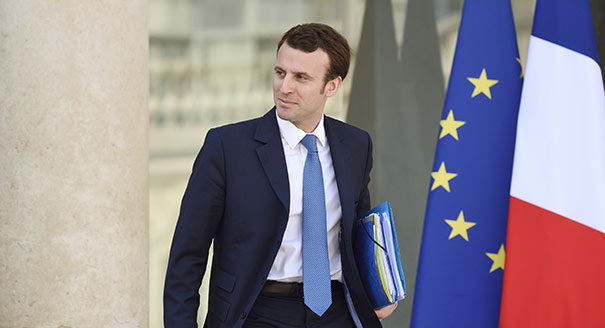
The French president was charming but also sent a message as Beijing searches for an EU partner.
Once again, timing has been fruitful for Emmanuel Macron, who was unexpectedly elected president of France last year, less than two years after creating his own political party.
This week, he became the first European head of state to meet President Xi Jinping since the 19th Communist Party congress was held in October. During his trip, Macron masterfully struck a balance between being charming and sending a message. He played “horse diplomacy” by offering his host a French horse called Vesuvius and delighted Chinese social media with a video of him learning to say “make the planet great again” in Mandarin.
It was a double act for Macron, as Europe’s newest leader. He visited China primarily as the French president and insisted on the bilateral relationship. He brought along 50 top French executives and oversaw several business deals in sectors such as food, financial services, catering and industry. For example, China agreed to lift a 16-year embargo on French beef within six months. Meanwhile, the biggest deal – construction of a radioactive waste processing plant in China by EDF and Areva – is still under negotiation, while Airbus, headquartered in Toulouse, France, will be producing more planes in China by 2020 through an “enhanced partnership in Tianjin” (arguably quite different from a straight commercial order by China).
Diplomatically, Macron addressed the Syrian crisis and the Korean peninsula with Xi, and asked for Chinese support in counterterrorism efforts on the African continent. And China agreed to work with France on a spring conference on fighting terror financing.
He also successfully appeared as one of Europe’s standard-bearers. In one of his speeches, he declared that “Europe is back”. In the eyes of a slightly sceptical Chinese public, it may have been preposterous, although France is perhaps the best-known European country in Chinese public opinion. The visit by its energetic, 40-year-old leader has attracted quite a bit of interest – not just for his charm and Chinese-language attempts. After all, China wants to increase its presence on the world stage, hence the need for more partners at a time when the United States under Donald Trump appears to be pulling back.
In the current context, Macron is Europe’s most recognisable face: German Chancellor Angela Merkel, who has been in power for 12 years, is struggling to put together a coalition government although she seems to see the end of the tunnel in her negotiations with her potential partner the SPD; Italy is facing uncertain parliamentary elections this spring; Spain has been focusing on the Catalonia crisis; and the United Kingdom is busy sorting out its fate both within Europe and as a stand-alone member of the international community once it will finally be out of the European Union. Prime Minister Theresa May will be the next European leader to visit Beijing in late January, but her message will clearly be of a different nature. While France has been firmly at the core of the EU since Macron’s election, Britain is looking for friends and economic partners to go through an uncertain future.
One concrete aspect of Macron’s European discourse has been the economy. In Xian, he threw his support behind Xi’s “Belt and Road Initiative” to revive trade routes connecting Asia and Europe. But he insisted that the new roads “should not be those of a new hegemony, which would transform those that they cross into vassals”. In other words, “If they are roads, they cannot be one-way”.
There is a sense, in Europe, that the trade and infrastructure plan is more about China’s ambition than about other countries’ economies, hence the lack of a firm EU commitment on the whole concept.
As for Chinese investments, they are mostly welcome, Macron said, but there have been increasing calls for reciprocity. The EU Chamber of Commerce in China, for example, made this clear in its annual report. It was a point the French leader wanted to stress, too. “The EU need to have a more coordinated approach to give China more visibility … We want to facilitate Chinese investments in Europe in predefined sectors … just as China want to facilitate European investments in sectors it will have defined,” Macron said.
Since September, discussions have been under way within the EU to start screening foreign investments – not specifically Chinese – in sensitive technological sectors or infrastructure.
During the visit, Macron also called for China and Europe to work together on climate change. As the host of the 2015 climate pact, France is willing to implement the deal and China also wants to make a difference following Trump’s decision to pull out of the accord. China and France said they would take “joint leadership” on the issue.
As permanent members of the UN Security Council, the two countries certainly had a lot to talk about. Macron has almost five years to deliver, especially on the French economy, and there is no doubt that he wants to make a difference. But China is also searching for a European partner, and France, as one of the most politically stable countries within the EU, fits the bill.
This article was originally published in South China Morning Post.
Former Nonresident Senior Fellow, Europe Program
Philippe Le Corre was a nonresident senior fellow in the Europe Program at the Carnegie Endowment for International Peace.
Recent Work

Paul Haenle, Philippe Le Corre

Erik Brattberg, Philippe Le Corre, Paul Stronski, …
Carnegie does not take institutional positions on public policy issues; the views represented herein are those of the author(s) and do not necessarily reflect the views of Carnegie, its staff, or its trustees.

The acknowledgment has sparked fears of a new arms race with China and Russia.

Chris O’Meara
Smaller powers cannot go it alone, but Canadian history shows that integration with the United States will not always be benign.
Paul Samson

The European Commissioner for Trade is headed to China. But after President Xi’s bridge-building visit to Washington, can a more isolated EU overcome Beijing’s stranglehold on critical raw materials? Who will blink first?

Rym Momtaz, ed.

The summit may be remembered as a fatal blunder, when Washington, Beijing, and the AI industry collectively chose ceremony over action.

Jeffrey Prescott

European NATO countries are wrestling with the possibility of U.S. disengagement from the alliance. With the continent’s security increasingly uncertain, governments must restore the credibility of their collective defense.



Hans-Dieter Lucas, Adam Thomson, Pierre Vimont