Source: Studies in Indian Politics
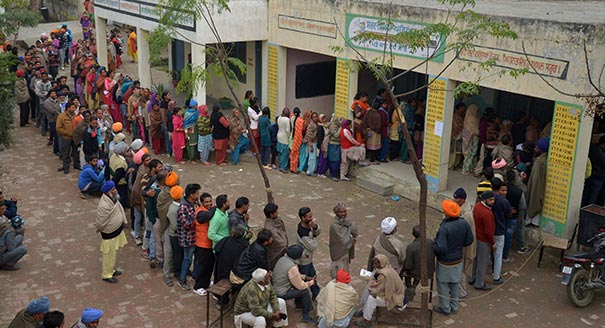
There is a longstanding, widely held belief in India that a positive increase in voter turnout is inherently anti-incumbent in nature. While the origins of this folk wisdom are indeterminate, statements in support of this contention are repeated ad nauseam nearly every election cycle. Proponents of this view argue that positive turnout growth—that is, an increase in voter turnout in the current election relative to the previous election—signals that the electorate is in a mood for change and, hence, the electoral fortunes of the incumbent government will be adversely affected. For instance, when discussing the growth in voter turnout in India’s May 2014 general election relative to the previous election in 2009, economist Surjit Bhalla claimed that ‘such a phenomena [sic] always goes against the incumbent. It is, if you will, bad news for the incumbent’ (Firstpost, 2014). After the 2016 state elections in Tamil Nadu, one election analyst proclaimed that ‘It is true that a huge voter turnout actually indicates an anti-incumbency wave. People turn up in huge numbers to vote out the government’ (Naig, 2016).
Given the widespread belief in a close connection between increasing voter turnout and anti-incumbency sentiment, it is surprising that there have been few (if any) systematic analyses of this relationship in the Indian context. Indeed, aside from the occasional newspaper opinion piece, we struggled to locate even one empirical analysis of the statistical relationship between turnout and incumbency in a scholarly publication. While in-depth analyses may be lacking, many experts have nevertheless begun to cast doubt on the conventional narrative in recent years. One of India’s leading election experts, Sanjay Kumar, told The Hindu (Shrinivasan, 2014) newspaper ‘I don’t know how this idea that high turnout is associated with anti-incumbency has persisted from generation to generation. The relationship has never existed.’ Some have even argued in favour of the opposite relationship—that is, that a spike in voter turnout is ‘pro-incumbent’. In 2012, the then-Chief Minister of Gujarat, Narendra Modi, attributed an increase in state voter turnout to a surge of support in favour of his incumbent Bharatiya Janata Party (BJP) government. ‘This is the record polling after the formation of the state. We have a popular term in anti-incumbency but after this state election, political pundits will have to adapt and discuss the term pro-incumbency,’ Modi said (Press Trust of India, 2012).
Drawing on recent electoral history, one can find examples linking a sharp rise in voter turnout to incumbent defeats as well as victories. Consider two elections: the 2010 assembly elections in Bihar and the 2011 assembly polls in Tamil Nadu. In Bihar, voter turnout grew by 6.8 per cent points between 2005 and 2010, part of an underlying trend of rising voter participation in the north Indian state. Notwithstanding this increase in turnout, the incumbent National Democratic Alliance (NDA) coalition headed by Nitish Kumar won a rousing re-election. The coalition grew its vote share by 3 per cent and increased its share of seats in the Bihar assembly by nearly 26 per cent. Contrast this with Tamil Nadu’s 2011 polls which saw a 7.2 per cent point increase in voter turnout over 2006. In this case, rising voter turnout coincided with an incumbent loss. In the 2011 election, the ruling Dravida Munnetra Kazhagam (DMK) alliance suffered a sharp defeat at the hands of its arch-rival All India Anna Dravida Munnetra Kazhagam (AIADMK), losing 3 per cent vote share and more than 43 per cent of its seat share. In the prior 2006 poll, which also saw a large increase in turnout, the incumbent AIADMK suffered a similar fate.
The present article scrutinizes the link between turnout and electoral outcomes by drawing on a dataset of 128 elections held across 18 major states of India between 1980 and 2012. For each state election in our dataset, we utilize data on three electoral outcomes: a binary measure of whether the incumbent party or coalition was re-elected, the change in the incumbent’s vote share, and the change in the incumbent’s seat share. We then explore how well changes in turnout (from one state election to the next) explain variation in these three outcomes. Our unit of analysis is a state election; we choose to concentrate at this level in order to capture the fortunes of a given incumbent party overall rather than those of individual candidates. This focus on parties more directly tests the conventional wisdom, which refers to aggregate turnout in a state and makes predictions about incumbent electoral performance on this basis...
Read Full Text
This piece was originally published in the Studies in Indian Politics.