

Commentary
Despite public disputes over trade and immigration, the strategic partnership’s foundations remain sturdy.
Sameer Lalwani
{
  "authors": [
    "Christophe Jaffrelot",
    "Kalaiyarasan A"
  ],
  "type": "legacyinthemedia",
  "centerAffiliationAll": "dc",
  "centers": [
    "Carnegie Endowment for International Peace"
  ],
  "collections": [],
  "englishNewsletterAll": "ctw",
  "nonEnglishNewsletterAll": "",
  "primaryCenter": "Carnegie Endowment for International Peace",
  "programAffiliation": "SAP",
  "programs": [
    "South Asia"
  ],
  "projects": [],
  "regions": [
    "South Asia",
    "India"
  ],
  "topics": [
    "Political Reform",
    "Democracy",
    "Economy",
    "Religion"
  ]
}
Source: Getty
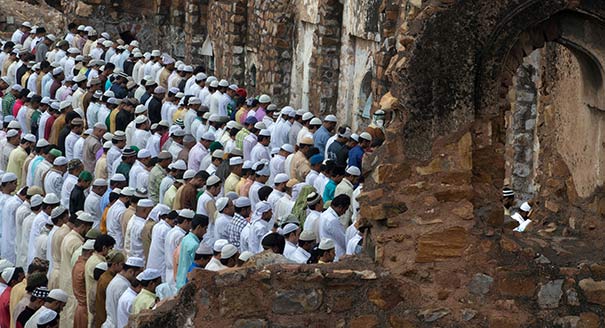
Despite popular narratives to the contrary, Muslims are losing ground in India in socioeconomic terms.
Source: Indian Express
In the current debate on the place of the Muslims in India, one variable has not been factored in — their socio-economic situation — as if the dominant repertoire had shifted for good towards the politics of symbols and identity. In socio-economic terms, Muslims are losing ground rapidly, even if their situation is deteriorating more in northern and western India than in the south. Using the two rounds of the Indian Human Development Survey (IHDS) of 2004-05 and 2011-12, we cover here all four regions, that is, north, east, west, and south, each region being represented by two states.
In the North, UP (where Muslims were 19.3 per cent of the population in the 2011 census) and Haryana (17 per cent); in the East, Bihar (16.9 per cent) and West Bengal (27 per cent); in the West, Gujarat (9.7 per cent) and Maharashtra (11.5 per cent) and in the South, Karnataka (12.9 per cent) and Kerala (26.6 per cent). The selected states constituted 68.5 per cent of the 170 million Muslims enumerated in 2011. We examine Muslims as a block because from a socio-economic point of view, differences between the Muslim OBCs and other Muslims are remarkably limited, compared to the gap that remains between Hindu OBCs and other Hindus.
Muslims are better off below the Vindhyas. In 2011-12, their annual per capita income in Kerala was twice that of Gujarat Muslims and more than twice that of the UP Muslims. Hindus are more affluent than Muslims, but the gap is smaller in poor states (Muslims earn 91 per cent of what the Hindus earn in UP and 82 per cent of what they earn in Bihar) and below the Vindhyas (where the percentage are respectively 73 per cent, 74 per cent and 75 per cent for Kerala, Maharashtra, and Karnataka). The gap is the largest in West Bengal as well as Gujarat (where Muslims earn only 63 per cent of what Hindus earn in both states) and in Haryana (where Muslims earn only 33 per cent of what Hindus earn, partly because of the poor condition of Muslim-dominated districts like Mewat and, in contrast, the affluence of the adjacent Hindu-dominated district of Gurgaon).
In no state are Muslims better off than Hindu OBCs. More importantly, in most of the states, Muslims earn less than Hindu Dalits: Their per capita annual income represents 68 per cent of that of the Dalits in Haryana, 69 per cent in Gujarat, 79 per cent in West Bengal, 82 per cent in Kerala and 87 per cent in Maharashtra. The only states where Muslims are better off than the Hindu Dalits are Karnataka (where they earn 101 per cent of what the latter get), Bihar (115 per cent) and UP (131 per cent).
The socio-economic situation of the Indian Muslims was less critical in 2004-05 when the results of the first round of the IHDS were released. For instance, they earned much more than the Hindu Dalits in Kerala (where they’ve dropped from 136 per cent to 82 per cent of what the latter earned). Their status vis-à-vis Hindu Dalits has declined everywhere, except in UP (where they’ve jumped from 124 per cent to 132 per cent). In Haryana, they’ve dropped from 85 per cent to 68 per cent of the annual per capita revenue of Hindu Dalits, in Gujarat, from 76 per cent to 69 per cent, in Maharashtra, from 90 per cent to 87 per cent, in Bihar, from 134 per cent to 115 per cent, in West Bengal, from 81 per cent to 79 per cent, and in Karnataka, from 107 per cent to 101 per cent. This erosion is not due to the Dalits’ substantial progress: The trend is even more pronounced vis-à-vis the Hindu OBCs. In 2004-05, Muslims registered higher annual per capita income vis-à-vis Hindu OBCs in UP and Bihar — no more in 2011-12. In some states, their decline is dramatic: Muslims were neck to neck with the Hindu OBCs in Gujarat in 2004-05 (they then earned 97 per cent of their annual per capita revenue), but seven years later, they lag behind at 72 per cent.
Following the pattern of income, Kerala tops in the education of Muslims. The percentage of graduates among Muslims in Kerala is 4.3 per cent followed by Maharashtra (3.6 per cent) and UP (3.5 per cent). The least performing states are Haryana (0.6 per cent), Gujarat (1.6 per cent) and West Bengal (2 per cent). These results are better than those of 2004-05, but they do not necessarily reflect a significant educational improvement among Muslims when one compares them with Hindu-SCs and Hindu-OBCs. Muslims lag behind the latter two in the percentage of graduates except in UP (where they have 3.5 per cent — against 2.3 per cent among Dalits) and in Bihar (3.1 per cent — against 0.9 per cent among Dalits).
The socio-economic condition of Muslims, who are largely working as artisans and petty shopkeepers, is directly related to their participation in the formal sector. Less than 10 per cent of them have a salaried job in the three states where they are among the poorest (Haryana, Bihar and West Bengal), whereas more than 20 per cent of them have a salaried job in two of the states where they are the richest (Kerala and Maharashtra). This achievement is partly due to reservation policies: Many South Indian Muslims enjoy some form of positive discrimination. Karnataka set aside 4 per cent quotas for Muslims as “more backward” within the OBC category and in Kerala, Muslims are given 12 per cent sub-quotas within the 40 per cent reserved for OBCs in government jobs. Unsurprisingly, Kerala is one of the two states (the other is UP) where Hindu Dalits do not have a higher percentage of salaried jobs than Muslims (17.6 per cent as against 21.6 per cent). And in Karnataka, the percentage of the graduates among Muslim OBCs is higher than the Muslim average (3.1 per cent as against 2.8 per cent), showing that reservations help.
In June 2005, Prime Minister Manmohan Singh appointed a high level committee to report on the situation of Muslims and suggest remedies for their deteriorating conditions. The Sachar Committee report was immediately attacked by the Hindu nationalist movement which denounced the pseudo-secularism of those Congressmen who “pampered” Muslims.
In a report it released last month on the “aspirational districts”, the Niti Aayog showed that 11 of the 20 most backward districts were Muslim-dominated. Yet this body continues to focus on districts, when the relevant units of analysis are communities, as shown by another commission appointed under Manmohan Singh, the National Commission for Religious and Linguistic Minorities, known as the Ranganath Misra Commission, which had recommended positive discrimination policies for the minorities which were losing ground. But its report was not even tabled in Parliament. Any move in favour of minorities looks illegitimate in the era of majoritarianism.
This article was originally published in the Indian Express.

Former Nonresident Scholar, South Asia Program
Jaffrelot’s core research focuses on theories of nationalism and democracy, mobilization of the lower castes and Dalits (ex-untouchables) in India, the Hindu nationalist movement, and ethnic conflicts in Pakistan.
Kalaiyarasan A
Kalaiyarasan is faculty at the Institute for Studies in Industrial Development, New Delhi.
Carnegie does not take institutional positions on public policy issues; the views represented herein are those of the author(s) and do not necessarily reflect the views of Carnegie, its staff, or its trustees.

Despite public disputes over trade and immigration, the strategic partnership’s foundations remain sturdy.

Sameer Lalwani

With its public finances in shambles, the far right polling at 35 percent ahead of the 2027 presidential election, and a growing protest movement, is France’s crisis a threat to the EU’s geopolitical awakening?

Rym Momtaz, ed.

Putin’s conservative staffing policies and search for ever greater control have cemented parliament’s transformation into a bureaucratic appendage of the executive branch.

Andrey Pertsev

Russian strikes are weakening the economy sustaining Ukraine’s war effort. Closing the growing funding gap will require more European support and politically contentious reforms in Kyiv.

Balázs Jarábik

Ex-president Gurbanguly Berdimuhamedov remains interested in politics, but his son Serdar, Turkmenistan’s current president, is becoming increasingly independent and willing to break with his father’s legacy. If their covert rivalry goes too far, both risk losing power.

Galiya Ibragimova