

Commentary
- +11
Cornelius Adebahr, Dan Baer, Rosa Balfour, …
{
  "authors": [
    "Erik Brattberg"
  ],
  "type": "legacyinthemedia",
  "centerAffiliationAll": "dc",
  "centers": [
    "Carnegie Endowment for International Peace"
  ],
  "collections": [],
  "englishNewsletterAll": "ctw",
  "nonEnglishNewsletterAll": "",
  "primaryCenter": "Carnegie Endowment for International Peace",
  "programAffiliation": "EP",
  "programs": [
    "Europe"
  ],
  "projects": [],
  "regions": [
    "North America",
    "United States",
    "East Asia",
    "China",
    "Japan",
    "Western Europe",
    "United Kingdom",
    "France",
    "Germany",
    "Iran"
  ],
  "topics": [
    "Economy",
    "Trade",
    "Global Governance",
    "Foreign Policy"
  ]
}
Source: Getty
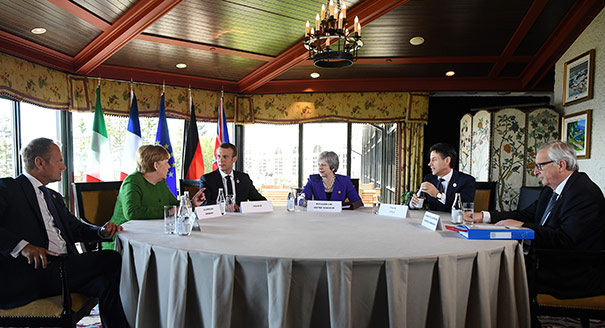
The prospect of growing U.S. isolation did not discourage President Trump from pushing his unilateral trade agenda at the G7 summit. This divisive approach is severing the unity that for decades tied together the multilateral economic system.
Source: Axios
As G7 leaders gather in Quebec, the U.S. is on a collision course with the 6 other members over it the Trump administration’s decision to impose tariffs on steel and aluminum producers in Europe, Canada and Japan.
Why it matters: The prospect of growing U.S. isolation has not deterred President Trump, who will likely use the summit to push his unilateral, economic nationalist trade agenda even harder. The optics of doing so while simultaneously cutting a deal with ZTE, the Chinese technology giant suspected of posing a national security threat to the U.S., add to allies’ sense of victimhood.
At the core of Trump’s trade policy is the notion that the global economy is unfairly rigged against the United States. Trump harbors particular scorn for America’s friends and neighbors, whom he views as cheaters and free-riders. Trump is convinced he can lower the trade deficit by eschewing multilateral negotiations in favor of a transactional deal-by-deal approach. This strategy is rending the fabric that has for decades knit together the multilateral economic system.
But Trump’s polarizing and divisive approach has yet to generate sizable concessions. He may have underestimated EU unity and the importance that export-dependent European nations place on multilateral trade. Rather than caving in to Trump’s demands and offering appeasement, Germany, France, Britain and Italy — along with Canada and Japan — have stuck to their guns. Their leaders expressed “unanimous concern and disappointment” and pledged “decisive action” in the form of counter-tariffs and challenges to the U.S. at the WTO. Both Justin Trudeau and Emmanuel Macron seem to have concluded their efforts to sway Trump have failed, opting instead now for a more direct confrontational approach.
What’s next: How the current dispute over steel and aluminum tariffs will be resolved is still uncertain. Germany wants to cut a deal with Trump that would eliminate transatlantic tariffs entirely. But France opposes entering into such negotiations under the barrel of a gun. And even if Trump eventually softens up, he will already have done irreparable damage to U.S. credibility and leadership.
The bottom line: Trump has managed to unite America’s friends against itself. And while they duke it out, China and Russia are emerging as the real winners.

Former Director, Europe Program, Fellow
Erik Brattberg was director of the Europe Program and a fellow at the Carnegie Endowment for International Peace in Washington. He is an expert on European politics and security and transatlantic relations.
Recent Work


Cornelius Adebahr, Dan Baer, Rosa Balfour, …

Erik Brattberg, Philippe Le Corre, Paul Stronski, …
Carnegie does not take institutional positions on public policy issues; the views represented herein are those of the author(s) and do not necessarily reflect the views of Carnegie, its staff, or its trustees.

Before the next wave of EU enlargement takes place, the union needs to grapple with thorny questions of how power is distributed among its members.


Emil Sondaj Hansen, Ditte Brasso Sørensen

The real test may come after the leaders leave the room.



Sheena Chestnut Greitens, Oriana Skylar Mastro, Yukon Huang, …

The Horn of Africa countries are among those facing a new security calculus.


Andrew Leber, Lesley Anne Warner

The European far right might fail to steer EU policy in the direction Russia wants, but they will create enough chaos inside Europe to benefit the Kremlin.

Dimitar Bechev

The new U.S.–Denmark–Greenland agreement will help Washington exert political, economic, and financial dominance under the guise of security. Yet, it acknowledged Copenhagen’s and Nuuk’s sovereignty on the island.

Marc Pierini