

Other
Michael D. Swaine
{
  "authors": [
    "Michael D. Swaine"
  ],
  "type": "other",
  "centerAffiliationAll": "dc",
  "centers": [
    "Carnegie Endowment for International Peace"
  ],
  "collections": [],
  "englishNewsletterAll": "asia",
  "nonEnglishNewsletterAll": "",
  "primaryCenter": "Carnegie Endowment for International Peace",
  "programAffiliation": "AP",
  "programs": [
    "Asia"
  ],
  "projects": [],
  "regions": [
    "East Asia",
    "China",
    "North Korea"
  ],
  "topics": [
    "Foreign Policy"
  ]
}
Source: Getty
Chinese observers generally view the Singapore summit as a positive step toward denuclearization on the Korean Peninsula. However, many have come to question the success of the summit and whether the positive momentum that resulted from it is markedly slowing down.
Source: China Leadership Monitor
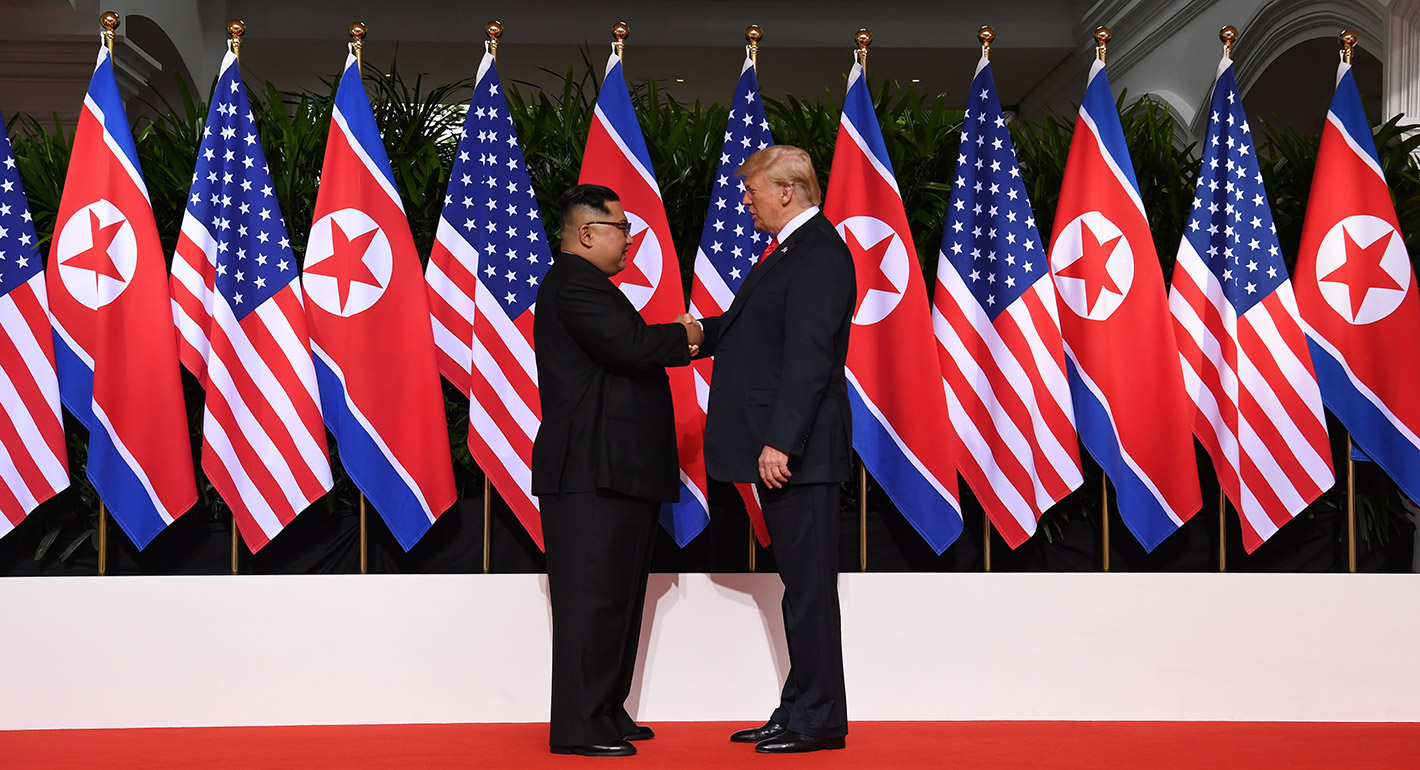
The long-awaited and much-hyped summit between U.S. President Donald Trump and North Korean leader Kim Jong-un was finally held on June 12, 2018. The purpose of the talks was to improve relations between the U.S. and North Korea and to establish a clear basis for the resolution of the escalating crisis triggered by the development of Pyongyang’s nuclear arsenal. Nearly five hours of talks between the two leaders resulted in “fulsome declarations of a new friendship but just vague pledges of nuclear disarmament.”1
Beyond the unprecedented nature and positive atmospherics, the most significant outcome of the summit was a short joint statement. It asserted that Trump and Kim were committed to implementing four agreed-upon stipulations “fully and expeditiously” via follow-up negotiations at the “earliest possible date.” These include:
In addition, Kim destroyed a nuclear weapons test site and Trump announced the suspension of U.S.-ROK military exercises. Yet despite such arguably positive gestures, the two countries made no outward progress in developing the specific goals, timing, and roadmap for the denuclearization of the Korean Peninsula.
While some observers in the People’s Republic of China (PRC) and elsewhere hailed the summit as a step toward peace and stability on the peninsula, many in the U.S. criticized it as high on gestures of good will but low on substance, while providing Pyongyang (and Beijing) with far more strategic gains than the U.S.3
This essay describes and assesses the Chinese views to date on the Singapore summit. As usual, such views are divided into authoritative and non-authoritative categories to identify possible lines of debate within both official and unofficial leadership and elite circles.4 The essay ends with a summary and assessment of the Chinese perspective and its implications for the North Korea nuclear crisis and U.S.-PRC relations.
This article will be published by the China Leadership Monitor.
1 Kevin Liptak, “Trump’s North Korean gamble ends with ‘special bond’ with Kim,” CNN Politics, June 12, 2018, https://www.cnn.com/2018/06/11/politics/trump-kim-summit-singapore/index.html.
2 “Full text of Trump-Kim signed statement,” CNN Politics, June 12, 2018, https://www.cnn.com/2018/06/12/politics/read-full-text-of-trump-kim-signed-statement/index.html.
3 See Jung H. Pak, Jonathan D. Pollack, Evans J. R. Revere, Robert Einhorn, Ryan Hass, Richard Nephew, Katharine H.S. Moon, Jonathan Stromseth, Michael E. O’Hanlon, Tarun Chhabra, and Jeffrey A. Bader, "Around the halls: Brookings experts react to the Trump-Kim Jong-un summit in Singapore," Brookings Institution, June 12, 2018, https://www.brookings.edu/blog/order-from-chaos/2018/06/12/around-the-halls-brookings-experts-react-to-the-trump-kim-jong-un-summit-in-singapore/; Nicholas Eberstadt, "Kim Wins in Singapore," National Review, June 21, 2018, https://www.nationalreview.com/magazine/2018/07/09/kim-jong-un-singapore-summit-north-korea-wins/; and Gillian Wong and Christopher Bodeen, “China Winner From Summit but Wary of Closer US-N. Korea Ties,” US News, June 13, 2018, https://www.usnews.com/news/world/articles/2018-06-13/after-summit-china-likely-to-remind-n-korea-of-close-ties.
4 For a detailed description of the nature and definition of various types of Chinese sources, see Footnote 1 in Michael D. Swaine, “Chinese Views of the U.S. National Security and National Defense Strategies,” China Leadership Monitor 56 (May 2018), https://www.hoover.org/sites/default/files/research/docs/clm56ms.pdf.

Former Senior Fellow, Asia Program
Swaine was a senior fellow at the Carnegie Endowment for International Peace and one of the most prominent American analysts in Chinese security studies.
Recent Work
Michael D. Swaine
Michael D. Swaine
Carnegie does not take institutional positions on public policy issues; the views represented herein are those of the author(s) and do not necessarily reflect the views of Carnegie, its staff, or its trustees.

It’s time to build momentum, and Ankara is the venue of the next opportune diplomatic window to do this.


Alper Coşkun, Garo Paylan

The EU is putting together a new security strategy to meet today’s myriad challenges. But for any proposal to be effective, the union needs to grapple with its identity and ambitions.

Pierre Vimont

Three years after the Ohrid Agreement, Kosovo and Serbia remain far from normalization. To revive implementation, the EU should abandon its ambiguity and act as an even-handed arbitrator.



Miloš Pavković, Fitim Gashi, Iliriana Gjoni, …
The Islamic Republic’s words and actions suggest that it has changed its approach to both diplomacy and war.

Mohammad Ayatollahi Tabaar

The EU’s new migration policy is not suited to today’s realities. With climate change increasingly becoming a driver of displacement, Europe needs to rethink its deterrence-focused approach.

Shana Tabak