

Research
- +6
Milan Vaishnav, Sameer Lalwani, Tanvi Madan, …
{
  "authors": [
    "Milan Vaishnav"
  ],
  "type": "legacyinthemedia",
  "centerAffiliationAll": "dc",
  "centers": [
    "Carnegie Endowment for International Peace"
  ],
  "collections": [],
  "englishNewsletterAll": "ctw",
  "nonEnglishNewsletterAll": "",
  "primaryCenter": "Carnegie Endowment for International Peace",
  "programAffiliation": "SAP",
  "programs": [
    "South Asia"
  ],
  "projects": [],
  "regions": [],
  "topics": [
    "Political Reform",
    "Democracy",
    "Global Governance",
    "Civil Society"
  ]
}
Source: Getty
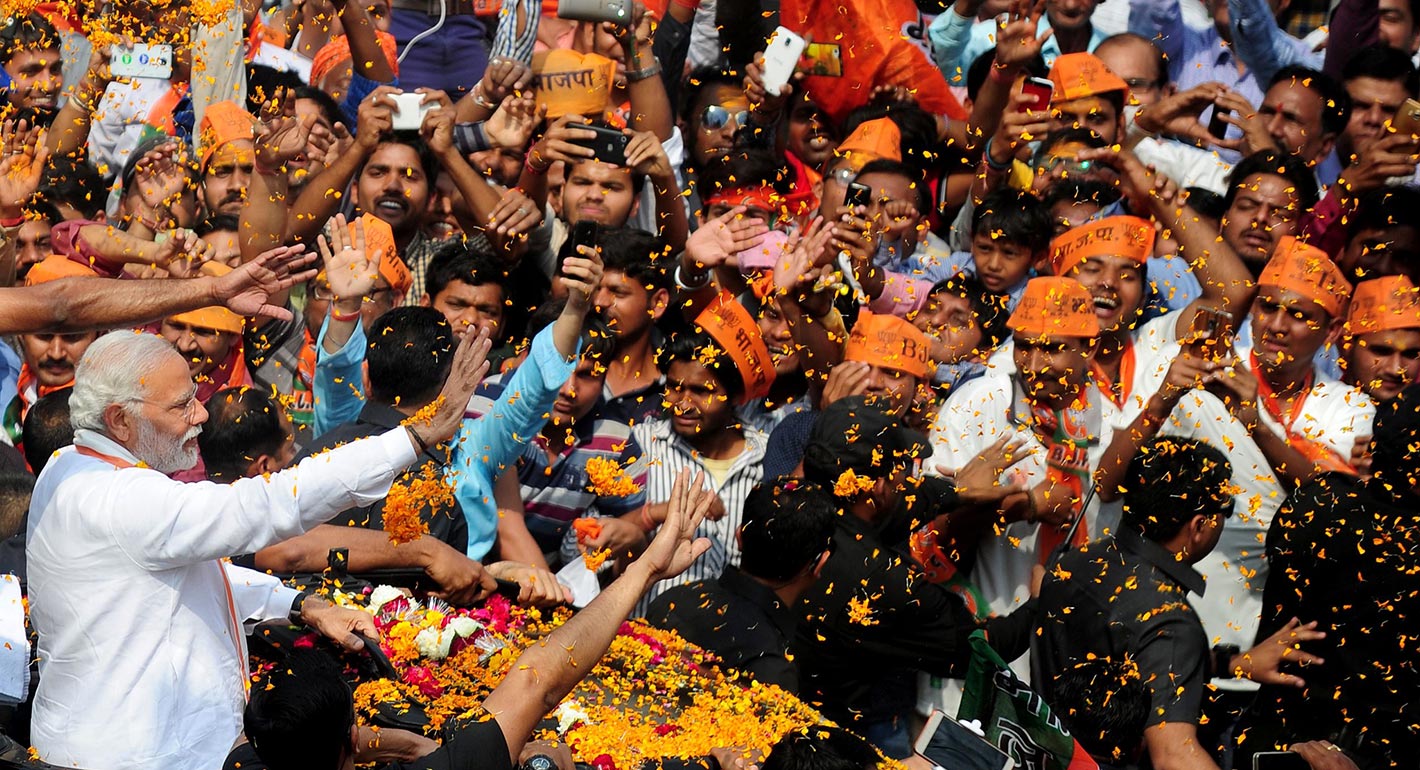
The ordinary voter still views Modi as a compelling leader who is personally incorruptible. Modi’s pitch this election season is simple: He needs more than a single, five-year term to undo 65 years of corruption and administrative rot.
Source: Washington Post
The first phase of India’s gargantuan national elections commences on April 11, when nearly 900 million eligible voters begin casting their votes in an election that pits the ruling alliance led by Prime Minister Narendra Modi’s Bharatiya Janata Party against its archrival, the Indian National Congress, and myriad regional political opponents.
For a time, after the Congress party reclaimed control of three pivotal north Indian states last December, it looked as though the opposition was gaining momentum. But now the “hawah” — or India’s mythical political winds — seem to have shifted once more, this time in favor of the incumbent.
While recent tensions between India and Pakistan are one reason for this change, there is a deeper rationale at play. Despite the government’s many foibles, from the inability to address the rising tide of rural distress to the disastrous consequences of demonetization, there is a simple truth animating public opinion: All told, most voters like Modi. A lot.
In 2014, Modi led the BJP to power in dramatic fashion, forming India’s first single-party parliamentary majority in three decades on the promise of ushering in “achhe din” (good times) for the Indian economy. At a time when the economy seemed in free fall, Modi was the right man in the right place at the right time: a decisive leader whose humble roots, executive experience as chief minister of Gujarat and reputation as a pro-Hindu strongman seduced voters fatigued by the opportunistic secularism and rudderless leadership of the dynastic Congress party.
Five years later, India’s macro-economy has stabilized, but its micro-fundamentals are in bad shape. The rural economy, in particular, is in dire straits: While the Modi government has amassed a impressive record creating rural assets such as roads and toilets, incomes have stagnated and farm incomes recently touched their lowest point in 18 years. Despite a roiling controversy over India’s official job statistics — the government recently tried to suppress a jobs report that uncovered a spike in unemployment — most independent data point to a slowdown in job growth. And despite allegations of fiddling with the country’s GDP figures, even the government’s own asterisk-marked numbers indicate that growth has slumped to its slowest pace in five quarters.
Therefore, if this were an election determined solely by economic fundamentals, the incumbent would be on the ropes. Yet most opinion surveys indicate that the BJP-led alliance will fall just shy of an outright majority, requiring a handful of additional allies to form the government. Only Modi’s enduring personal popularity can explain this disjuncture. The ordinary voter still views Modi as a compelling leader who is personally incorruptible. Modi’s pitch this election season is simple: He needs more than a single, five-year term to undo 65 years of corruption and administrative rot.
To put it bluntly, many Indians are looking for an excuse to vote for Modi. The terrorist attack in Jammu and Kashmir and the subsequent Indian strike on alleged Jaish-e-Muhammad terrorist camps in Pakistan provide voters with just such a pretext. While legitimate questions have been raised about the intelligence failures that led to the worst terrorist attack in Kashmir in 30 years and the efficacy of the Indian military response, they are largely irrelevant to the political discourse.
The message imbibed by the masses is that after years of exercising “strategic restraint,” a decisive prime minister finally hit Pakistan hard. For the past five years, the BJP has exploited nationalism to bolster its standing, painting government critics as “anti-national.” Having sown the seeds of jingoism, Modi is now reaping the fruits of the harvest.
This explains why the opposition has erred in trying to corner Modi on national security. As columnist T.N. Ninan has written, “Any fool would know that tackling Modi on a national security platform … is like playing Rafael Nadal on clay.” The opposition may have further played into Modi’s hands by continually harping on alleged improprieties surrounding the prime minister’s arbitrary intervention in his government’s purchase of Rafale combat aircraft from France. There are two problems with this line of attack: Few Indians are able to grasp the intricacies of a complex defense procurement deal, and even fewer are willing to believe Modi himself is on the take.
Every moment the opposition is talking about foreign policy is a moment that it is not hammering the BJP on the economy. Gandhi and his party mates have belatedly gotten the message: This past week, the Congress party announced it would implement an expansive new income support scheme for India’s poorest households if brought to power.
But it may be too little, too late. As voting drags on for the next several weeks, the salience of the Indo-Pakistan conflict will likely recede, but India’s motley gang of anti-BJP opposition parties have struggled to articulate an alternate vision for the country. In 2017, a top BJP official privately told a Washington audience that scholars should study the Modi government as a curious example of the delinking of economic performance and electoral outcomes. Unless the opposition can convince voters that it offers a better path, it will have five more years to conduct its own examination.
This article was originally published by the Washington Post.

Director and Senior Fellow, South Asia Program
Milan Vaishnav is a senior fellow and director of the South Asia Program and the host of the Grand Tamasha podcast at the Carnegie Endowment for International Peace. His primary research focus is the political economy of India, and he examines issues such as corruption and governance, state capacity, distributive politics, and electoral behavior. He also conducts research on the Indian diaspora.
Recent Work


Milan Vaishnav, Sameer Lalwani, Tanvi Madan, …
Sumitra Badrinathan, Devesh Kapur, Andy Robaina, …
Carnegie does not take institutional positions on public policy issues; the views represented herein are those of the author(s) and do not necessarily reflect the views of Carnegie, its staff, or its trustees.
Europe has an interest in supporting Armenian leader Nikol Pashinyan as he tries to make peace with neighbors and loosen ties with Russia. But it is depersonalized support in the long term, not quickfire flash, that will win the day.

Thomas de Waal
For the Middle Corridor to fulfill its promises, one of these routes must become scalable. At present, neither is.

Friedrich Conradi
The court’s opinion aims to clarify responsibility and lay out a path to accountability on climate mitigation and adaptation. Yet concrete policy advances have been limited.

Shana Tabak
For Lukashenko, abandoning Western internet services and embracing Russian equivalents would mean tying himself even closer to Moscow.

Artyom Shraibman
The return of parliamentary politics reflects a broader shift from earlier expectations of a settlement and elections toward the reality of a prolonged war.

Balázs Jarábik