

Commentary
Sinan Ülgen
{
  "authors": [
    "Sinan Ülgen"
  ],
  "type": "legacyinthemedia",
  "centerAffiliationAll": "dc",
  "centers": [
    "Carnegie Endowment for International Peace",
    "Carnegie Europe",
    "Malcolm H. Kerr Carnegie Middle East Center"
  ],
  "collections": [
    "Turkey’s Transformation"
  ],
  "englishNewsletterAll": "ctw",
  "nonEnglishNewsletterAll": "",
  "primaryCenter": "Carnegie Europe",
  "programAffiliation": "EP",
  "programs": [
    "Europe"
  ],
  "projects": [],
  "regions": [
    "Europe",
    "Türkiye",
    "Middle East",
    "Iran"
  ],
  "topics": [
    "Political Reform"
  ]
}
Source: Getty
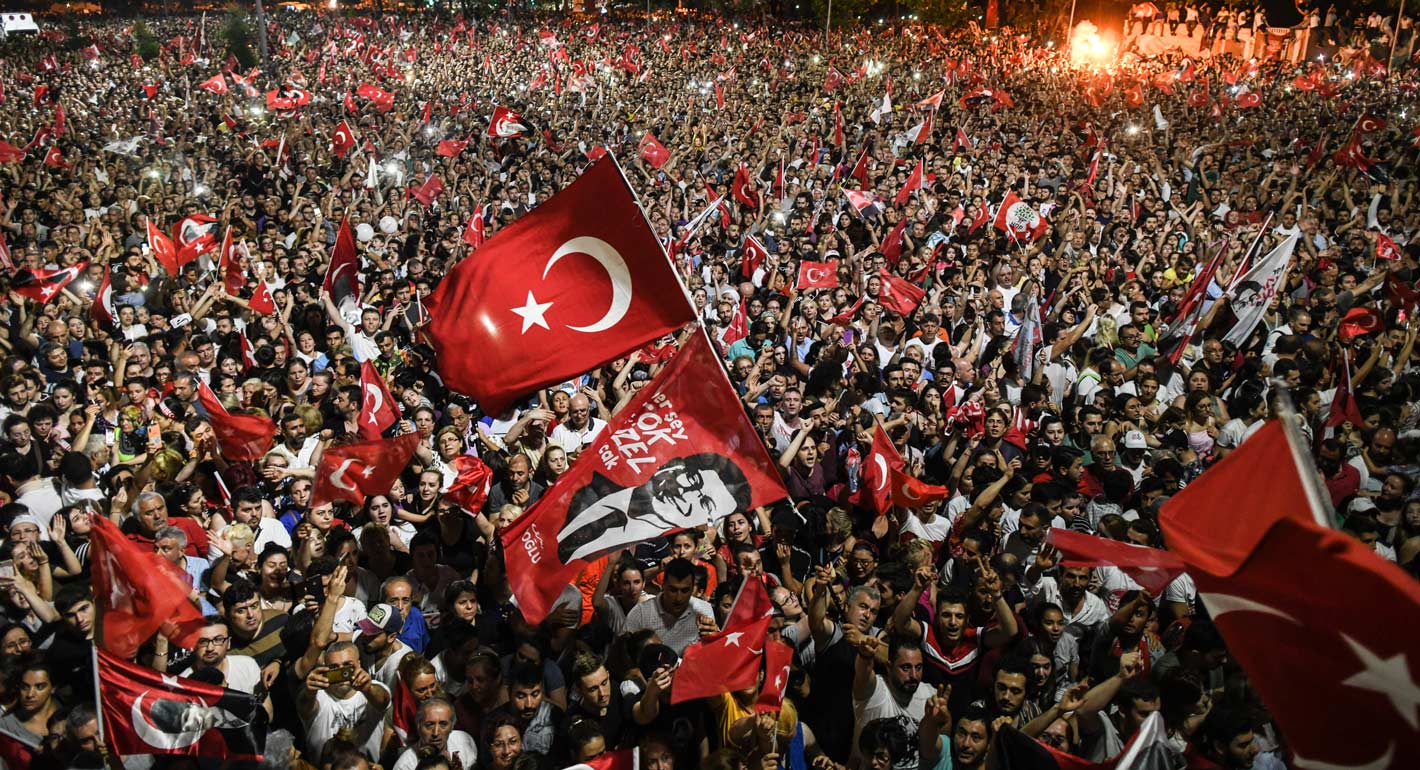
The landslide victory of Ekrem Imamoglu in the Istanbul elections constitutes a threat to Recep Tayyip Erdogan’s hegemony.
Source: Guardian
The opposition candidate Ekrem İmamoğlu’s landslide victory in the re-run mayoral elections in Istanbul will change very little in Turkish politics in the near term. But it has the potential to change everything in the long run.
After winning the Istanbul elections in March with a margin of 13,000 votes in a constituency of 10 million, İmamoğlu was denied victory on dubious legal grounds, with the High Electoral Council decreeing that new elections should be held on 23 June. On Sunday, the Istanbul electorate gave a strong mandate to İmamoğlu. He increased his majority to 800,000, almost 60-fold, and received the backing of 54% of the citizens of Turkey’s largest city. In contrast, Binali Yıldırım, the ruling Justice and Development party (AKP) candidate, received 45% of the vote.
The impressive margin is first due to people’s sense of injustice, triggered by the decision to repeat the elections. A share of the vote even shifted directly from the AKP candidate to the opposition Republican People’s party (CHP) candidate. Polling by Istanbul Economics Research suggests that the motivation for this shift was the perception that İmamoğlu’s win had been unfairly challenged.But he was also able to develop a conciliatory narrative that appealed to these voters. He provided a fresh alternative to inhabitants of Istanbul fatigued from years of acrimonious and exclusionary political rhetoric. (As a result, İmamoğlu’s campaign should be examined closely for its global implications in the fight against populism.) Last, he was particularly effective in coalescing Turkey’s fragmented opposition, which included this time the CHP, but also the secular nationalist İyi party, as well as the pro-Kurdish Peoples’ Democratic party (HDP).
The wide margin of the opposition’s win precludes a new challenge scenario. İmamoğlu will become, once more, the new mayor of Istanbul. And his victory constitutes a clear longer-term threat to Recep Tayyip Erdoğan’s hegemony.
First the established opposition parties will be emboldened by his win. The opposition is now in control of cities accounting for almost 70% of Turkey’s GDP. Nine out of the 10 biggest urban areas in the country will be ruled for the next five years by a mayor linked to the opposition, the exception being the industrial province of Bursa. The opposition will have the opportunity to dismantle and then restructure the patronage networks that have helped the AKP to establish itself so successfully at the helm of Turkish politics.
New contenders are also likely to interpret this outcome as a window of opportunity. In particular, the political movement rumoured to have been set up by the former AKP minister Ali Babacan will be encouraged by this clear sign of growing grassroots disenchantment with the ruling party.
More importantly, Sunday’s result is likely to lead to a rethink by the AKP leadership. The shock must be momentous. It is surely the most severe interruption in Erdoğan’s electoral winning electoral streak. . . .

Senior Fellow, Carnegie Europe
Sinan Ülgen is a senior fellow at Carnegie Europe in Brussels, where his research focuses on Turkish foreign policy, transatlantic relations, international trade, economic security, and digital policy.
Recent Work
Sinan Ülgen

Raluca Csernatoni, Sinan Ülgen
Carnegie does not take institutional positions on public policy issues; the views represented herein are those of the author(s) and do not necessarily reflect the views of Carnegie, its staff, or its trustees.
It’s time to build momentum, and Ankara is the venue of the next opportune diplomatic window to do this.

Alper Coşkun, Garo Paylan

The EU is putting together a new security strategy to meet today’s myriad challenges. But for any proposal to be effective, the union needs to grapple with its identity and ambitions.

Pierre Vimont
Three years after the Ohrid Agreement, Kosovo and Serbia remain far from normalization. To revive implementation, the EU should abandon its ambiguity and act as an even-handed arbitrator.

Miloš Pavković, Fitim Gashi, Iliriana Gjoni, …
For all the menacing rhetoric, the Armenian prime minister remains a leader with whom Putin is prepared to interact: not as an ally, but as a partner, albeit a problematic one.

Alexander Atasuntsev
The Islamic Republic’s words and actions suggest that it has changed its approach to both diplomacy and war.
Mohammad Ayatollahi Tabaar