

Commentary
Tatiana Stanovaya
{
  "authors": [
    "Tatiana Stanovaya"
  ],
  "type": "commentary",
  "centerAffiliationAll": "",
  "centers": [
    "Carnegie Endowment for International Peace",
    "Carnegie Russia Eurasia Center"
  ],
  "collections": [],
  "englishNewsletterAll": "",
  "nonEnglishNewsletterAll": "",
  "primaryCenter": "Carnegie Endowment for International Peace",
  "programAffiliation": "",
  "programs": [],
  "projects": [],
  "regions": [],
  "topics": []
}
Source: Getty
Russia’s government agencies are so busy competing with one another and presenting themselves in a good light to the Kremlin that they are failing to deal with the new street protests.
“How will the ruling regime deal with the growing street protests in Moscow and other cities?” This is the Number One question in Russian politics today. As far as tactics go, everything is more or less clear: the government’s preferred option is to use force.
When it comes to strategy, things get more complicated. The government won’t get very far with these new protesters if it refuses to recognize that there is a real opposition and merely calls the protesters a handful of stooges sponsored by the West. The regime is trying to flex its muscles, but its emphasis on force only reveals a growing lack of vision and coordination among its key institutions.
What decisionmaking mechanisms are being used to deal with the protests? Who issues orders to jail opposition activists? Who coordinates the Foreign Ministry statements? Who in the Kremlin discusses the demands of the protest? How often do the meetings on this issue take place, and how involved is the president in all of this? There are no definitive answers to any of these questions today.
So far, the authorities’ plan is pretty much as follows: disperse unauthorized rallies, campaign against foreign interference, arrest opposition leaders, start criminal cases against protest participants, and orchestrate selective moves to split the opposition. However, none of these responses are a part of a planned or unified campaign directed from a unified center. Instead, various government agencies are guided by their own priorities and ignore the interests of the system as a whole.
Evidently, the president made the overall decision to use force. In fact, he didn’t need to do it in a form of a direct order; his tacit approval was all that was needed. Once that was set in motion, different parts of the system scrambled to put on the best show for the president.
Yet Putin stays out of the limelight. His official website features everything but the protests. The last Security Council meeting mostly focused on the termination of the INF Treaty and fires in Siberia.
The government clearly underestimates the nature of the crisis simply because it contradicts Putin’s worldview: that he continues to enjoy broad popular support and there is a “responsible” opposition which is represented in parliament, plays by the rules, and doesn’t rock the boat. As per Putin, the other opposition simply doesn’t exist, and the protesters are just a bunch of thugs. No one tells the president that the situation has drastically changed since his triumphant election victory in the spring of 2018, and that the country has entered a new phase.
If the regime sees no crisis, there is no need for strategy. However, institutional interests are still there and each reacts differently to events. The Moscow mayor wants to get an obedient municipal legislature, he is promoting the United Russia party and abusing the signature collection procedure for the elections. Security agencies watch the civilian authorities’ actions with frustration, itching to crack down harder. Officials in the presidential administration commission “studies,” seeking to find evidence of foreign involvement in the protests, while unofficially they lay the blame at the doorstep of Moscow Mayor Sergei Sobyanin.
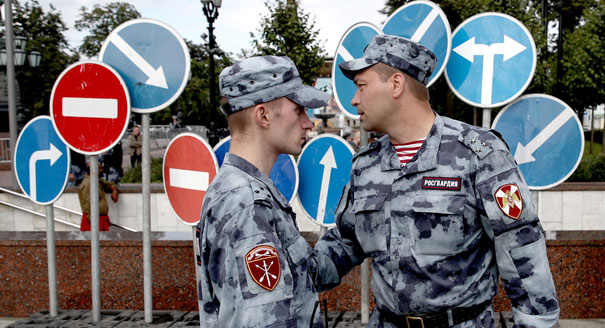
The National Guard (Rosgvardia) makes every effort to show the president its utility as an independent entity by lobbying for a harsh crackdown. They know that their own future and that of their head Victor Zolotov depend on this. Meanwhile, the Federal Security Service (FSB) and the Investigative Committee are busy defending the Constitution by filing criminal cases for obstructing the work of election committees and organizing mass protests.
The Foreign Ministry is also getting involved as spokeswoman Maria Zakharova accuses Germany, the United States, and Western media of meddling in Russia’s internal affairs. We’ll leave aside the dubious merits of these allegations. The point is that the Foreign Ministry also wants to be seen among the defenders of the Constitution, so it can make a good impression on Putin. Everyone is vying for the president’s attention.
The Russian television channels are playing the same game as they present the opposition as an “orange threat.” A comparison between the nice Russian police and their ruthless French counterparts has dominated pro-government news outlets.
At the center of this is the president, who is yet to formulate a detailed position on this issue. Lack of clarity leaves plenty of space for creative interpretation by the lower levels of government. A hasty phrase instructing the authorities to “bring things under control” can be interpreted as a sanction for harsh actions. Nowadays, whatever Putin explicitly does not prohibit can be considered fair game.
Every government agency—be it the FSB, National Guard, Foreign Ministry, or RT—now feels the need to demonstrate its usefulness, as well as the danger of yielding the initiative to someone else. Distracted by these efforts, no one in the government is left to deal with the actual protest itself. No one is trying to understand its nature and trajectory, nor are there attempts to look for compromise.
They are also failing to deal with the issue of opposition leader Alexei Navalny. For many years, the authorities didn’t dare put him in jail for a long period, although that’s clearly what law enforcement officials wanted. It’s unclear whether the authorities will dare to do so now, but the stakes are clearly rising as Navalny gets jailed more frequently and for longer terms. Indeed, his alleged poisoning appears to be a personal and very harsh official warning.
All this is eroding the regime from within. It is no longer able to identify problems and resolve them properly. It is building a rigid corporate structure instead of creating conditions for a broad political space, dialogue, and compromise. This gets back to the root of this crisis in the first place: the Kremlin has begun to yield the initiative in domestic politics and to lose elections.
The Kremlin is no longer setting the political agenda in Russia. What happens next will be determined much more by people’s political mobilization, by the effectiveness of new opposition leaders, and by the number of mistakes the government will make.

Senior Fellow, Carnegie Russia Eurasia Center
Tatiana Stanovaya is a senior fellow at the Carnegie Russia Eurasia Center.
Recent Work
Tatiana Stanovaya
Tatiana Stanovaya
Carnegie does not take institutional positions on public policy issues; the views represented herein are those of the author(s) and do not necessarily reflect the views of Carnegie, its staff, or its trustees.