

Q&A
Dara Massicot, Aaron David Miller, Andrew S. Weiss
{
  "authors": [
    "Aaron David Miller"
  ],
  "type": "legacyinthemedia",
  "centerAffiliationAll": "",
  "centers": [
    "Carnegie Endowment for International Peace"
  ],
  "collections": [],
  "englishNewsletterAll": "",
  "nonEnglishNewsletterAll": "",
  "primaryCenter": "Carnegie Endowment for International Peace",
  "programAffiliation": "",
  "programs": [],
  "projects": [],
  "regions": [
    "North America",
    "United States"
  ],
  "topics": [
    "Political Reform"
  ]
}
Source: Getty
The intersection of election politics, Trump’s own mercurial temperament, a polarized Congress, and the absence of wise counsel around him could create a deadly mix, pushing the United States into a military conflict neither Trump nor the country wants or needs.
Source: CNN
President Richard Nixon loved foreign policy, had Henry Kissinger as Secretary of State and also a determination to show the world that Watergate wouldn't undermine American power. President Bill Clinton compartmentalized impeachment proceedings and, in the weeks leading up to his February 1999 acquittal, sought refuge in dealing with foreign leaders, meeting with officials from from Jordan, Germany, Argentina, Albania, Venezuela, New Zealand and France. Against the backdrop of domestic scandal both managed to keep their foreign policy focused and on track.
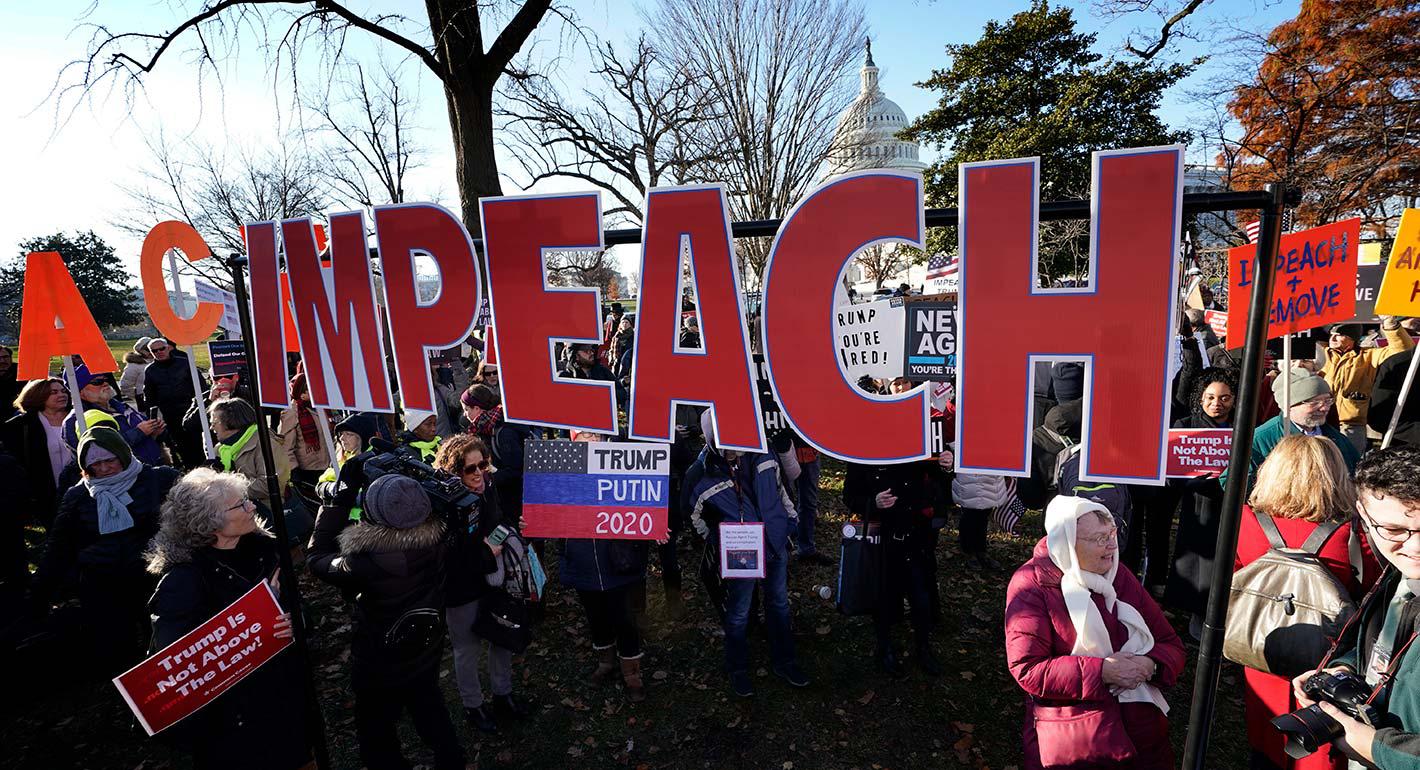
So how will impeachment affect Donald Trump's foreign policy? With an already distracted, now impeached and angry, President, we can't rule out some reckless and unpredictable adventure abroad, especially in response to American adversaries like North Korea and Iran eager to test Trump's resolve. But it's more likely the election year will have a greater affect than impeachment.
Conventional wisdom suggests that the biggest risk to any scandal ridden President's foreign policy would be distraction and an inability to focus. But there's already such a high level of chaos and dysfunction in the administration -- Trump is on his fourth National Security Adviser and his second Secretary of State in three years -- that one wonders how you'd even measure impeachment's negative impact. Not to mention the possibility -- despite his denials -- that Secretary of State Mike Pompeo might well depart early to run for Senate in Kansas.
Moreover, for the distraction and dislocation of impeachment to undermine foreign policy, the Administration would first need to have a coherent set of policies that they were actually working on and that held promise of some success.
But right now, all of Trump's policies are highly questionable works in progress: a seemingly never-ending dance with North Korea that's brought Kim Jung Un to the verge of resuming long range missile testing; a maximum pressure campaign against Iran that appears to have no coherent objective; a Syria policy that has gone back and forth on withdrawal of US forces and confused allies and adversaries alike; and a Middle East peace plan that is likely so weighted in favor of the Israelis and against Palestinians that it's not ready for prime time.
Indeed, minus an overhyped trade deal with China and a revised NAFTA that was finally ratified by the House, the Administration's Christmas stocking of foreign policy successes is pretty much empty.
Far more consequential for Trump's foreign policy is that impeachment is occurring in an election year -- a coincidence that makes Trump's circumstances unique and likely will set the stage for what Trump will try to do abroad. Trump's foreign policy is already tethered tightly to serving his domestic political needs like no other President. From withdrawing from the Paris Climate accords and the Iran nuclear deal to recognizing Jerusalem as Israel's capital and opening an embassy there, Trump has satisfied political constituencies at the expense of the national interest.
As the election approaches, Trump will want to appear busy looking for high profile vanity summits to attend and seeking to avoid risky military conflicts abroad that might alienate his base and provide his opponents with campaign ammunition. The fear that Trump will try to stage some "Wag the Dog" like crisis abroad to distract attention or rally the country is overblown, precisely because it is an election year and a reckless move that led to military conflict with Iran or North Korea might be fatal at the polls.
Of course, Trump is unpredictable, and it's possible that he could get "fire and fury" mad in the wake of impeachment overreacting to, say, North Korea's missile provocations. But it's just as likely he'd try to set up another vanity summit with Kim to show that his negotiating gambit with North Korea is still in play.
Or as unlikely as it now appears, Trump could try the same with Iran, taking advantage of any number of negotiating initiatives, especially from France, to extend billions in a line of credit for the high level meeting Trump has long wanted to have with Iranian President Rouhani.
Perhaps the greatest risk and danger to US foreign policy in the coming year is that US adversaries, aware of Trump's desperation, will test him. They might assume that Trump's reelection worries will prevent him from responding forcefully to their provocation, or that he can be lured into a negotiation, and needing a win, will make concessions.
Kim Jung Un is likely to test him by ramping up missile testing by year's end or perhaps in the middle of a Senate trial in January. And there's a pretty good chance that Iran -- having watched his unwillingness to strike Iranian targets for their attacks on Saudi oil facilities last September -- might do the same by violating some aspect of their commitments under the Iran nuclear deal, which they remain in, or making some aggressive move in the Persian Gulf.
This is where the intersection of election politics, Trump's own mercurial temperament, a polarized Congress, and the absence of wise counsel around him could create a deadly mix, pushing the United States into a military conflict neither Trump nor the country wants or needs.

Senior Fellow, American Statecraft Program
Aaron David Miller is a senior fellow at the Carnegie Endowment for International Peace, focusing on U.S. foreign policy.
Recent Work


Dara Massicot, Aaron David Miller, Andrew S. Weiss



Sophia Besch, Eric Ciaramella, Steve Feldstein, …
Carnegie does not take institutional positions on public policy issues; the views represented herein are those of the author(s) and do not necessarily reflect the views of Carnegie, its staff, or its trustees.

In an interview, Ian Lustick and Eli Clifton discuss their new book on why a prominent ally has so much influence in America.

Michael Young

Sergei Kiriyenko used Russia’s parliamentary vote to further hone his strategy of corporate mobilization that is designed to maximize votes for United Russia.

Andrey Pertsev

Trump has promised Belarus a massive potash deal. But Minsk is seeking something greater: restored Western transit and greater room for maneuver from Russia.

Balázs Jarábik

Before the next wave of EU enlargement takes place, the union needs to grapple with thorny questions of how power is distributed among its members.


Emil Sondaj Hansen, Ditte Brasso Sørensen

The real test may come after the leaders leave the room.



Sheena Chestnut Greitens, Oriana Skylar Mastro, Yukon Huang, …